
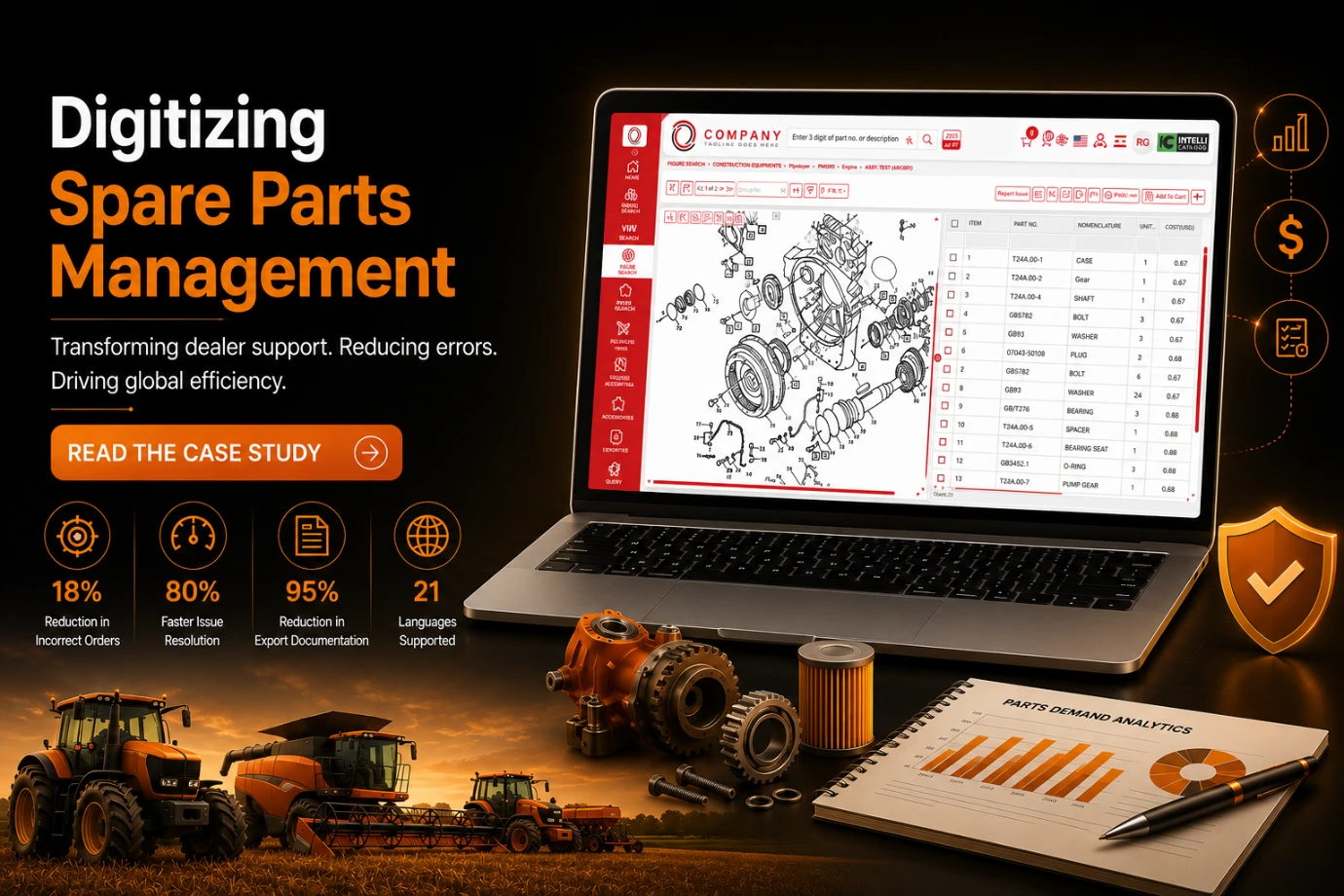


How Global Agricultural Equipment Manufacturer Digitized Spare Parts Management with Intelli Catalog
Customer: Leading Agricultural Equipment Manufacturer (Name Confidential)
Industry : Agricultural Equipment Manufacturing
Markets : Asia, Africa, Europe, North America
Solution : Intelli Catalog + Intelli Assist
Executive Summary
As the OEM expanded across Asia, Africa, Europe, and North America, its traditional parts management processes struggled to keep pace, resulting in ordering errors, delayed support resolution, and limited visibility across its global dealer network. Printed catalogs, disconnected spreadsheets, and manual customs paperwork could no longer keep pace with the business.
Dealers routinely ordered incorrect or superseded parts. Engineers spent hours tracing twenty years of change records buried in service circulars. Customer queries often took a month or more to resolve.
The agricultural equipment manufacturer partnered with Intellinet Systems to implement Catalog, an interactive digital catalog, alongside Intelli Assist, an integrated ticket management solution. The implementation provided the OEM with a centralized parts intelligence platform for its entire network, along with a streamlined support process that now resolves most issues in days rather than weeks.
Results at a Glance
- 18% reduction in incorrect spare parts orders.
- 80% faster issue resolution
- 95% reduction in export documentation effort
- 15% improvement in engineering change traceability
- The digital catalog supports 21 languages, enabling global operations.
- Centralized repository for parts, engineering history, and technical documentation across the dealer network.
Customer Overview
Our customer is a leading agricultural equipment manufacturer that designs and manufactures farm mechanization equipment for customers across Asia, Africa, Europe, and North America. Its product portfolio includes tillage equipment, sowing and planting machinery, crop care solutions, harvesting equipment, and crop residue management machinery.
A single equipment category can include fifteen to fifty machine variants, each with its own parts list and configuration history, making accurate spare parts identification critical for dealers, distributors, and service teams worldwide.
Supporting this scale required a platform that could keep pace with a growing product line, a global dealer network, and the regulatory differences that come with operating across multiple regions simultaneously.
Business Challenges:
Inconsistent Parts Identification
- Inconsistent parts identification led to costly ordering errors.
- Dealers and customers often worked from outdated catalogs without knowing a newer version existed, and had no self-service way to confirm a part before ordering. Much of this stemmed from a reliance on traditional printed catalogs and dealer-maintained spreadsheets; with a single catalog covering fifteen to fifty machine variants, dealers had to manually search through hundreds of pages to find the part they needed, with no search function and no way to confirm they were even holding the current edition.
- A suspected error meant contacting a field engineer, who coordinated with the parts team to investigate, a process that added days to what should have taken minutes.
- Only after fulfillment would the parts team sometimes discover that a requested part had been superseded or did not match the machine, resulting in wrong shipments and repeated confusion between similar models.
Engineering Knowledge Locked in Paper Archives
- Nearly two decades of Engineering Change Note records, spanning both assembly and aggregate-level modifications, existed only in printed service circulars.
- Tracing when a part changed meant manually searching that archive. Because the customer’s internal change process did not map cleanly onto standard supersession conventions, the records were also difficult to standardize into a simple lookup.
Global Operations Exposed Gaps in Documentation and Access
- Every destination country enforces its own customs requirements, and compiling shipment documentation by hand consumes several hours of staff time per shipment.
- Distributors also had no way to share only the catalog pages relevant to a customer’s machine, so any information request meant handing over an entire catalog spanning dozens of variants.
- This was also becoming a compliance consideration: emerging Right to Repair requirements in several international markets are increasing the need for OEMs to provide structured access to service and parts information. The challenge was also structural. While parts information in India has traditionally been distributed through the authorized dealer network, international customers increasingly expect to service their own equipment and require direct access to documentation instead of relying on dealers for every request.
- Language coverage added further constraints, as the existing documentation did not support the range of languages required by the agricultural OEM’s international network.
Support Requests Traveled Through Too Many Hands
- Catalog and parts queries were submitted via email and routed through the regional representative and internal teams before reaching parts administration.
- Requests were frequently delayed or lost in inboxes, and resolution routinely took thirty days or more.
Inflexible Distributor Pricing
- The customer’s commercial model rewards distributors differently based on their business volume, but the existing platform could only support two fixed prices, Dealer Retail Price and Maximum Retail Price. This left no way to reflect the multiple pricing tiers distributors actually operated under.
- Distributor classifications also change over time as sales volumes fluctuate, making it impractical to maintain separate, manually updated price lists for each distributor at scale and increasing the risk of distributors using outdated or incorrect pricing.
Post-Implementation: Limited Visibility into Adoption and Demand
- Management has limited visibility into adoption and demand.
- There was no structured way to see whether dealers were using digital tools instead of falling back on email, or to identify which models and regions generated the most demand and the most ordering errors.
- Compounding this, many dealers and field engineers work in areas with limited internet access, so any platform needed to function reliably for teams that could not assume continuous connectivity.
Solution
Intellinet System addressed these challenges with Intelli Catalog and Intelli Assist, customizing both platforms to fit customers’ engineering processes, compliance needs, and global scale.

Accurate, Self-Service Parts Identification
Intelli Catalog converted OEM’s legacy part catalogs into an interactive digital environment with hotspot navigation, allowing users to click a component in an exploded-view illustration to open its detail. The platform supports rich visual content across SVG, 3D, JPEG, and PNG formats, ensuring illustrations render consistently across devices and use cases. Parts can be located by model number, machine configuration, VIN or vehicle serial number, and other identifiers available in the customer’s product data, giving dealers a reliable way to confirm the correct component before ordering.
This gave every user, regardless of location, a consistently updated source of parts data to work from, helping reduce the incorrect orders caused by outdated or incomplete information.
Engineering Change History and Supersession Tracking
The agricultural equipment manufacturer’s complete twenty-year ECN history was consolidated into a unified repository linked to each part. Because the company's internal engineering workflow did not follow standard supersession conventions, the platform was adapted to match its own methodology rather than requiring engineering to change how it worked.
Any part now shows its introduction date, every revision, and its full supersession history in one view, along with the original service circulars that once existed only in print. What was once a manual search through printed archives is now a single click from the part page, giving distributors and service teams a trusted reference for a part's engineering status.
Global Documentation and Access
Export documentation is generated from the same product data maintained in the catalog. Users select the relevant parts and produce configurable reports in Excel or PDF, adjusted to match a given customs authority's requirements, turning a task that once took several hours per shipment into a matter of minutes.
Distributors can also generate catalog documentation scoped to what a customer actually needs, whether a single page, a specific assembly, or the parts tied to one VIN or machine, instead of an entire catalog. This helps address emerging Right to Repair expectations in international markets while giving the customer control over how much product data is shared in any interaction. Language coverage was expanded from 11 to 21 languages so dealers, distributors, and customers across the network can work in their preferred language.
Integrated Support Through Intelli Assist
Users can now raise a support ticket directly from the part they are viewing, with the system automatically capturing the catalog page, selected parts, and context, along with attachments such as images, videos, or spreadsheets. This information, known as the Reference Path, helps administrators quickly understand the issue. Tickets are routed directly to the responsible administrator, eliminating the need to pass through regional representatives and significantly reducing resolution time.
A centralized dashboard tracks new, urgent, and closed tickets with complete response history, and supports monitoring against predefined service-level agreements (SLAs), enabling administrators to measure response times against defined targets rather than estimate them from email threads. Requests that once took 30 days or more to resolve are now typically closed within two to three days.
Distributor-Specific Pricing Through SAP Integration
Rather than maintaining pricing separately inside the catalog, Intelli Catalog was integrated directly with the customer’s SAP system. When distributors log in, the platform retrieves their commercial profile from SAP and displays only the pricing tier assigned to their agreement.
Because pricing is centrally managed in SAP, changes to a distributor's classification or commercial terms are automatically reflected in the catalog, eliminating manual price list updates and ensuring distributors consistently see accurate, authorized pricing.
Adoption and Ordering Analytics
To give the OEM visibility into platform usage and demand, Intellinet added an analytics layer covering login activity and portal usage, including which pages and modules each user accesses, which helps identify users who need additional training, alongside ordering analytics that surface demand by machine model, regional patterns, and trends in incorrect or repeated orders. The platform also tracks least frequently ordered models alongside top performers. It continues to surface areas where incorrect parts ordering persists, giving the OEM an ongoing view of recurring problems rather than a one-time snapshot. This provides visibility that supports training planning, inventory decisions, and demand analysis.
Streamlined Catalog Publishing
Catalog creation was digitized through a role-based workflow that mirrors the customer’s existing process: the Literature and Publication team prepares content in collaboration with R&D, the Spare Parts team validates it, and nothing goes live until all required reviews are complete. Administrators then activate approved catalogs with a single action, and the same layer supports announcements and campaigns to the dealer network.
Print Catalog and Export Support
The Print Catalog functionality allows dealers and field teams to generate and print customized catalogs for specific models, assemblies, or product sections whenever required. This provides flexibility for field operations, dealer support, and offline documentation.
The Export Catalog functionality was implemented for the customer, allowing standardized item lists and catalog exports for international operations.
Mobile Access and Enterprise Integration
Android and iOS applications extended full catalog search, part lookup, and ordering to field engineers working outside the office, addressing the connectivity gaps that a desktop-only system could not. The platform was also integrated with the OEM internal product database, with SAP for pricing and product data, and with the Dealer Management System used for sales, purchasing, and repair operations, keeping the catalog synchronized with the systems the business already relies on.
Customizations
While Intelli Catalog and Intelli Assist are established products, several capabilities described above were purpose-built for the agricultural equipment manufacturer rather than deployed as standard functionality: the consolidation and digitization of ECN history, the adaptation of the supersession model to OEM’s own engineering conventions, the configurable export documentation reports, the targeted catalog distribution feature, the adoption and ordering analytics dashboard, the role-based publishing workflow, and the expansion from 11 to 21 languages.
Core catalog search, hotspot navigation, and the underlying ticketing framework reflect the standard platform. The distinction matters: Intellinet's approach was to adapt the platform to the customer’s existing processes rather than forcing them to change how it operates.
Business Outcomes
The engagement delivered measurable improvement across the areas that mattered most to the OEM’s operations.
- Parts ordering became more accurate, as real-time access to a current, centralized catalog searchable by model, configuration, or VIN/serial number removed a leading cause of errors: dealers working from whichever printed or outdated version happened to be on hand.
- Engineering traceability improved significantly, giving distributors and service teams a connected information hub for a part’s history instead of requiring them to search printed circulars.
- Export documentation became dramatically faster, dropping from several hours of manual work per shipment to minutes, which reduced administrative effort and accelerated international shipments.
- Support resolution time accelerated from roughly 30-60 days to 2-3 days, and because every request and response is retained on the platform, the process is now fully traceable rather than scattered across inboxes.
- Catalog sharing became more targeted, with distributors able to provide only the information a customer needs, supporting emerging Right to Repair expectations in international markets.
- Distributor pricing became consistent and self-maintaining, with each distributor automatically seeing accurate, tier-appropriate pricing without manual list management.
Technologies Implemented
The engagement centered on Intelli Catalog for interactive parts search, supersession tracking, multilingual support, export documentation, analytics, and role-based publishing, paired with Intelli Assist for integrated ticket management. The solution integrates with SAP for pricing, the Salesforce-based Dealer Management System for sales and repair operations, and the customer’s internal product database, and is available to field users through Android and iOS applications.
Implementation
The full engagement, including commercial discussions, planning, customization, testing, and deployment, spanned roughly six to seven months. Within this timeline, the OEM’s historical data, including ECN records, export documentation, and other business-specific information, was added to the platform in about two to two and a half months. The extended timeline reflected custom workflows, enterprise integrations, testing, and deployment.
Support today focuses on ongoing enhancement rather than initial rollout. The adoption and ordering analytics dashboards, for example, were added after go-live once the customer could see that some users still defaulted to email, giving the business a way to address that gap directly rather than rely on anecdotal feedback from regional teams.
See how Intelli Catalog helps OEMs simplify global spare parts management, improve dealer support, and create a connected aftermarket ecosystem.


About the Author


Nishant Sharma
Nishant Sharma is the Marketing & Sales Lead at Intellinet Systems, specializing in B2B sales, digital marketing, and automotive aftermarket solutions. With extensive experience in driving business growth, lead generation, and go-to-market strategies, he is passionate about helping businesses adopt innovative technologies that enhance operational efficiency and customer experience. Through his articles, Nishant shares practical insights on industry trends, emerging technologies, and best practices shaping the future of the automotive aftermarket.
Explore More Case Studies




Schedule a Free Demo, and go live in just 7 days

Our team will get back to you in 24 hours

