


How LMW Digitized Four Decades of Engineering History with Intelli Catalog
Customer: LMW Limited (formerly Lakshmi Machine Works Limited)
Industry : Industrial machinery: textile spinning machinery, CNC machine tools, precision castings, and aerospace components
Markets : India, with exports across Asia, Oceania, and Europe
Solution : Intelli Catalog
Executive Summary
LMW Limited (formerly Lakshmi Machine Works Limited) was founded in 1962 in Coimbatore, Tamil Nadu, to supply spinning technology to Indian textile mills. It is now one of only three companies in the world that manufacture the complete range of textile spinning machinery and has since diversified into CNC machine tools, precision castings, and aerospace components.
Because LMW predates digital record-keeping, decades of its product data existed only on paper or as scanned images. Prior attempts at digitization had simply scanned paper catalogs into image-only PDFs, files that could not be searched, indexed, or used to power a modern parts lookup experience. Its complete engineering change history was similarly scattered across bulletins and circulars, with no structured record of how one part had evolved into another.
LMW partnered with Intellinet Systems to implement Intelli Catalog, using AI-based extraction to convert its historical catalogs and engineering bulletins into structured, searchable data, and building a new Dealer Variant Mapping capability so each customer could see only the exact machine variant they owned. Where other vendors had asked LMW to reform its own historical archive before implementation could even begin, Intellinet took ownership of the conversion itself. Following the success of the initial rollout for LMW’s Textile Machinery Division, the company’s Machine Tool Division engaged Intellinet separately for the same platform, along with additional capabilities including OEM-level cart visibility and a fully managed Data Support Service.
Result at a Glance
- ~50% of LMW’s product catalog, products predating the year 2000, recovered from scanned, image-only archives using AI-based extraction.
- ~6 weeks to structure and digitize LMW’s complete historical Engineering Change Notice (ECN) and supersession archive, work that manual reorganization would have taken five to six months or longer to complete.
- ~3 months from project kickoff to a live, production-ready Electronic Parts Catalog, despite more than half the data requiring historical reconstruction.
- ~1/10th the cost of the alternative vendors LMW evaluated, most of which were unwilling to take on the historical data conversion at all.
- Zero production errors since go-live, with strong customer satisfaction reported by LMW.
- ~120 product catalogs processed during the initial implementation.
- 2 LMW business divisions (Textile Machinery and Machine Tools) onboarded onto the platform, with the Machine Tools Division engaging Intellinet directly after seeing the Textile Machinery Division's results.
- 5 Languages support delivered, including Vietnamese and Bahasa, added specifically for LMW using AI-assisted translation.
Transform Your Legacy Parts Data into a Smart Digital Parts Catalog. Book a Personalized Demo
Customer Overview
LMW Limited, formerly Lakshmi Machine Works Limited, is headquartered in Coimbatore, Tamil Nadu, with a registered office at S.R.K.V. Post, Perianaickenpalayam, and a subsidiary, LMW Global FZE, based in Dubai. Founded in 1962, the company’s Textile Machine Division is one of only three manufacturers worldwide offering the complete range of spinning machinery, from blow room to ring spinning. It holds a leading share of India’s domestic textile spinning machinery market.
LMW diversified into CNC machine tools through its Machine Tool Division, which manufactures CNC lathes and machining centres for customers across Indian industry. Its Foundry Division produces precision castings for original equipment manufacturers in both domestic and global markets, and its Advanced Technology Centre, added in 2010, develops components for the aerospace and defense sector. LMW exports primarily to Asian and Oceanic markets, with a presence in Europe as well.
LMW’s after-sales business is organized by machine serial number: every machine sold is tracked and supported throughout its lifecycle using the unique serial number assigned at the time of sale, and its existing Bill of Materials (BOM) system was built around that model. Its customers are not high-volume dealers in the automotive sense; a typical customer purchases one or a small number of machines, each representing a significant capital investment, and expects support for that specific configuration over a long operating life.
As LMW pursued its digital transformation, it needed a partner that could modernize after-sales parts lookup and ordering without first requiring the company to clean up decades of legacy records.
Business Challenges
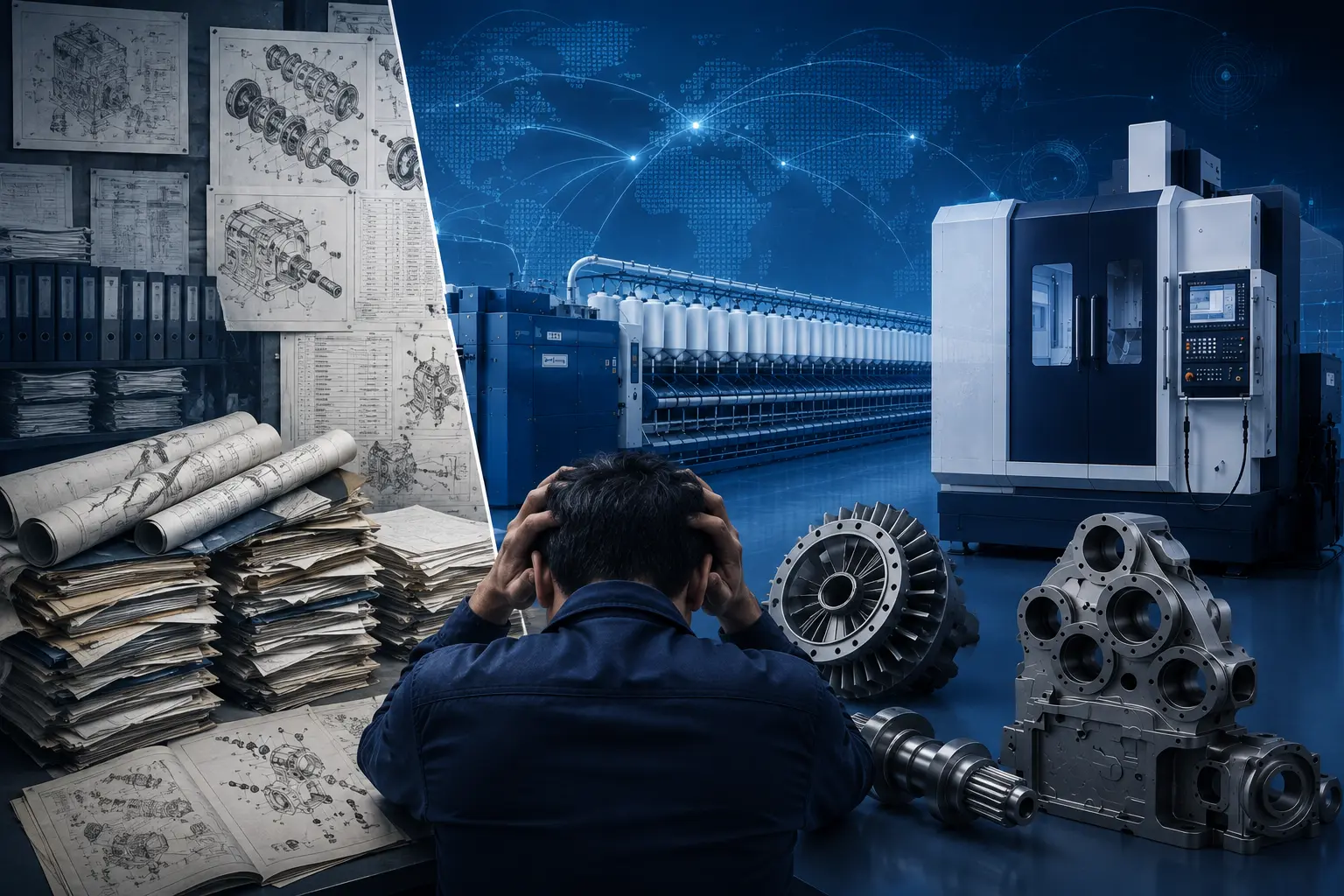
Four Decades of Product Data Trapped in Legacy Formats
- LMW’s product data existed in three very different states of readiness. Products manufactured before 2000, roughly half the total catalog, existed only as scanned images with no underlying structured data, making automatic extraction impossible.
- A further ~40% of the catalog existed only as PDF documents. These were easier to extract than scanned images, but the illustrations were engineering drawings rather than the clean, exploded-view illustrations a modern parts catalog requires.
- Only the remaining ~10%, LMW's newest machines, designed on a modern engineering system, came with proper 3D drawings and catalog-ready illustrations.
- Because more than half of the portfolio sat in the unusable historical formats, digitizing only the clean, modern data would have left LMW’s core business problem unsolved.
Unstructured Engineering Change History
- LMW maintained a complete record of part changes through Engineering Change Notices (ECNs), but the information was entirely unstructured. It was scattered across engineering bulletins and individual documents, with no centralized database linking obsolete part numbers to their replacements.
- A modern parts platform expects structured supersession data to connect old and new part numbers; no such structure existed, and organizing four decades of engineering history by hand was not something any single employee could confidently validate.
Machine Identification Beyond the Model Level
- LMW already used the familiar category, model, and variant hierarchy, but its business requirements extended beyond that. Within a single variant, different customers could own machines with different serial number ranges, while different variants of the same model could have entirely different configurations.
- The existing platform supported dealer and customer access only at the model level, which was appropriate for automotive customers, where variants typically differ only slightly. However, this approach was insufficient for LMW, where variants within the same model could differ significantly.
- LMW needed each customer to see only the exact variant supplied to them, rather than every variant available under the same model.
No Centralized Visibility into Customer Buying Intent (Tooling Division)
- After onboarding the Textile Machinery Division, LMW’s Machine Tool Division approached Intellinet with related but distinct requirements. Shopping cart activity in the existing platform was visible only to the user who created it, leaving LMW's head office with no visibility into what dealers or customers were planning to purchase.
- Without that visibility, LMW had no data-driven way to design targeted discount schemes or promotional campaigns around actual buying intent.
Inefficient Saved-Cart Workflow
- LMW's users typically maintained separate carts for each machine serial number, adding parts over time before placing an order. To add a part to a specific saved cart, users first had to add it to the currently open cart and then manually move it to the intended cart, turning a routine task into an unnecessary three-step process.
No Internal Capacity for Catalog Data Management
- LMW's business users had deep expertise in manufacturing and spare parts but lacked the resources and specialized skills needed to prepare and maintain digital catalog data. As a result, they asked Intellinet to take end-to-end responsibility for the catalog lifecycle rather than simply providing software.
Legacy Interface Habits and Engineering Edge Cases
- Users accustomed to LMW’s legacy paper catalogs preferred to browse by a traditional Index View rather than the platform’s standard Grid and List views.
- LMW's engineering practices allowed two different spare parts to share the same reference number when they applied to different serial number ranges within the same machine diagram. The platform, however, assumed that each reference number uniquely identified a single part and could not support this scenario.
Solution
Intellinet System addressed these challenges with Intelli Catalog, combining AI-based data conversion with platform capabilities purpose-built for LMW’s engineering and after-sales processes.
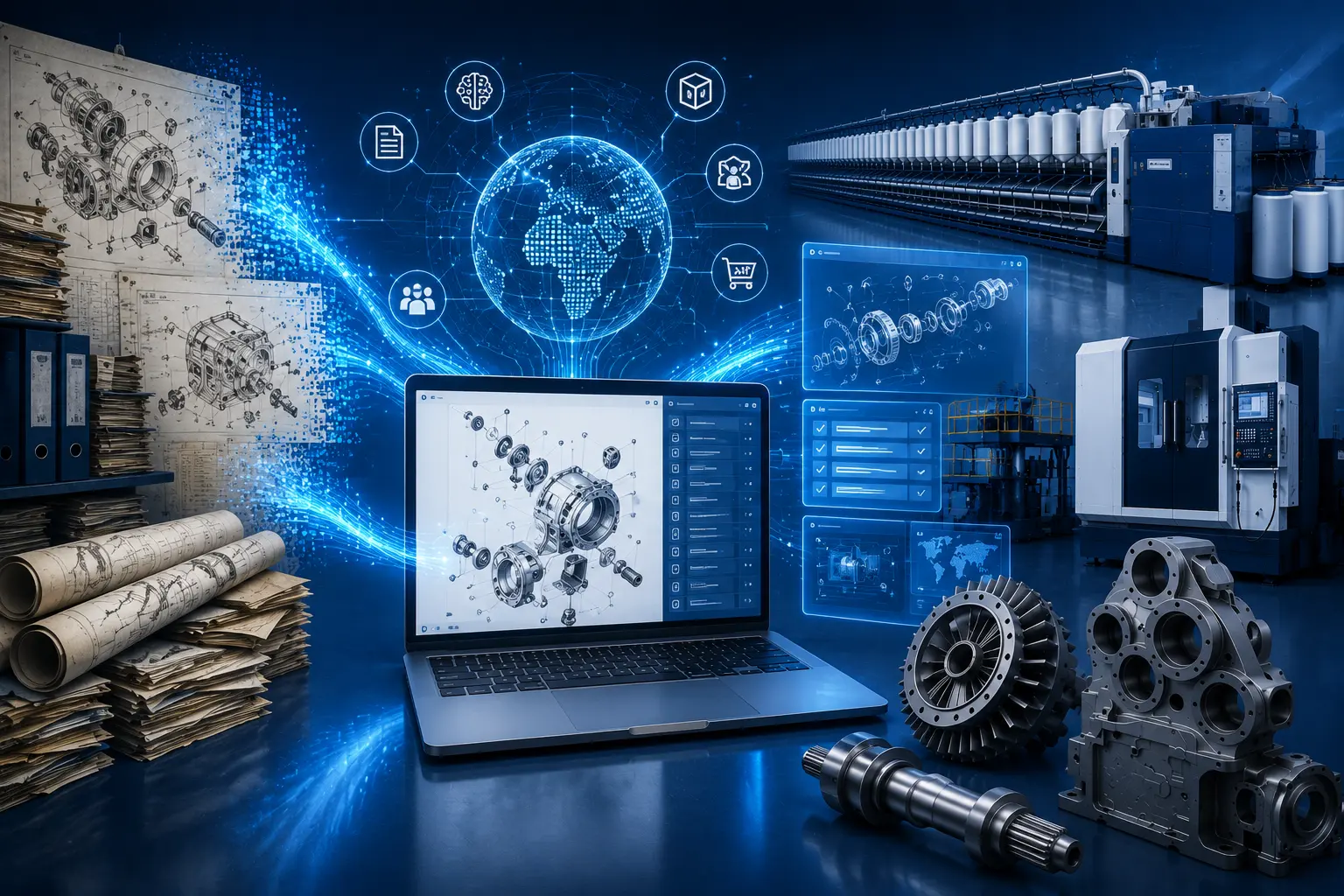
AI-Powered Historical Catalog Digitization
For the portion of LMW’s catalog that existed only as scanned images, Intellinet developed an in-house AI image-processing workflow that extracted text separately from the scanned pages and converted the accompanying engineering drawings into usable 2D illustrations. AI-extracted text was matched with the corresponding illustrations, and every result was manually verified by LMW before publication. The remaining PDF-based dataset, already containing structured text, was processed directly through Intellinet’s standard extraction workflow, and the newest, modern-format data required no additional processing.
AI-Based Supersession and ECN Structuring
Intellinet built an in-house AI model to read LMW’s historical PDF engineering circulars and service bulletins and extract supersession information, including which part changed, when it changed, and why, into a structured, tabular format. The most recent decade of records, already available in Excel, was merged with this newly structured historical data, cleaned, organized chronologically, and deployed into the electronic catalog in phases for LMW’s engineering team to validate before release to end users.
Dealer Variant Mapping
To meet LMW’s requirement that each customer see only the exact variant supplied to them, Intellinet redesigned its core product hierarchy so that category, model, and variant could each be assigned independently, rather than granting access only down to the model level. This new Dealer Variant Mapping capability, developed specifically for LMW, now allows any individual variant to be mapped directly to a specific user or dealer.
LMW also required applicability mapping at the individual dealer level rather than the dealer-group level used elsewhere on the platform, since dealers in the same region could each own a different combination of machine variants. To support this, Intellinet introduced user-level applicability mapping, allowing OEM administrators to control exactly which variants each dealer is authorized to view.
Centralized Cart Visibility and Analytics
Intellinet built new functionality giving LMW’s head office centralized visibility into what every dealer and customer had added to their carts, comparable to a retailer seeing purchase intent across its customer base, so LMW could design targeted discount schemes and promotional campaigns around actual demand.
Streamlined Saved Carts
Intellinet redesigned the Add to Cart workflow so that, on selecting a part, users are shown a list of their saved carts and can add the item directly to the correct one, for example, a specific machine serial number’s cart, removing the extra navigation steps the previous workflow required.
Fully Managed Data Support Services
To address LMW’s limited internal capacity for catalog administration, Intellinet introduced Data Support Services: LMW supplies source data and a single point of contact, and Intellinet’s team takes full responsibility for preparing, uploading, and maintaining the catalog on an ongoing basis. This reflects the platform’s flexible delivery model, under which other customers, such as Eicher Motors and Shaktiman, manage their own catalog data internally instead.
Legacy-Familiar Navigation and Engineering-Accurate Reference Numbers
Intellinet added an Index View alongside the platform’s standard Grid and List views, matching the browsing style LMW’s users were already familiar with from its legacy catalogs. The platform was also extended to support multiple parts against a single reference number, each tied to the serial-number range it applies to, along with additional fields for HSN codes and tax details against individual parts.
Multilingual Support
LMW required catalog support across five languages. Three were already available on the platforms; Vietnamese and Bahasa were added using AI-assisted translation, allowing Intellinet to meet the requirement without building entirely new language packs from scratch.
Mobile Access
LMW's requirement for a mobile application across all user types was met by the platform's existing Android and iOS applications, requiring no additional development.
Customizations
While Intelli Catalog is an established platform, several capabilities described above were purpose-built for LMW rather than deployed as standard functionality: the AI-based image-processing workflow for scanned historical catalogs, the AI model for extracting structured supersession data from engineering circulars, the Dealer Variant Mapping module and its underlying independent category-model-variant hierarchy, user-level (rather than group-level) applicability mapping, centralized OEM-level cart visibility, the streamlined multi-cart Add to Cart workflow, the Index View display option, support for multiple parts sharing a reference number with serial-range applicability, and the addition of Vietnamese and Bahasa language support.
Core catalog search, standard Save Cart functionality, and multilingual infrastructure reflect the standard platform. As with other implementations, Intellinet’s approach was to adapt the platform to LMW’s existing engineering and after-sales processes rather than asking LMW to change how it operates.
Business Outcomes
- A viable path for decades of legacy data: where other vendors were unwilling or unable to convert LMW’s image-only historical archive, Intellinet’s AI-based workflow made it usable for the first time, at a fraction of the cost of the alternative LMW had evaluated.
- Engineering history became searchable: ECN and supersession records once locked in printed circulars are now structured, centralized, and linked directly to each part.
- Customer-specific visibility replaced one-size-fits-all catalogs: Dealer Variant Mapping ensures LMW customers see only the machine variants and spare parts relevant to the equipment they actually own, removing the confusion of browsing LMW’s full model range.
- Head office gained visibility into buying intent: Centralized cart visibility gives LMW’s Textile Machinery and Machine Tool Division a data-driven basis for discount schemes and promotional campaigns.
- The relationship expanded organically: The Machine Tool Division adopted the platform on the strength of results delivered for the Textile Machinery Division, and the engagement now includes an ongoing managed data service that frees LMW’s business teams from catalog administration.
Technologies Implemented
The engagement centered on Intelli Catalog for interactive parts search, AI-based digitization of legacy catalogs and supersession data, dealer variant mapping, multilingual support, and cart and ordering functionality. These capabilities were supported by Intellinet's in-house AI tools, built specifically to extract text and illustrations from image-based catalogs and to structure historical engineering change data. The solution is available to LMW’s users through the platform’s existing mobile applications.
Implementation
The engagement began in November 2025. LMW’s historical data was the primary driver of the project timeline: with over forty years of product information spread across multiple legacy formats, Intellinet spent roughly one and a half months studying the historical data, designing the AI-based extraction approach, building the required AI tools, and validating their output before catalog preparation could begin in earnest.
Even after AI-based extraction, meaningful manual work remained: hotspot creation, illustration mapping, and engineering validation, some of which continued after the platform went live. The scope excluded only the server infrastructure, which LMW managed itself; Intellinet handled the rest of the implementation end-to-end.
Book a demo to see how Intelli Catalog helps OEMs transform decades of legacy engineering data into intelligent digital catalogs, provide customer-specific spare parts visibility, and streamline aftermarket operations.


About the Author

Nishant Sharma
Nishant Sharma is the Marketing & Sales Lead at Intellinet Systems, specializing in B2B sales, digital marketing, and automotive aftermarket solutions. With extensive experience in driving business growth, lead generation, and go-to-market strategies, he is passionate about helping businesses adopt innovative technologies that enhance operational efficiency and customer experience. Through his articles, Nishant shares practical insights on industry trends, emerging technologies, and best practices shaping the future of the automotive aftermarket.
Explore More Case Studies


Schedule a Free Demo, and go live in just 7 days

Our team will get back to you in 24 hours

