



How a Global Agricultural Equipment OEM Modernized a Legacy Parts Catalog with Intelli Catalog
Industry: Agricultural and construction equipment manufacturing
Markets: India, United States, Europe, and other global export markets
Solution: Intelli Catalog + Intelli Assist
Executive Summary
The partnership between an established Indian manufacturer of tractors and agricultural implements, and a Japanese global leader in agriculture, created a company with an expanded portfolio of tractors, harvesters, and construction equipment, supported by a dealer and distributor network across India and international export markets.
Unlike many Intellinet engagements that start from a blank slate, the customer already had a digital parts catalog in place through a previous vendor. The problem was not a lack of technology; it was years of unstructured customization. Every new request had been built directly into the platform without architectural planning, and over a decade, the system became so slow that basic tasks, such as searching for a part, took an excessive amount of time. When performance issues were raised, the previous vendor's response was to strip out features rather than fix the underlying architecture.
The customer approached Intellinet Systems to migrate this live, actively used production environment onto Intelli Catalog without data loss or disruption, and then extend the platform to solve business problems the previous vendor had never been able to address. What followed was one of Intellinet's most extensive customization engagements, spanning reverse supersession logic, group alternate parts, kit management, child part ordering, role-based pricing control, enterprise system synchronization, single sign-on, and a modernized cloud infrastructure.
Result at a Glance
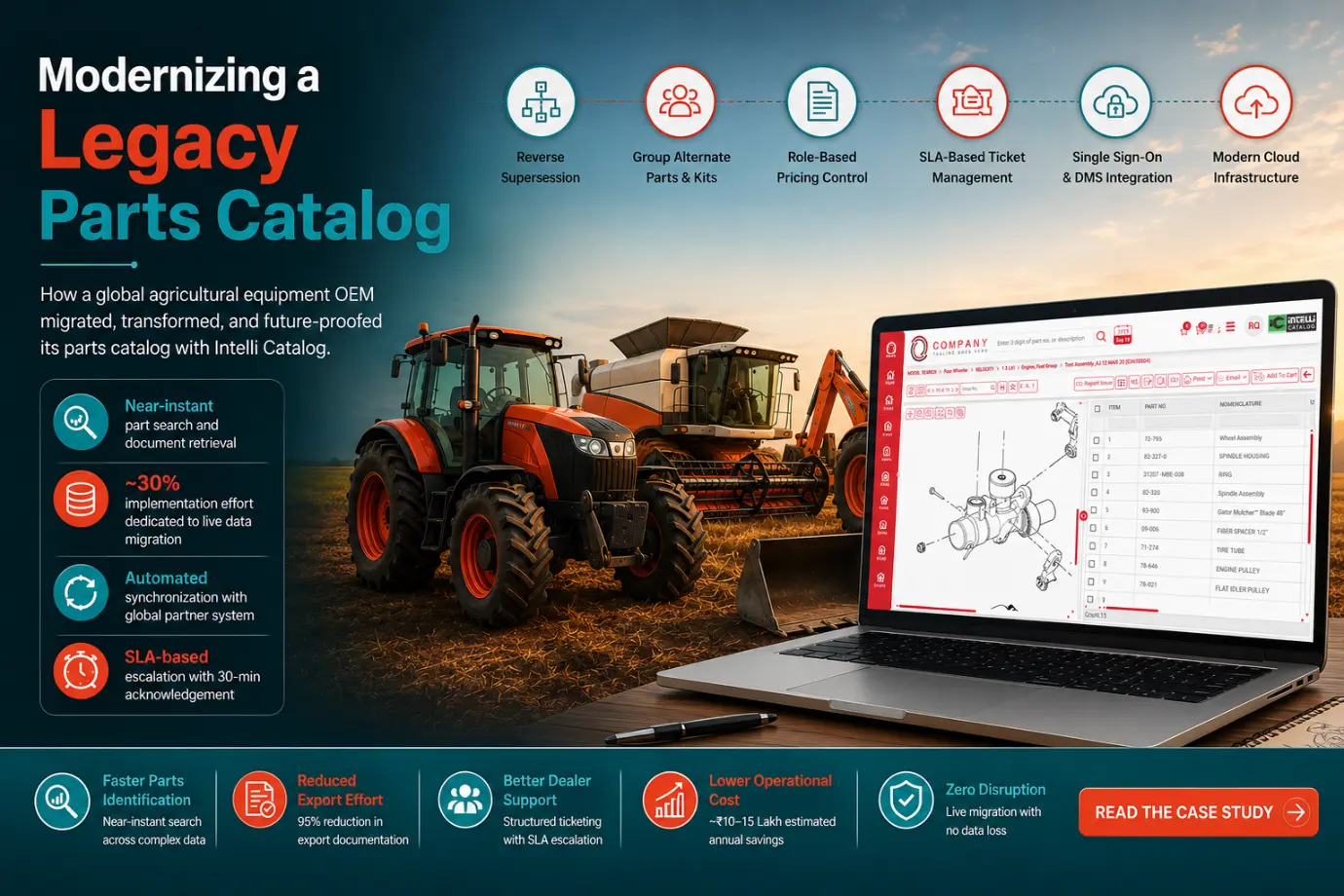
- Near-instant part search and document retrieval, replacing a platform that had become too slow for daily use
- ~30% of implementation effort dedicated to migrating and restructuring years of live production data, with zero disruption to users
- K-Pad integration reduces catalog synchronization from one to two weeks down to a few minutes
- SLA-based escalation acknowledges tickets within 30 minutes and escalates unresolved issues within 60 minutes
- ~90% of a new model's catalog structure reused automatically through Category Replication
- Estimated annual savings of ₹10–15 lakh from reduced wrong-part ordering and lower operational effort
- Single sign-on (“Omni Login”) unifies DMS, Salesforce, and Intelli Catalog access across desktop and mobile
Customer Overview
The customer brought together a respected Indian brand built primarily on tractors and tractor implements and a Japanese company with a global agriculture footprint. The partnership paired the Japanese company's engineering with the Indian brand's cost-effective manufacturing, expanding the combined portfolio to include tractors, harvesters, and construction equipment.
The customer serves domestic dealers as well as distributors across export regions, including the United States and Europe, each with its own support team and pricing structure. As the business scaled, its product portfolio and underlying data grew substantially. The customer already operated a digital electronic parts catalog with dealer management system integration, engineering change notice management, and parts ordering, so this was not a first-time digitization project. It was a modernization and expansion of an existing production platform that could no longer keep pace with the business.
Business Challenges
A Legacy Platform Eroded by Years of Ad-Hoc Customization
- The customer's existing vendor had delivered every requested feature over the years, but never advised the business on scalable design or industry best practices. The platform evolved entirely through one-off customizations rather than a structured product architecture.
- Over three to four years, this approach caused the system to become extremely slow. Even basic operations such as searching for a part or retrieving a model's details took an excessive amount of time, because the underlying database and software architecture had never been optimized to support the growing number of business rules, part mappings, and dealer mappings across countries.
- When the customer raised performance concerns, the vendor responded by removing features instead of addressing the underlying architectural issues, leaving the business with a platform that technically functioned but was no longer practical for day-to-day operations.
A Live Production Environment That Could Not Be Disrupted
- The customer’s existing system was actively in use. Any new platform had to preserve every workflow, dataset, and user expectation the business had already built around, with no discrepancies or missing data at go-live.
Support Requests Disappeared into Email
- The OEMs had a basic complaint portal that generated email notifications, but it offered no ticket tracking, status visibility, reporting, or monitoring.
- Complaints accumulated in inboxes with no structured ownership, and there was no way to assign issues to the right regional team across OEM’s distributed support organization in India, the United States, and Europe.
A Rigid, Multi-Step Document Model
- The customer’s document repository was extensive, but the platform only supported attachments from the Model level downward, with no support at the Category level.
- Visibility followed country mapping rather than language, so a model deployed across ten countries would expose all ten language versions of an operator manual to every user, rather than showing an Italian user only the Italian manual.
- Adding or updating a single document required three separate steps across multiple screens: uploading, mapping, and updating.
Parts Relationships More Complex Than the Platform Assumed
- Supersession logic only moved forward (A → B → C), with no way to revert to an earlier part once a later revision proved unsatisfactory.
- No way to represent a single part being replaced by a defined group of components, a scenario common in tractors such as an exhaust assembly, 5th wheel coupling, differential gearbox assembly
- No kit management, so commonly co-ordered components had to be selected and ordered individually.
- No way to order a single child component of an assembly without ordering the entire assembly
Pricing Visibility Was All-or-Nothing
- The OEM needed to show fixed domestic pricing while keeping dynamic, market-specific export pricing hidden from most users.
- The existing platform only supported showing pricing to everyone or hiding it from everyone, with no way to control visibility by user, dealer group, distributor, or country.
Complex Assembly and Ordering Scenarios
- The manufacturer’s engineering and assembly variation needs went beyond standard alternate parts and kit ordering. In some cases, a single component needed to be replaced not by one alternate part but by an entire predefined group of components.
- In others, dealers needed to order commonly bundled components as a single kit, or order an individual child component of a larger assembly, such as one button within a remote control, without purchasing the entire assembly. None of this was supported by conventional parts catalog design.
Manual Catalog Synchronization
- Following the partnership, every engineering change note had to be manually converted into a predefined format and transferred to the partner's systems. This manual process often took several days, and in many cases one to two weeks, to complete.
Fragmented Authentication Across Enterprise Systems
- The company operated multiple enterprise applications, including separate dealer management systems for domestic and export operations, and Salesforce for certain business teams.
- Users had to maintain separate credentials for each system, which conflicted with the company’s enterprise security policies.
Infrastructure Strain from Combined Data and Asset Storage
- The database, images, application files, and other large assets were all stored on the same server, placing significant load on the database and affecting overall system performance.
Solution
Intellinet approached this engagement differently from a typical greenfield implementation. Its first priority was to faithfully migrate and stabilize the existing production environment before extending the platform with new capabilities that the previous vendor had been unable to deliver.
Migrating a Live Production Environment
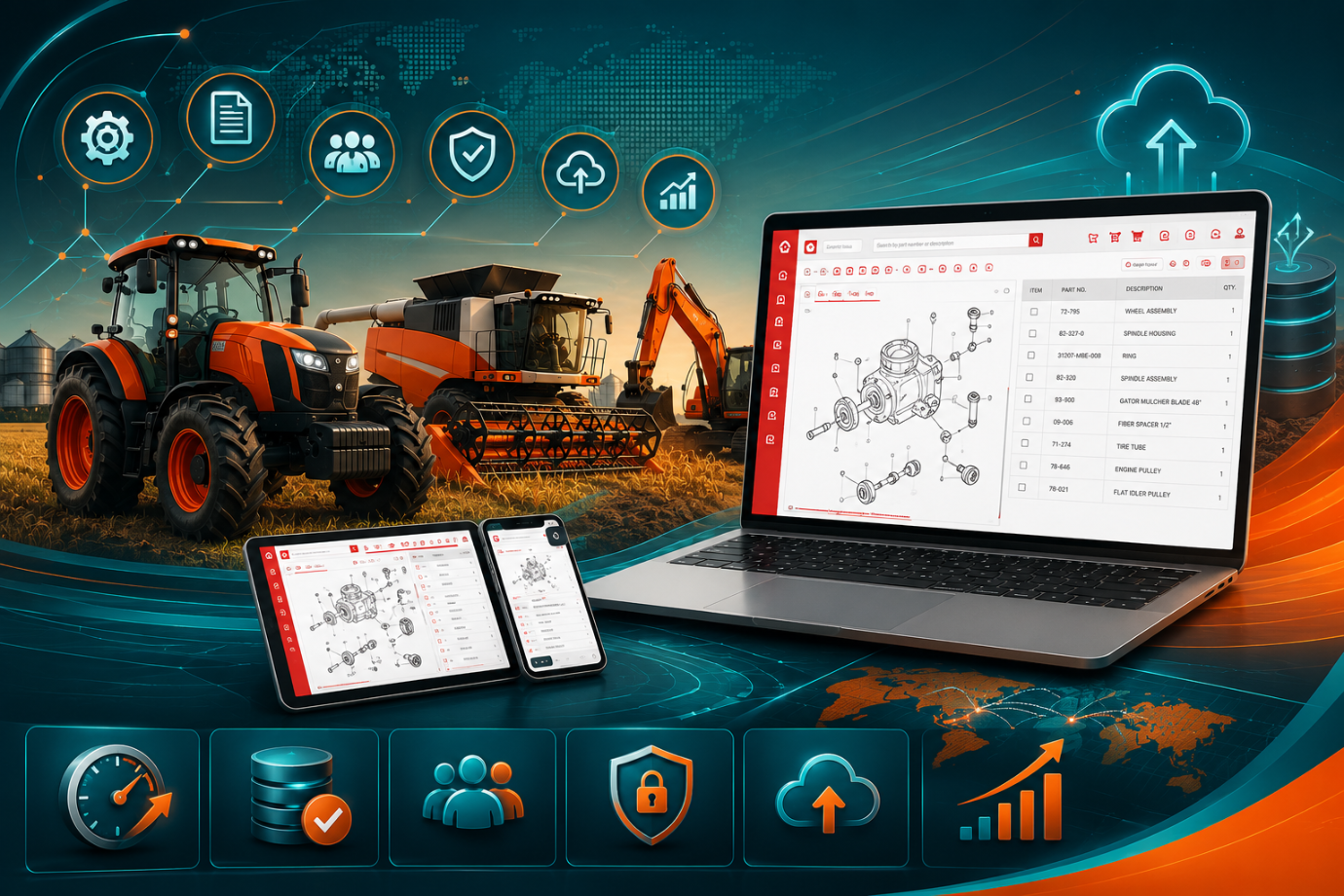
A dedicated technical team analyzed the existing database and mapped it into Intelli Catalog's standardized product architecture. The migrated system was handed over for thorough validation before go-live, ensuring that every module the business previously relied on was available with no data loss or discrepancies.
This transformation phase, restructuring the existing data to align with Intelli Catalog's standardized architecture, took approximately six weeks and accounted for nearly 30% of the total implementation effort, before any new business capability was introduced. This phased approach mattered for user adoption, since preserving familiar functionality first built trust before new enhancements were introduced.
Once restored, the existing functionality was not just intact; it was significantly faster. Users could search for parts, retrieve documents, and complete everyday operations without the delays that had made the previous system impractical.
Reverse Supersession Support
Intelli Catalog's supersession engine originally assumed replacement chains moved forward only. To support the business requirement of reverse supersession, where a part from C can be reverted to B without disrupting data integrity or the broader replacement chain, a capability that had not existed in the original product architecture.
Structured, Region-Aware Ticket Management
Intellinet implemented its ticketing system, previously developed for another customer, to replace the client's existing unmanaged email-based complaint process. The system was then enhanced with regional ownership, allowing India, the United States, Europe, and other regions to manage their own support requests independently instead of routing everything through a single administrator.
The client also requested formal SLA management, which Intellinet implemented through SLA-based escalation rules. For example, if a ticket is not acknowledged within 30 minutes, it is automatically escalated to the next support level. If it remains unresolved after 60 minutes, it is escalated further according to a predefined escalation matrix. Dealers now have full visibility into their own tickets, including the ability to monitor status, review responses, reopen tickets, and track resolution progress, bringing greater transparency to the support process and enhancing dealer trust in the support system.
Redesigned Document and Attachment Management
Rather than build a narrow fix, Intellinet redesigned the entire attachment framework using industry best practices. The upgraded system introduced a structured document repository with rich metadata and classification, so documents can now be categorized by type, restricted to specific countries, assigned to specific languages, and associated with any level of the catalog hierarchy, including the Category level that was previously unsupported. The upload, mapping, and update process was consolidated into a single interface instead of three separate steps.
Print Catalog and Export Support
Intellinet also delivered the platform's Print Catalog functionality. This capability is particularly important for OEMs operating in European and other Western markets, where providing accurate user and service documentation supports regulatory documentation requirements and Right to Repair initiatives, helping OEMs meet customer expectations and compliance obligations. Users can generate and print catalogs for specific models, assemblies, or product sections whenever required, providing greater flexibility for field operations, dealer support, and offline documentation.
The Export Catalog functionality implemented for this engagement was similar to the solution delivered for other global OEMs, allowing standardized item lists and catalog exports for international operations.
Category Replication for Faster Catalog Creation
Since a new equipment model typically shares around 90% of its assemblies and parts with an existing model, Intellinet introduced Category Replication, allowing administrators to duplicate an existing catalog structure in a single operation, then rename, remove obsolete items, add required changes, and publish, rather than rebuilding an entire catalog hierarchy from scratch for every new model.
Group Alternate Parts
Intellinet introduced an entirely new capability called Group Alternate Parts, allowing a single original component to be substituted by a predefined combination of several components, rather than the conventional one-to-one alternate part replacement. Users can search by equipment serial number and immediately see all valid alternate combinations applicable to that specific machine, replacing what had previously been managed through circulars and manual communication.
Kit Management
Intellinet designed and implemented a dedicated Kit Management feature, allowing the customer to define kit structures so dealers could order a full predefined set of commonly ordered components, such as a piston assembly and its associated parts, through a single transaction. This simplified ordering for dealers and reduced packaging and shipping costs for the OEM.
Child Part Ordering
Intellinet developed a new capability that enables users to order individual child components within a larger assembly, eliminating the need to purchase the complete assembly. Assemblies with orderable child components display a dedicated indicator, so users can expand the structure and order only what they need.
Role-Based View Control for Pricing
Rather than build a one-off customization, Intellinet developed a flexible Role-Based View Control framework that lets administrators manage visibility of pricing, inventory quantities, and Minimum Order Quantity information at a granular level, by country, distributor, user role, or individual account. This addressed the need to show fixed domestic pricing while controlling dynamic export pricing.
K-Pad Integration
Intellinet fully automated the catalog synchronization process with a global partner's system. Whenever a relevant change is approved in Intelli Catalog, the system automatically detects the trigger, generates the required catalogs and variant files, converts them into the required format, and places them in the designated integration folder for the partner system to retrieve, reducing a process that previously took days or weeks to a few minutes with a single business approval step.
Single Sign-On Across the Enterprise (Omni Login)
Intellinet implemented Single Sign-On, internally referred to as Omni Login, so users authenticate once against the organization's centralized directory and access Intelli Catalog without maintaining separate credentials, with automatic synchronization whenever corporate passwords are updated. A dedicated authentication API extended the same experience to the mobile application.
Intellinet also built a contextual integration between Intelli Catalog and the Dealer Management System. When a service advisor opens a job card, a single click launches Intelli Catalog with the user identity, vehicle information, and job card context already passed through, showing only the relevant parts for that vehicle. Selected parts are automatically added back to the job card, and bi-directional navigation allows users to move freely between both systems without repeated logins.
Infrastructure Modernization
Beyond product functionality, Intellinet recommended separating binary assets from the database by moving images and large files to Azure Blob Storage while keeping only transactional data in the database. This improved system performance, processing speed, and infrastructure scalability, with minimal cost impact.
Context-Aware DMS Integration
From a job card inside the DMS, a service advisor can now launch Intelli Catalog directly, with user identity, vehicle information, and job card context passed automatically so only the relevant parts for that specific machine are displayed. Selected parts flow back into the job card without a second login or manual search, and bi-directional links let users move between Intelli Catalog and the DMS in either direction.
Customizations
Several capabilities delivered during this engagement were purpose-built rather than standard functionality: reverse supersession support, regional ticket ownership and SLA-based escalation, the redesigned document and attachment management framework, Group Alternate Parts, Kit Management, child part ordering, the Role-Based View Control framework for pricing and inventory visibility, external partner system integration, Omni Login single sign-on and mobile authentication, contextual DMS integration, and the migration and restructuring of a live production environment into Intelli Catalog's standardized architecture.
Many of these customer-driven enhancements, including K-Pad integration, role-based enterprise authentication, contextual DMS integration, category replication, and the modernized infrastructure architecture, have since become reusable capabilities that strengthen the Intelli Catalog platform for future OEM implementations.
Business Outcomes
- Dramatically Improved System Performance: Following migration to Intelli Catalog, the years of performance degradation caused by unmanaged customization were resolved. Users reported that they could search for parts, access information, and place orders almost instantly, a substantial and immediately visible improvement over the previous platform.
- Granular Pricing Control for Global Operations: Where pricing visibility was previously limited to an all-or-nothing approach, the Role-Based View Control framework now allows pricing to be managed at the level of individual users, distributors, countries, or business roles, supporting both domestic and export operations within the same platform.
- Structured Ticket Management and Greater Transparency: Email-based complaint handling was replaced with structured ticket tracking, country-specific ownership, SLA-based escalation, real-time status monitoring, and dashboard reporting. Dealers now have complete visibility into the tickets they raise and can track resolution progress directly.
- Lower Operating Cost: Excluding one-time implementation costs, annual savings are estimated at approximately ₹10 to 15 lakh, driven by reduced wrong part ordering, faster parts identification, lower operational effort, reduced manual processing, and fewer customer service issues.
- Reduced Customer Complaints: With performance and response time issues resolved, and the ticketing system ensuring every issue is tracked and managed through a transparent workflow, customer complaints have reduced significantly compared to the legacy platform.
- Faster Catalog Synchronization: K-Pad integration reduced catalog synchronization from a manual process that took one to two weeks to an automated workflow completed in just a few minutes.
Technologies Implemented
The engagement centered on Intelli Catalog, extended with reverse supersession logic, Group Alternate Parts, Kit Management, child part ordering, Role-Based View Control, and Category Replication, paired with Intelli Assist for regional, SLA based ticket management. The platform integrates with multiple dealer management systems across domestic and export operations, Salesforce, and partner systems through K-Pad integration, with enterprise Single Sign On through Omni Login and Azure Blob Storage for asset management.
Implementation
Because the existing system was live and actively used, the implementation followed a phased approach rather than a single cutover. Migration and restructuring of the existing production data into Intelli Catalog's standardized architecture came first, taking approximately six weeks and accounting for nearly 30% of total implementation effort. Every module was validated before any new capability was introduced.
Only after this foundation was confirmed did Intellinet begin building the new business capabilities described above, including reverse supersession, group alternate parts, kit management, role-based pricing control, ticketing enhancements, the document management redesign, and the synchronization workflow.
Overall Outcome
The engagement transformed an underperforming legacy parts catalog, one that technically worked but had become impractical for daily use, into a modern, high-performance enterprise platform. Beyond preserving the customer’s existing business processes through careful data migration, the implementation introduced substantial product innovation across supersession logic, pricing control, ticket management, catalog replication, and enterprise integration. Many of these customer-driven enhancements have since become standard capabilities within the Intelli Catalog platform, strengthening its value for future OEM implementations.
See how Intelli Catalog helps OEMs simplify global spare parts management, improve dealer support, and create a connected aftermarket ecosystem.


About the Author

Nishant Sharma
Nishant Sharma is the Marketing & Sales Lead at Intellinet Systems, specializing in B2B sales, digital marketing, and automotive aftermarket solutions. With extensive experience in driving business growth, lead generation, and go-to-market strategies, he is passionate about helping businesses adopt innovative technologies that enhance operational efficiency and customer experience. Through his articles, Nishant shares practical insights on industry trends, emerging technologies, and best practices shaping the future of the automotive aftermarket.
Explore More Case Studies



Schedule a Free Demo, and go live in just 7 days

Our team will get back to you in 24 hours

