
Overview: Individual dealerships use dealer-level tools to manage daily operations, but OEMs need visibility and control across the entire dealer network. An OEM-level DMS enables standardised workflows, centralised reporting, connected sales and service records, parts visibility, dealer benchmarking and system integration. Intelli DMS is designed to bring all these operations together in a connected platform.

Introduction
There are a lot of day-to-day activities to be managed in a car dealership. These activities include customer enquiries, vehicle bookings, sales, service, appointments, workshop jobs, spare parts and invoicing. A dealership management software brings all these activities in a unified platform and provides greater visibility to the dealership.
But what happens when an automotive OEM has 100, 200, or more than 500 dealerships operating across multiple locations?
This brings a whole new set of challenges for the OEM. Now, they are not concerned about the performance of just one dealership. There is a need for consistent processes, connected dealer networks, reliable data exchange, and better visibility into sales and after-sales performance across all the dealer locations.
Conventional dealer-level tools fall short here. A system that is designed to handle operations across one dealership can handle all the local transactions easily, but it will most definitely fail to do so when there are multiple dealers across different locations.
Car dealership management software designed for OEM-level dealers is designed to address this gap. By connecting individual dealerships through a common operating platform, it allows OEMs to monitor performance and coordinate sales, service and parts operations across the dealer network.
Key Takeaways:
- A dealership-level DMS primarily helps individual dealerships manage daily operations, while OEMs need a connected view of every dealer in the network.
- Standardised workflows help maintain consistency in sales, service and reporting practices.
- With the help of centralised dashboards, it becomes easier to monitor dealer-level performance and identify operational issues.
- By connecting sales, service, parts, and customer records, fragmented information can be reduced.
- With parts visibility across the network, OEMs can identify stock gaps and coordinate availability.
- When every dealer follows consistent processes and records data in a common format, dealer benchmarking becomes more meaningful.
- Intelli DMS provides an OEM-oriented platform that helps manage sales, service, parts, invoicing and customer records across the dealer network.
Connect Your Entire OEM Car Dealer Network with Intelli DMS. Book a Demo
Why Do OEMs Need More Than Dealer-Level Management Software?
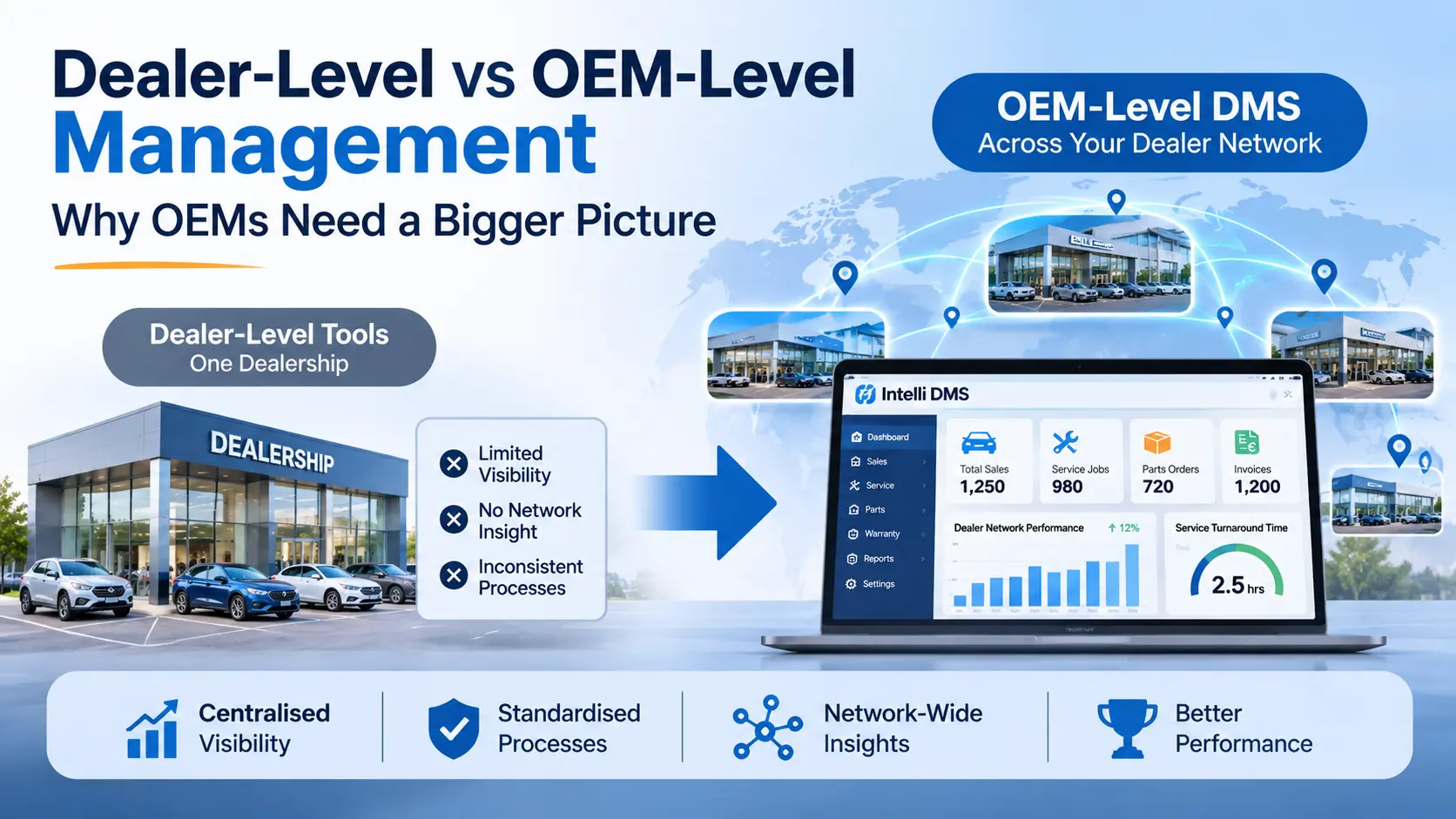
A conventional car dealer-level management software helps an individual dealership manage customers, sales transactions, workshop activities, inventory and billing.
An OEM has a different set of responsibilities that cover all the dealerships in the dealer network. They must coordinate multiple dealerships, maintain brand standards, monitor after-sales performance, and ensure that there is an exchange of information between dealers and the OEM’s central teams.
Consider a scenario where a single dealership adopts a digital job card solution, whereas another continues to depend on spreadsheets or manual paper logs. Although both sites handle their everyday tasks, the OEM struggles to accurately benchmark after-sales service metrics due to inconsistent data collection methods across locations.
The STAR Dealer Infrastructure Guidelines highlight the importance of communication and data exchange between dealership systems, technology providers and OEMs. This reflects that dealer systems must work together if OEMs want reliable network-level information.
This challenge is addressed by a network-oriented DMS by connecting dealer operations through shared workflows and a consistent data structure.
7 Things Dealer-Level Tools Can't Do for OEM Networks
Here are the seven things dealer-level tools cannot deliver on their own and why there is a need for OEM-level dealership management software.
1. Standardise Sales and Service Processes Across Every Dealership
Every dealership has its own way of handling its operations with its own management structure. If every dealership manages its operations in its own way, there would be no common system.
One dealer could have a structured process for customer enquiries and vehicle bookings, while another could be doing all these processes through spreadsheets or using separate CRM software.
From an OEM’s perspective, these differences can make it difficult to maintain consistency in these operational standards.
A DMS that operates at the network level allows the OEM to establish common workflows across the dealer network. Every dealer in the network can follow the same process for the following activities:
- Customer enquiry and follow-up.
- Test drive scheduling and vehicle bookings.
- Vehicle allocation and invoicing.
- Service appointments and vehicle check-in.
- Digital job card creation and repair tracking.
- Parts requests and inventory management.
- Service billing and customer follow-up.
This does not imply that all locations need to function identically in their daily tasks. Local market needs and specific dealership duties can easily be incorporated into these standardised operational processes.
How Intelli DMS helps: Intelli DMS helps OEMs implement a common platform for sales, service, parts and invoicing operations. This can be rolled out across the dealer network so all the dealers within the network work within a consistent operating procedure.
2. Provide Real-Time Visibility Across the Entire Dealer Network
Dealers using a dealer-level tool get information about their own performance. But OEMs need answers to broader questions
- Which dealers are generating the highest sales?
- Where are most service jobs getting delayed?
- Which locations have the most open job cards waiting for parts?
- How much business is being invoiced from each dealer?
- Which regions have service follow-up pending?
Information being collected through separate systems would mean that OEMs would have to wait for periodic emails, reports and manual updates from dealers. By the time an issue reaches the OEM, it has already affected the customers or dealer operations.
With a connected DMS, OEMs gain centralised visibility into dealer network activities. This enables central management teams to monitor operational performance across all locations and quickly address emerging issues.
How Intelli DMS helps: As Intelli DMS brings dealer sales, service, and parts information into a network-level dashboard, OEM teams can view invoicing, open job cards, parts stock and service reminder activities and help the dealers identify operational gaps earlier.
3. Enforce OEM Policies and Operating Standards
Every OEM establishes certain policies for how their dealer networks should handle customer interactions, vehicle sales, service and after-sales activities.
However, merely sharing a policy document does not ensure it will be followed across the dealer network.
Consider a scenario where an OEM establishes a mandatory vehicle intake workflow that mandates capturing mileage, fuel levels, and inspection photos. When a specific location diligently tracks every detail while another logs only minimal data, the manufacturer faces compromised, non-uniform service records across its operations.
A network-oriented dealership management software can ensure defined process requirements are part of the actual workflow. Dependence on manual instructions can be reduced with the help of mandatory fields, structured records, and approval stages.
How Intelli DMS helps: Intelli DMS helps dealers and OEMs with structured digital job cards that capture information such as odometer readings, fuel levels, photographs and labour details. It enables dealerships to maintain clear and complete service records within a common system.
4. Connect Sales, Service, Parts and Customer Information
In many dealerships, separate applications are used for sales, service and parts.
Sales teams use one system to maintain customer information and vehicle purchase details. A different platform is used by the service department for appointments and job cards. The parts team might use a different inventory tool to manage the stock.
This system creates information gaps.
Whenever a client comes in for maintenance, dealership personnel often spend time retrieving original sales records or re-entering client profile details. Workshop technicians opening new repair orders frequently lack real-time visibility into inventory stocks, while service advisors face challenges accessing comprehensive historical vehicle logs.
For OEMs, fragmented records increase the challenge of understanding the customer journey across the dealer network.
A connected DMS brings all these activities into a shared operating environment. Linked workflows can be used to access customer, service, vehicle, and parts information. This reduces repeated data entry and improves coordination.
How Intelli DMS helps: Intelli DMS connects sales, service, parts, invoicing and customer records. Dealerships can work with more consistent information through digital job cards, parts stock management, and customer service history capabilities.
5. Monitor Parts Availability Across Multiple Dealers
Parts availability directly impacts workshop operations and customer experience.
A vehicle could be waiting for a replacement part at a dealership, but the same part could be available at a different dealer in the same region. If stock information is not available across locations, the opportunity to coordinate for parts availability may be missed, resulting in delayed repairs.
This results in longer repair times, repeat customer visits, and unnecessary emergency orders.
A dealer-level tool can only help one dealer manage its own stock, but OEMs need a tool that helps them with a broader view of parts availability across the network.
A dealership management software that is connected can help OEMs and dealers identify:
- Parts stock levels by dealership.
- Parts required for open job cards.
- Items frequently unavailable across locations.
- Dealers holding stock that could be needed elsewhere.
- Potential stock imbalances across different regions.
This information enables OEMs to make data-backed decisions about stock replenishment and movement.
How Intelli DMS helps: Intelli DMS provides live parts stock visibility and catalog lookup information. It has a dashboard that can highlight parts lines that are currently out of stock against open job cards. This helps teams identify where availability of stock may delay service or repair work.
6. Benchmark Dealer Performance Using Consistent Data
Dealer benchmarking provides crucial insights to OEMs to help them understand why some locations perform better than others.
However, consistent data is required for meaningful comparison. If there are different reporting formats, service stages, or performance definitions used by dealers, the result of this comparison can often be misleading.
Consider a scenario where a single location logs a repair as finalised immediately following technical completion, whereas another site delays closure until final customer invoicing. Consequently, their documented service duration metrics evaluate fundamentally disparate operational milestones.
A network-oriented DMS creates a common foundation for performance measurement.
OEMs can use standardised information to review important indicators such as:
- Sales enquiries and conversion rates.
- Vehicle bookings and invoicing.
- Open job cards and service turnaround time.
- Parts availability against service demand.
- Service reminders and customer follow-ups.
- Dealer-level sales and after-sales performance.
The end goal is not just dealer ranking, but to identify locations where additional training, operational support or process improvements are required.
How Intelli DMS helps: Intelli DMS consolidates sales, service, and parts data across dealer locations. This provides OEMs with consistency in performance reviews and identifies dealers that may need extra support.
7. Integrate Dealer Operations With OEM Enterprise Systems
Rather than dealers working in isolation, they might need to connect with the OEM's ERP, warranty platform, electronic parts catalog platform, CRM and other business platforms.
In the absence of effective data exchange between these systems, employees might need to enter the same information multiple times. This not only increases administrative work but also creates data redundancy and errors.
Integration is crucial for OEMs with a large dealer network where information exchange between central systems and dealerships is essential.
The Infosys case study on DMS integration for an automotive OEM highlights how standardised interfaces enabled integration across a network exceeding 1,200 dealerships. This underscores the necessity of structured communication and data exchange between dealer systems and central OEM enterprise platforms.
The evaluation of a network-oriented DMS should be based on its ability to connect with existing systems, support reliable data exchange, and accommodate the OEM's technology architecture.
How Intelli DMS helps: Intelli DMS can integrate with enterprise platforms such as Oracle, SAP, and Microsoft Dynamics. It also supports both Microsoft Azure and on-premises deployment, depending on the OEM's needs.
What Should OEMs Look for in Car Dealership Management Software?
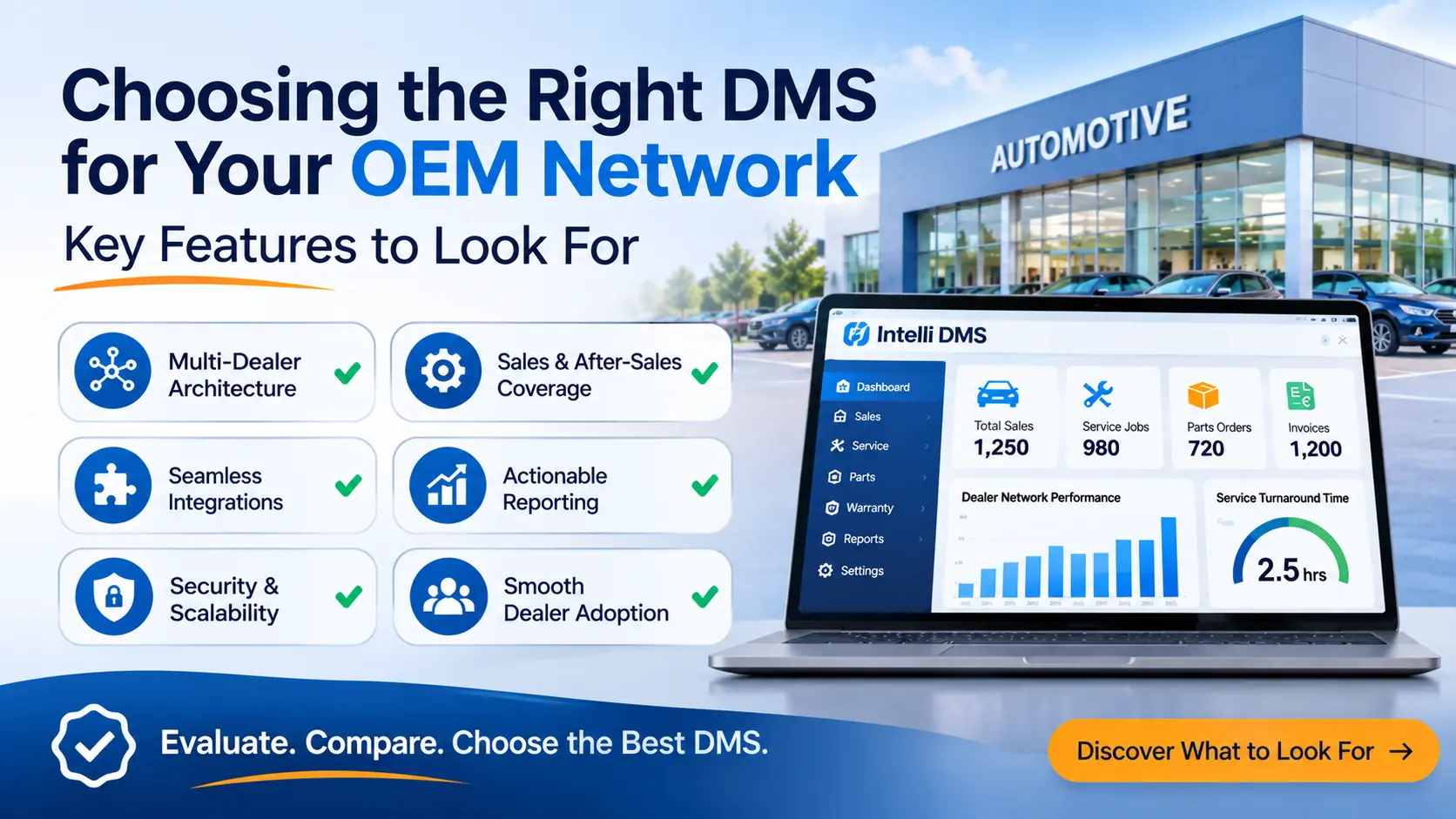
Selecting dealership management software for an entire OEM network demands a distinct perspective compared to evaluating tools for a single location.
Manufacturers must measure potential systems against their overarching, long-term strategic needs across every dealership site.
Network-Wide Architecture
It is important for OEMs to check if the dealership management software can support multiple dealers through a shared platform, with appropriate access for dealer staff and OEM teams.
Complete Sales and After-Sales Coverage
OEMs should look for connected workflows that cover customer enquiries, bookings, invoicing, service appointments, digital job cards, parts data and customer records.
Integration Flexibility
Evaluation should be done on available integrations with ERP, CRM, warranty systems, electronic parts catalog, and other OEM business applications. OEMs should confirm which integrations are available and which ones would require additional development work.
Reporting and Operational Visibility
The objective of a car dealership management software should be to provide useful dealer-level and network-level reporting. OEMs should ask the vendors to demonstrate how this information is updated and how it helps in the performance review across the dealer network.
Deployment, Security and Scalability
OEMs must evaluate deployment flexibility, such as cloud and on-premises options, system security measures, mobile access capabilities, multilingual functionality, and the overall framework for onboarding new dealership locations.
Dealer Adoption and Implementation
When all the dealers in the network don’t use a deployed system consistently, even a capable system will deliver limited value. OEMs should evaluate training, onboarding, support and availability of a phased rollout.
How Intelli DMS Supports OEM Dealer Networks
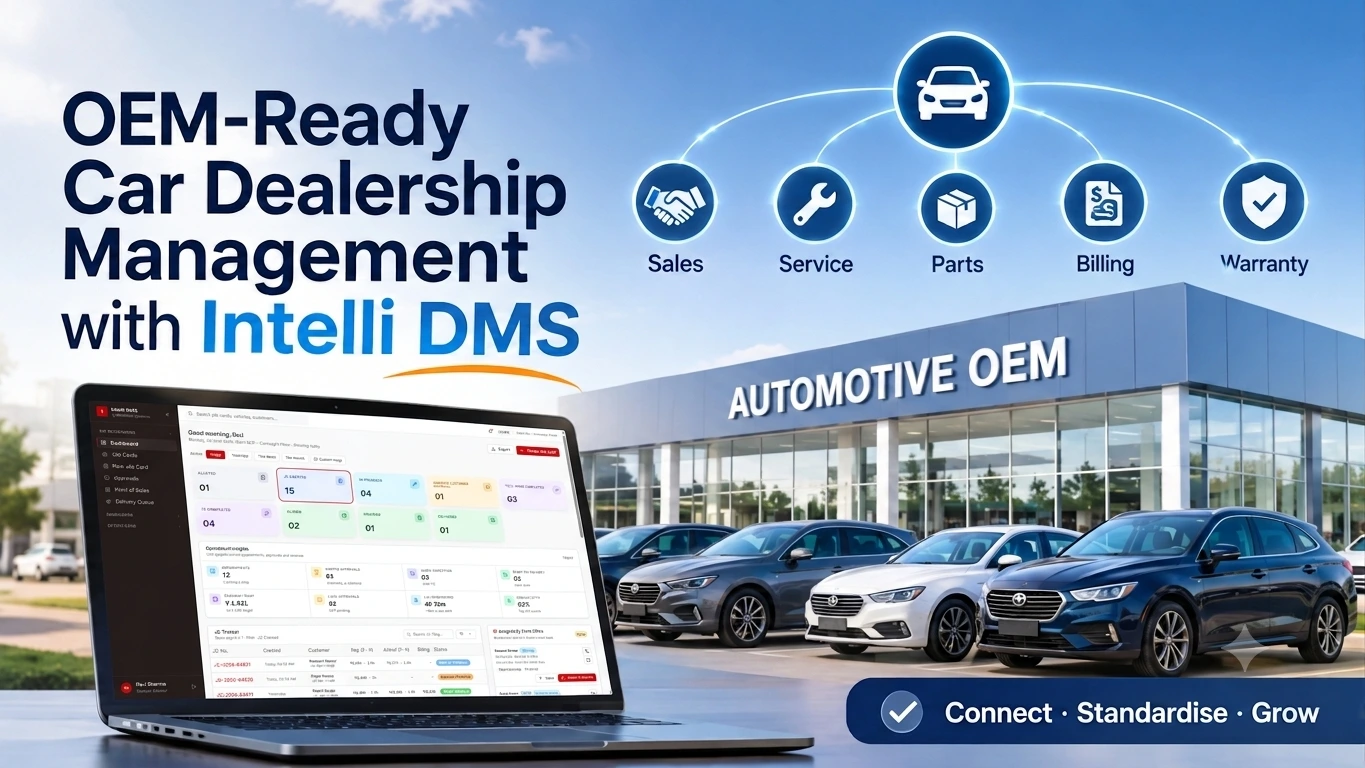
Intelli DMS is a cloud-based car dealership management software designed for OEMs to connect their dealer network and provide crucial insights about the dealer network performance.
This system doesn’t treat each dealership as a separate operating environment. It helps connect sales, service, parts, invoicing, and customer records into a common, unified system.
Below are the capabilities of Intelli DMS:
- Sales and training: It helps manage dealership sales activities and invoicing workflows.
- Digital job cards: It enables the service technicians to record vehicle details, odometer readings, fuel levels, photographs and labour details.
- AI-powered vehicle check-in: Intelli DMS supports vehicle damage identification and documentation at vehicle check-in through its AI offering.
- Parts stock management: It enables OEMs and dealers to track stock availability and connect parts information with catalog lookup.
- Customer records: With Intelli DMS, service histories and support reminders through SMS, WhatsApp and email can be maintained.
- ERP integration: Intelli DMS offers integration capabilities with SAP, Oracle and Microsoft Dynamics.
- Mobile access: It supports dealership staff and technicians with access to the platform through web, Android and iOS applications.
- OEM dashboards: Intelli DMS provides consolidated visibility into dealer invoicing, open job cards, parts availability and service activities.
Intelli DMS supports multiple deployment options as per the OEM’s requirements.
OEMs that are seeking to standardise dealership operations, improve data visibility and connect sales and after-sales workflows can evaluate Intelli DMS, as it supports all these requirements and offers a common platform for managing the entire dealer network.
Explore Our Complete Dealer Management System Guide to discover key features, benefits, and insights that can help you streamline dealer operations and drive business growth.
Conclusion
Dealer-level tools can help dealers manage daily operational activities of an individual dealership. However, OEMs have a broader responsibility and need to coordinate multiple dealers across different locations. They need to maintain consistent processes, monitor performance, and ensure reliable information exchange across the network.
The absence of a connected platform would lead to OEMs struggling with fragmented records, inconsistent workflows, limited parts visibility and delayed reporting.
OEM-oriented car dealership management software addresses all these challenges by connecting dealers through common processes and shared operational data.
Intelli DMS, a cloud-based car dealership management software, brings sales, service, parts, invoicing and customer records together and provides central teams with a consolidated view of dealer operations.
For OEMs that are looking to move beyond disconnected dealer-level tools and fragmented records, Intelli DMS can be a great value addition, as it provides a structured foundation for managing a more connected and consistent dealer network.
Connect dealership sales, service, digital job cards, parts inventory, invoicing, and customer records through one unified platform. Talk to a consultant.
Frequently Asked Questions
What is car dealership management software?
Car dealership management software is a digital platform that helps manage dealership activities such as sales, vehicle bookings, service operations, parts inventory and invoicing. For OEMs, opting for a network-oriented DMS also provides visibility into the entire dealer network across multiple dealerships.
How is an OEM DMS different from a dealer-level DMS?
A dealer-level DMS primarily helps manage the daily operational activities of an individual dealership. An OEM-oriented DMS helps connect multiple dealerships through common workflows, shared data, and centralised reporting structures. This gives OEMs a broader view of network performance.
Does Intelli DMS support multiple dealerships?
Yes. Intelli DMS is a network-oriented car dealership management software that is designed for OEMs managing multiple dealerships. It provides a common platform for sales, service, parts, and invoicing. It also enables OEMs to have consolidated operational visibility across the network.
Can a DMS connect sales, service and parts operations?
Yes. A connected DMS can link customer and vehicle information with sales, service, job cards, parts information and invoicing operations.

Nishant Sharma is the Head of Demand Generation at Intellinet Systems, specializing in B2B marketing, sales, digital transformation, and automotive aftermarket solutions. He shares insights on emerging technologies, industry trends, and strategies that help OEMs and businesses improve operational efficiency, customer experience, and aftermarket growth.