


For decades, OEM warranty management was built around one type of vehicle: the combustion engine. Thousands of mechanical parts, well-known repair methods, and years of cost data to work with. Then electric vehicles arrived, and everything had to change.
EV warranty management is not just the same process applied to a different powertrain. It is a completely different job. The types of claims are different. The data needed to check those claims is different. The chain of suppliers involved is different. The legal requirements are different. And the money at stake, with high-voltage battery packs costing between £8,000 and £12,000 to replace, is on a completely different level.
Speaking of the cost gap: EV warranty claims are, on average, 26 to 50% higher than comparable ICE vehicle claims, according to two separate studies by Warranty Solutions Group (WSG) covering thousands of real-world claims between 2022 and 2025. That gap does not close on its own. It requires a warranty management system built for the EV era, not an older platform with a battery field added on.
In this blog, we explain the key differences between EV warranty management and traditional ICE warranty management, the challenges OEMs need to prepare for, and what a modern warranty platform must be able to handle.
1. Fewer Parts, But Much Higher Costs
A petrol or diesel car is a maze of moving mechanical parts, while an electric vehicle runs on a fraction of that complexity. At first glance, that looks like a warranty win. In practice, it creates a very different kind of risk.
ICE warranty claims are frequent but relatively affordable. A broken sensor, a worn gasket, a faulty fuel injector. These are common, well-understood repairs with pricing built up over many years. EV warranty claims happen less often, but when they do, the cost is much higher. The main reason is the battery.
According to a WSG analysis of 800 EV warranty claims paid between August 2023 and August 2024, the most common issues include battery charge control modules (averaging £1,311 to fix), power distribution boxes (£747), and warning light faults (£875). Battery replacement for standard EVs typically costs between £8,000 and £12,000.
Key Stat
EV warranty claims are 26 to 50% higher on average than comparable ICE claims. Battery replacement alone costs £8,000 to £12,000 per vehicle.
What this means for OEMs is straightforward: one EV battery claim can cost more than ten ICE claims put together. A warranty management system that cannot track battery health, spot unusual wear patterns, or automatically chase supplier reimbursements is leaving a serious financial hole unmanaged.

2. Connected Vehicle Data Changes How Claims Are Checked
When a dealer submits an ICE warranty claim, the process is mostly manual. A technician looks at the part, writes down the labour hours, and sends in a claim with a part code. The information used is limited: odometer reading, VIN, labour code, and repair cost.
EV warranty management works in a much richer data environment. A connected electric vehicle constantly records information that is directly useful for checking warranty claims: battery state of health (a measure of how much capacity the battery still has), charge cycle count, heat events, charging speed and pattern, GPS location at the time of the fault, and which software version was running when the problem occurred.
This data is valuable, but only if your warranty management system can actually use it. OEMs without telematics-linked warranty platforms are sitting on a large amount of useful fraud-prevention and fault-diagnosis data that never reaches the claims team.
In 2026, leading OEMs are using telematics data to check claims before a technician even opens the bonnet. If the vehicle's own data shows the battery wore down at a normal rate, the claim gets flagged before it is approved. If the mileage on the claim does not match what the vehicle recorded, the fraud detection system automatically escalates it. This is the new standard for EV warranty management.
3. Software Warranties: Something ICE Vehicles Never Had

EVs are, in many ways, software products that happen to have wheels. Over-the-air (OTA) updates can change driving range, charging speed, how the brakes regenerate power, and how the vehicle performs, all without the owner visiting a dealer. This creates a warranty question that does not exist in the ICE world.
When an EV owner reports that their range has dropped, is that a battery problem that should be covered under warranty? Or was it caused by a recent software update, a change in how they charge the car, or very cold weather? The answer determines whether the OEM pays for the repair. Getting that answer right requires warranty software that can check telematics data, software version history, and the claim information all at the same time.
Manufacturers can also push software updates that change how a vehicle performs, and those changes do not automatically create a warranty obligation. OEMs need clear policy settings in their warranty platform to define exactly which software-related issues are covered, which are not, and how those decisions are applied consistently across their entire dealer network.
ICE vs EV Warranty Management: Comparison
The table below sets out the main practical differences OEMs need to account for when managing warranty across a mixed or fully electric fleet.
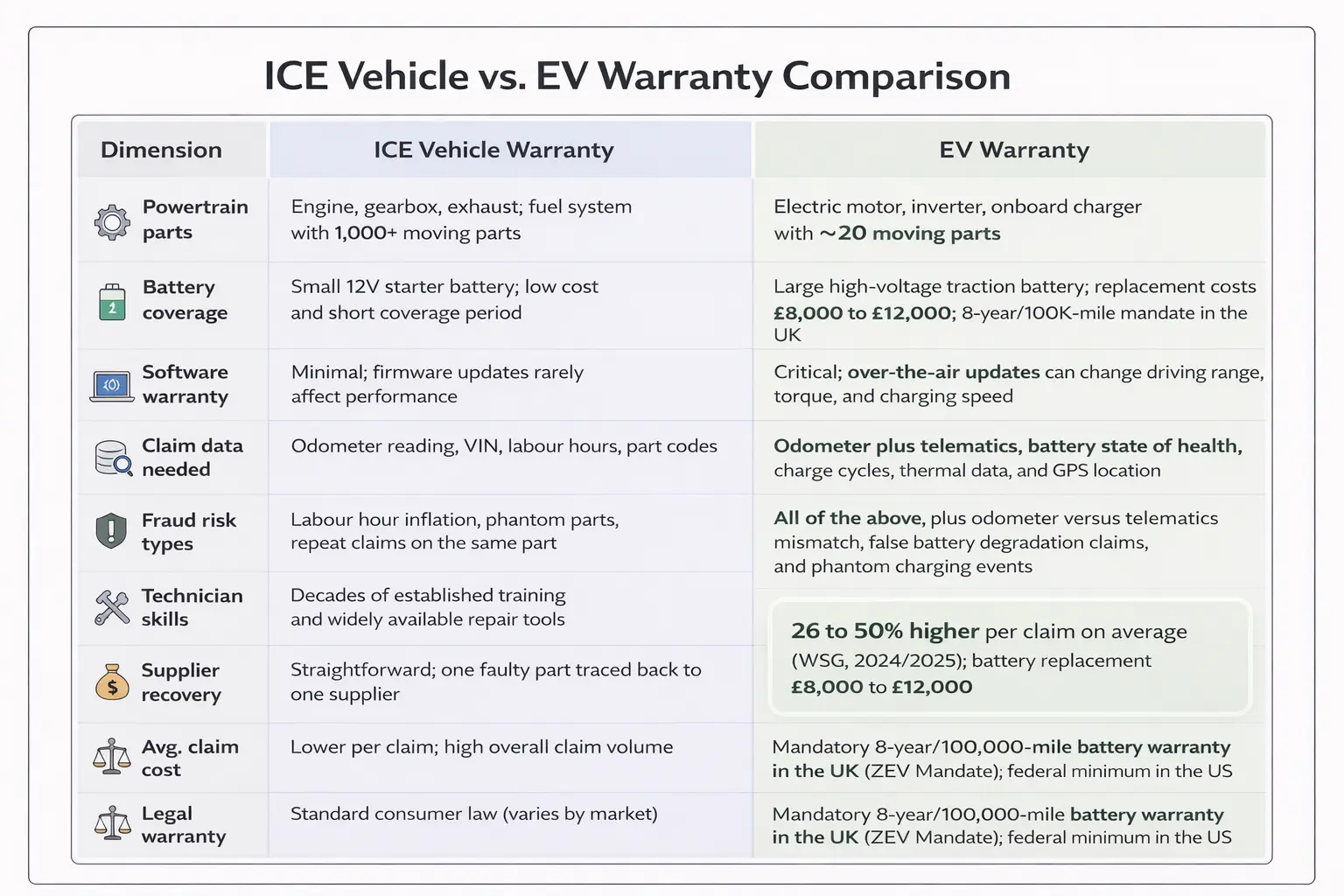
The Four Biggest Electric Vehicle Warranty Challenges for OEMs
Beyond the structural differences above, EV warranty management brings four specific challenges that systems built for ICE vehicles are simply not set up to handle.
Challenge 1: Battery Wear Claims
Battery capacity loss is a normal part of owning an EV. But under the UK ZEV Mandate, OEMs must guarantee that a battery does not fall below 70% of its original capacity within 8 years or 100,000 miles. When an owner claims their battery has dropped below that level, checking the claim properly requires historical capacity data, charge cycle records, and heat event history. No manual process can do this reliably at scale. A warranty management system with battery data built in is not a nice extra; it is the minimum requirement for ZEV Mandate compliance. See the UK Government ZEV Mandate guidance for full details.
Challenge 2: Complex Supplier Recovery
In ICE warranty management, chasing a supplier for reimbursement is difficult but relatively straightforward. A faulty part is traced back to one supplier, and a recovery claim is raised. In EV warranty management, a single battery fault can involve the company that made the cells, the vendor of the battery management software, the supplier of the thermal system, and the company that assembled the pack, all in the same claim. Without automated supplier claim creation, OEMs miss recovery money because the manual process cannot keep up with the complexity or the deadlines.
Challenge 3: Not Enough Trained EV Technicians
According to ADAC's 2025 breakdown analysis covering 3.6 million roadside callouts, ICE vehicles aged 2 to 4 years broke down 2.5 times more often than equivalent EVs (9.4 incidents per 1,000 ICE vehicles versus 3.8 for EVs). The mechanical reliability is improving. But the network of technicians trained to fix EVs when they do go wrong has not kept pace. This means claim checks take longer, labour cost benchmarks are harder to set, and the risk of inflated labour claims is higher. Warranty software needs to hold EV-specific labour rate benchmarks and flag anything that looks out of line.
Challenge 4: New Types of Fraud
ICE warranty fraud follows familiar patterns: inflated labour hours, parts that were never fitted, and the same component claimed multiple times. EV warranty fraud brings entirely new patterns. These include false battery wear claims designed to trigger an early replacement, odometer readings that do not match what the vehicle's own data shows, and the same repair claimed through two different service networks. OEMs need an AI fraud detection system built around EV-specific warning signs, not just the old ICE rules applied to a new type of vehicle.
How Intelli Warranty Handles EV Warranty Management
Intelli Warranty is built for the level of complexity that EV product lines bring. It goes beyond processing claims to cover the full EV warranty lifecycle: setting up policy rules, managing dealer claim submissions, detecting fraud with AI, automating supplier recovery, and providing real-time reporting.
- Battery Warranty Policy Setup: Define EV-specific coverage terms, battery capacity thresholds, and warranty period rules by model, including full support for UK ZEV Mandate compliance requirements.
- Telematics-Linked Claim Checking: Cross-check dealer claims against vehicle telematics data, including battery state of health, charge cycle history, heat events, and odometer readings, to approve or flag claims before payment.
- AI Fraud Detection with EV Parameters: More than 25 fraud detection signals, including odometer versus telematics mismatch, false battery wear patterns, duplicate image detection, and claims submitted close to the end of the warranty period.
- Automated Supplier Recovery: When a dealer claim is approved, Intelli Warranty automatically creates the supplier recovery claim, including multi-party battery supply chain claims, within the required filing window.
- Intelli Insights Dashboards: Detailed reports on EV claim trends, battery fault rates by model, dealer performance, and supplier recovery totals, giving your After-Sales leadership team the information needed to act before costs grow.

The best part: Intelli Warranty manages both EV and ICE warranties in one platform. OEMs with mixed fleets do not need two separate systems. They need one system that is capable enough for EV complexity and fast enough for ICE scale.
Conclusion
Moving to electric vehicles is not just a change of powertrain. It is a complete change in how warranty management has to work. OEMs that keep using ICE-era systems to handle EV claims will face higher costs, slower resolutions, missed supplier recovery money, and growing legal risk as battery warranty rules tighten.
The gap between ICE and EV warranty management comes down to data complexity, the size of the costs involved, legal obligations, and new fraud patterns. All of these require a warranty platform built for the EV world. Intelli Warranty delivers exactly that.
Book a free demo to streamline your EV and ICE warranty management operations with AI-powered Intelli Warranty.
Frequently Asked Questions
What is EV warranty management?
EV warranty management is the process of setting up, checking, and resolving warranty claims for electric vehicles. It is different from ICE warranty management because it requires telematics data and battery health records.
How does AI improve EV warranty fraud detection?
AI-powered warranty fraud detection checks EV claims against more than 25 specific warning signs, including odometer versus telematics mismatch, false battery wear claim patterns, phantom charging event identification, and image analysis.
Can one warranty management system handle both ICE and EV vehicles?
Yes. A modern warranty management platform like Intelli Warranty supports both ICE and EV policies within a single system, with model-specific settings for coverage terms, data inputs, and supplier recovery workflows.
Do EVs have fewer spare parts than ICE vehicles?
Correct. You change fewer parts in EVs. Common ICE parts, like fuel pumps, gearboxes, and exhausts, are absent. EVs focus on batteries as well as controls. This way, they reduce regular maintenance needs.
Do EV batteries need frequent replacement?
Not really. Most batteries last 6 to 8 years and come with warranties.


Explore More Insights





.webp)


About the Author


Chandra Shekhar
Chandra Shekhar is the Senior Manager, Strategy & Business Development at Intellinet Systems. With over a decade of experience in the automotive industry, Chandra Shekhar has led digital transformation and aftersales strategy initiatives for OEMs across multiple markets. His background combines deep industry knowledge with a practical understanding of how technology can solve real operational challenges. He focuses on making complex ideas clear and relevant for automotive and aftermarket professionals navigating ongoing change.


