


Aftermarket parts revenue is one of the most reliable income streams an OEM can build. However, most of these OEMS have a real problem hiding in plain sight. The distributor is stocking parts, the field team is visiting retailers, the orders are flowing, but genuine parts sales are not growing in proportion to that demand.
The gap is neither the product quality nor the pricing. It is the distribution system itself.
Between the OEM and the retailer who ultimately sells a part to an end customer, there are distributors, field sales teams, order entry processes, pricing communications, and inventory management workflows. When these steps run on manual processes, calls, emails, or spreadsheets, it introduces delays, errors, and data gaps that cost the OEM genuine sales at every point.
Say, for example, when retailers place orders by calling a distributor or waiting for a sales rep to visit, order frequency drops. When part pricing is communicated through email or printed sheets, price disputes and confusion slow down the transactions. When the OEM gets secondary sales through monthly distributor reports, the information is too late to act on.
A distributor management system closes those gaps and changes how orders move, data flows, and how field teams operate. For OEMs focused on aftermarket parts sales growth, it is one of the most direct levers available. This post explains why.
The Market Is Growing. Genuine Parts Capture Depends on Distribution.
The global automotive aftermarket reached USD 489.45 billion in 2025 and is projected to grow to USD 643.78 billion by 2033, at a CAGR of 3.4%. In North America alone, the market was valued at USD 137.53 billion in 2025, according to Fortune Business Insights.
Genuine parts hold the leading segment position in this market. But that position is not guaranteed. Non-genuine alternatives are actively competing for retail shelf space. The Automotive Aftermarket Suppliers Association (AASA) has estimated the US industry loses around $3 billion annually to counterfeit parts, with global losses estimated at $12 billion.
When a retailer cannot find the right part quickly through a distributor, or when an order takes days to process, they move to an alternative third-party supplier. Every delayed, missed, or incorrect order is a sales opportunity shifted to a competitor. That is a distribution infrastructure problem, not a product problem.
Where the Distribution System Loses Genuine Parts Sales

1. Ordering Is Too Dependent on Visit Frequency
In most OEM secondary networks, retailers place orders when a sales representative visits them. In practice, it means a retailer who needs a part on a Tuesday morning, after a field representative’s Monday visit, waits for the next scheduled call to order the part. That can be one-to-two days/week delay. During that window, the retailer orders by calling a third-party vendor on a same-day delivery basis.
To increase genuine parts sales, the ordering process needs to be available whenever the retailer needs to place an order, not just when a field representative shows up.
2. Wrong Parts, Wrong Quantities
Part catalog complexity is a real barrier. Automotive, farm equipment, and construction OEMs manage SKU catalogs with thousands of items across multiple models and equipment generations. When a retailer or field rep searches by memory or a printed catalog, misidentification happens. Wrong parts get ordered, received, and returned. That cycle costs both the distributor and the OEM money, and erodes retailers' confidence in the genuine parts ordering channel.
With Intelli Catalog, VIN-based lookup, barcode scanning, and figure-based part identification directly reduce wrong parts order rate. When a retailer can identify the right part the first time with confidence, they order more frequently and with less hesitation.
3. No Real-Time Pricing
OEMs revise parts pricing regularly. Promotional discounts are time-sensitive. When price changes are communicated through email or printed sheets, inconsistencies build up, leading to different price lists for different retailers and distributors. The result is invoice disputes, delayed payment collection, and a secondary channel that feels unreliable to the retailer.
4. Late Secondary Sales Data Means Missed Revenue Signals
Most OEMs receive secondary sales data through monthly distributor reports. By the time a demand signal, such as a surge in a specific part in a specific region, appears in that data, the window to respond has often closed. Fast- moving parts in specific regions go undetected until a stockout has already occurred. This makes retailers source the stockout parts from third-party vendors. Moreover, slow-moving stock accumulates without triggering a promotional response.
Decisions that depend on up-to-date demand signals, including inventory positioning, pricing adjustments, and promotional campaigns, are made on last month's numbers.
Increasing OEM parts sales requires the ability to see demand as it builds, not weeks after the fact. Real-time order data turns a reactive distribution system into a proactive one.
Related Read - 7 Signs Your Distributor Network Needs a Management System Before Revenue Loss
How Sales Through a Distributor Management System Resolves These Gaps

A well-built distributor management system addresses each of these gaps in a connected way. Here is what it looks like in practice.
24/7 Mobile Ordering
Retailers place orders through a mobile app, at any time of day, without waiting for a rep visit. Orders are submitted directly into the OEM's workflow. This removes the single biggest constraint on order frequency: the field representative visit schedule.
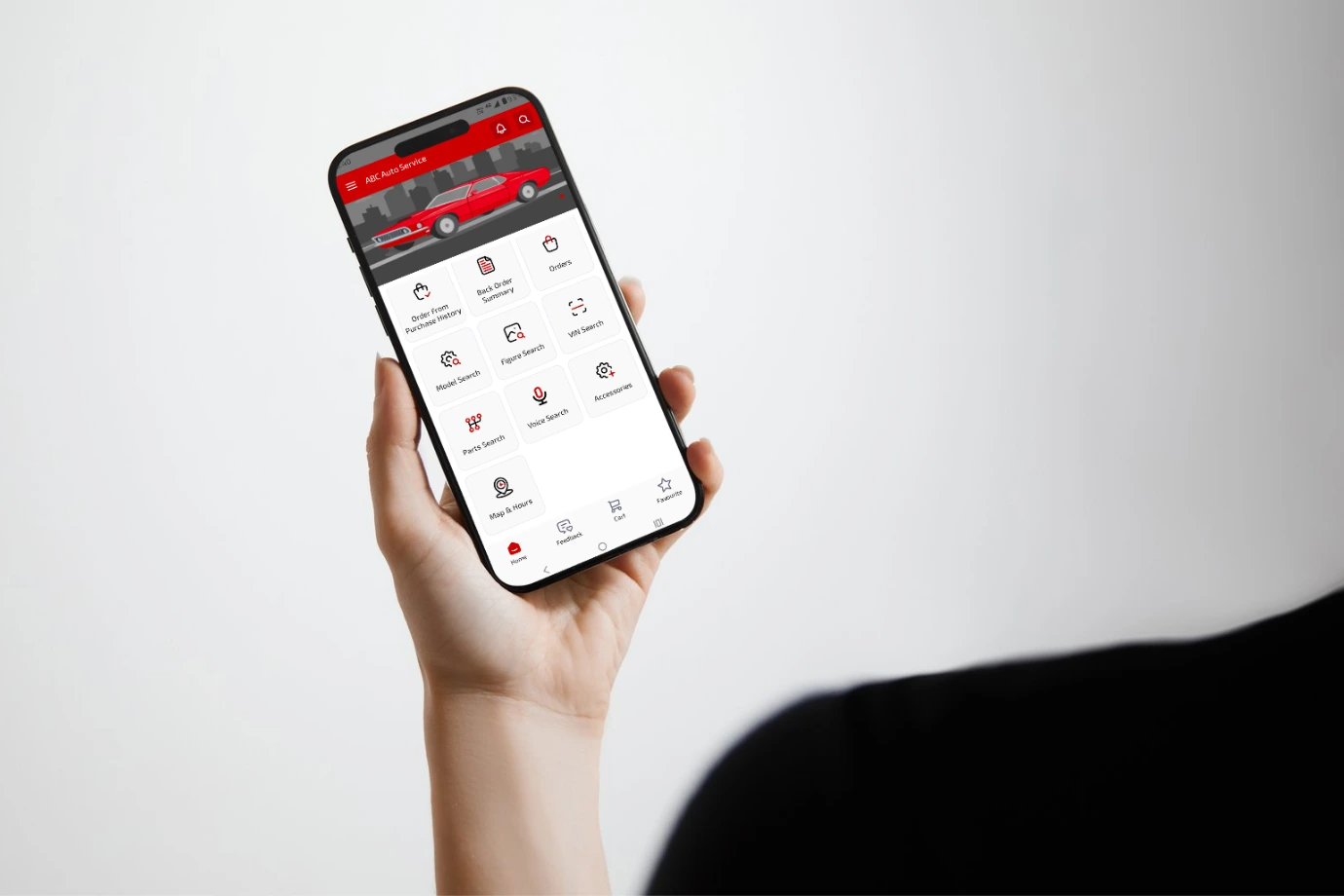
Intelli Commerce, developed for OEM secondary sales networks, puts the full ordering interface on a mobile app. Retailers in automotive, farm equipment, construction machinery, and industrial equipment networks can browse catalogs, place orders, and track fulfilment status in one place. The ordering cycle is no longer gated by when a field representative is physically present.
Multi-Mode Parts Search Reduces Order Errors
Intelli Commerce lets retailers search parts by part number, part name, equipment model, VIN/ barcode scan, or figure/diagram. This reduces the rate of incorrect part identification, which is the primary reason for order errors and returns. Retailers can also reorder from purchase history or browse top-part recommendations, which speeds up routine replenishment cycles and keeps order volumes consistent.
Centralized Pricing and Promotions
Pricing is set once in the system and automatically applied at the point of order across every retailer in the network. When an OEM updates a price or launches a promotional campaign, every distributor and retailer sees it immediately on the distributor management system. There is no version lag, no conflicting price lists, no disputes about which rate applied to which order.
OEMs and distributors can also run targeted promotions on slow-moving inventory through Intelli Commerce, turning dead stock into a revenue opportunity rather than a carrying cost.
Real-Time Secondary Sales Visibility
Every order placed through the mobile or web app appears at OEM headquarters in real time. Sales leaders see volume by region, by distributor, by part category, and by individual retailer. Demand signals that used to take weeks to appear in a monthly report are now visible the day they occur. OEMs can see demand signals before stockouts occur and respond to slow-moving inventory before it becomes dead stock.
Intelli Commerce also provides region-wise overlays of sales data and units in operation, giving aftermarket teams a data foundation for decisions about where to add distributor capacity, how to allocate promotional budgets, and which SKUs need repositioning.
AI-Powered Field Productivity
Sales executives using Intelli Commerce arrive at retailer visits with AI-generated talking points built from the retailer's past order data, slow-moving inventory, and active promotions. Instead of visiting a retailer without preparation, each visit of a sales rep is specific with data-backed content like parts retailers haven’t ordered in a long time, promotions relevant to the retailer’s purchase pattern. This increases both the quality and the commercial outcome of each field call without increasing headcount.
Geolocation-based attendance tracking and smart route optimization reduce the time field reps spend traveling and increase the number of productive calls per day.
ERP Integration Closes the Loop
Orders placed through the mobile or web app create records directly in the OEM's ERP system. Dispatch details from the ERP flow back to the Intelli Commerce app, giving retailers a single, accurate view of fulfilment status. Inventory and planning teams work from actual secondary sales data, not just primary purchase volumes from distributors. Moreover, Intelli Commerce can be integrated with the OEM’s existing ERP systems.
What the Business Impact Looks Like

The connection between Intelli Commerce, an OEM distributor management system, and genuine parts revenue is not theoretical. It follows directly from how orders get placed.
- Higher order frequency means more parts sold per retailer per month.
- Lower error rates mean fewer returns and more trust in the ordering process.
- Real-time demand signals mean inventory is in the right location when demand spikes.
- Faster promotional execution means slow-moving stock converts to revenue rather than remaining a carrying cost.
Each of these outcomes is a function of how the distribution system operates. A distributor management system that fixes the friction points in order placement, part identification, pricing, and data flow converts the latent demand in the existing retailer network into actual, genuine parts sales.
Where to Start
The starting point for any OEM evaluating its distribution system is data: how often are retailers ordering, what is the return rate, how long does order-to-fulfillment take, and what percentage of secondary sales data reaches headquarters in real time. Those four numbers will identify where the system is losing genuine parts revenue.
An OEM that fixes these operational gaps builds a secondary channel that actively grows genuine parts sales, rather than one that captures only a fraction of the available demand.
For US-based OEM aftermarket leaders evaluating their distribution infrastructure, the starting point is understanding exactly where the current system is creating friction and where the revenue gap sits. A structured look at secondary sales data, ordering frequency, and distributor performance against a platform like Intelli Commerce will identify that quickly.
To see how Intelli Commerce maps to your distributor network structure, schedule a demo.


Explore More Insights







.webp)


About the Author


Chandra Shekhar
Chandra Shekhar is the Senior Manager, Strategy & Business Development at Intellinet Systems. With over a decade of experience in the automotive industry, Chandra Shekhar has led digital transformation and aftersales strategy initiatives for OEMs across multiple markets. His background combines deep industry knowledge with a practical understanding of how technology can solve real operational challenges. He focuses on making complex ideas clear and relevant for automotive and aftermarket professionals navigating ongoing change.


