

A distributor management system is a comprehensive ecosystem for OEMs to manage secondary sales networks, including distributors, retailers, and field teams. This mobile-based system digitises the order flow from retailer to ERP, controls distributor-retailer mapping, and presents OEMs with real-time secondary sales data.
This article serves as an expert guide to the distributor management system. We will cover the challenges OEMs face without a structured distributor management system, and the operational benefits of a well-engineered platform like Intelli Commerce. We will explore the core capabilities of the distributor network management system, from multi-mode search to integrated cart and seamless checkout.
What is a Distributor Management System?
A distributor management system is a platform that enables retailers to place orders directly through mobile apps and makes those orders visible to OEM headquarters in real-time. It is the operational backbone that connects every node of the OEM’s secondary sales network, including distributors, retailers, and field representatives.
At its core, a distributor management system replaces the chaos of phone calls, manual Excel entries, WhatsApp messages, and delayed reporting that plagues unmanaged distribution networks. A well-engineered distributor management system eliminates these friction points and replaces them with a structured, data-driven workflow.
For OEMs operating in automotive, agriculture, construction, industrial equipment, and other industries with multiple models and multiple deliveries, the scale of the distributor network makes manual management not just inefficient but commercially dangerous. Managing secondary sales across such a vast ecosystem of distributors and retailers without a digital system is virtually impossible for OEMs.
Intelli Commerce, a reputed distributor management system, addresses this by serving three distinct audiences simultaneously. The retailer who needs an easy ordering experience through a mobile app, the distributor who needs inventory and claims visibility, and the OEM who needs real-time data on what is selling, where, and at what pace to plan inventory and price accurately.
The Hidden Cost of an Unmanaged Distributor Network
Before exploring what Intelli Commerce delivers, it is worth understanding what OEMs lose when their distributor network management system is inadequate or relies on the field sales executive to place parts orders. The consequences are not abstract; they manifest as revenue leakage, poor customer experience, pricing inconsistencies, overstocks and stockouts, and decision-making based on inconsistent data.
1. No Visibility into Secondary Sales
The most damaging gap in an unmanaged distribution network is the loss of secondary sales visibility. In the secondary sales network, orders flow from retailers to distributors and then to the OEM. The OEM sees only what the distributor reports and chooses to share, at the frequency and detail the distributor chose to provide. This means if a distributor receives 500 units of a spare part but only 200 move to retailers in the quarter, the OEM has no way of knowing. What the retailer is actually ordering, from which distributor, at what price and volume, is invisible to the OEM.
With unreported and inconsistent data, OEMs lose visibility into demand trends, struggle with overstocking at some nodes and stockouts at others, and cannot even detect when retailers move to non-genuine parts outside the official channel.
2. Order Errors and Processing Delays
In OEM networks where retailers still call or message distributors or field representatives to place orders, errors are inevitable. Part numbers get confused, quantities are misheard, and orders placed after business hours sit unprocessed until the next day. Each of these delays has a compounding effect: the retailer is out of stock, the end customer goes to a third-party vendor, and the OEM loses a sale that never even appeared in their system.
Manual order processing also creates reconciliation problems. When orders pass through multiple hands: retailer to field rep to distributor to OEM, there are multiple points at which data can be lost, misrecorded, or duplicated. The manual collection of orders from retailers can severely impact inventory accuracy, allowing non-genuine parts suppliers to exploit the gaps created due to order errors.
3. Distributor- Retailer Mapping
Without a structured OEM distributor management platform, the mapping between distributors and their assigned retailers is typically maintained in spreadsheets, emails, or, worse, in people's heads, or is not at all defined.
When the mapping of which distributor serves which retailer is not enforced, distributors may compete for the same retailers, pricing consistency breaks, and order accountability becomes difficult to maintain.
Moreover, when field executives change, or territories are reorganised, or new retailers are onboarded, the spreadsheet and email mapping become unreliable. This leads to the governance problem as OEMs end up with retailers placing orders from the wrong distributors based on price and convenience, bypassing assigned territories, or falling through the cracks entirely.
4. Pricing Inconsistencies Create Disputes Across OEM Network
Parts prices change frequently. OEMs' part price revisions, regional pricing structures, promotional campaigns, and currency fluctuation all require distributors' and retailers' price lists to be updated instantly across the network. When this is communicated manually through printed price sheets or email, it leads to different price lists for different retailers and distributors.
The result is invoice disputes, delayed payment collection, and a secondary channel that looks unreliable to retailers. Resolving these disputes manually pulls account management time away from sales activity. For OEMs with large SKU catalogs and multiple distributor tiers, the scale of this problem is significant.
5. Slow, Reactive Decision-Making
Traditional distribution reporting is monthly at best. By the time an OEM's sales team analyses the data and responds to a market signal, say, an increase in demand for a particular spare part in a specific region, the window has closed. A competitor with a faster distribution system has already captured the demand, and the OEM is left managing the fallout: frustrated retailers, dissatisfied end customers, and a missed revenue opportunity.
This pattern holds across every segment. An industrial equipment OEM misses a regional demand spike for a high-margin consumable. A farm equipment distributor runs out of a critical wear part mid-harvest because the signal never reached the OEM in time. An EV service network cannot respond to a parts demand surge from a new model rollout because reporting cycles are too slow. Without a structured distributor network management system, OEMs are always reacting to problems rather than preventing them.
6. Stockouts and Excess Inventory Coexist
One of the most commercially damaging distributor network challenges is the simultaneous occurrence of stockouts and overstock within the same network. While one distributor holds excess inventory of slow-moving parts, another is out of stock on a fast-moving item that retailers actively demand.
Neither situation is visible to the OEM in real time. The OEM continues shipping on the same flawed assumptions, pushing more inventory into already overstocked nodes while understocked distributors keep losing sales to alternative suppliers. The disconnect between supply and demand worsens with every order cycle, and without retailer-level data flowing back to headquarters, there is no mechanism to correct it.
7. Distributor and Field Team Performance Is Difficult to Evaluate
When an OEM does not have data on what retailers are actually ordering, the only number available to judge a distributor is how much that distributor purchased from the OEM. But that number only tells what was left in the OEM's warehouse. It does not tell whether those parts reached retailers, whether retailers are buying them or skipping them, or whether retailers have started ordering from a third-party supplier instead.
A distributor can show strong primary purchase numbers and still be failing at the retail level. The OEM has no way to know.
The same blind spot applies to field sales teams. If there is no system tracking when a sales representative visited a retailer, where they were, and how long they stayed, the OEM is taking their word for it. There is no way to confirm whether visits actually happened, whether the field executive is spending time at the right retailers, or whether the conversation covered the products and promotions the OEM intended.
It usually means the OEM is paying for distributor stock-up and field team activity, but has no visibility into whether those investments are converting into actual retail sales.
Intelli Commerce: Purpose-Built for OEM Distributor Networks

Intelli Commerce by Intellinet Systems is a mobile-based distributor management system designed specifically for the operational realities of OEM secondary sales networks. It is not a generic CRM or a repurposed ERP module; it is built from the ground up for the workflows that define the OEM-distributor-retailer relationship. The platform is actively deployed across industries, including automotive, agriculture, construction equipment, aerospace, industrial equipment, and electric vehicles.
What distinguishes Intelli Commerce from conventional tools is its approach to the ordering experience. Rather than requiring distributors or field teams to log into a desktop portal and navigate complex interfaces, Intelli Commerce puts the entire ordering workflow in a mobile app. This design decision matters enormously in practice: field teams operate in the field, not at desks, and a mobile-first system meets them where they are.
Interested in seeing Intelli Commerce integration in action? Book Free Demo.
Core Capabilities of Intelli Commerce
Intelli Commerce, a well-engineered distributor management system, has several core capabilities.
Mobile-First Order Placement
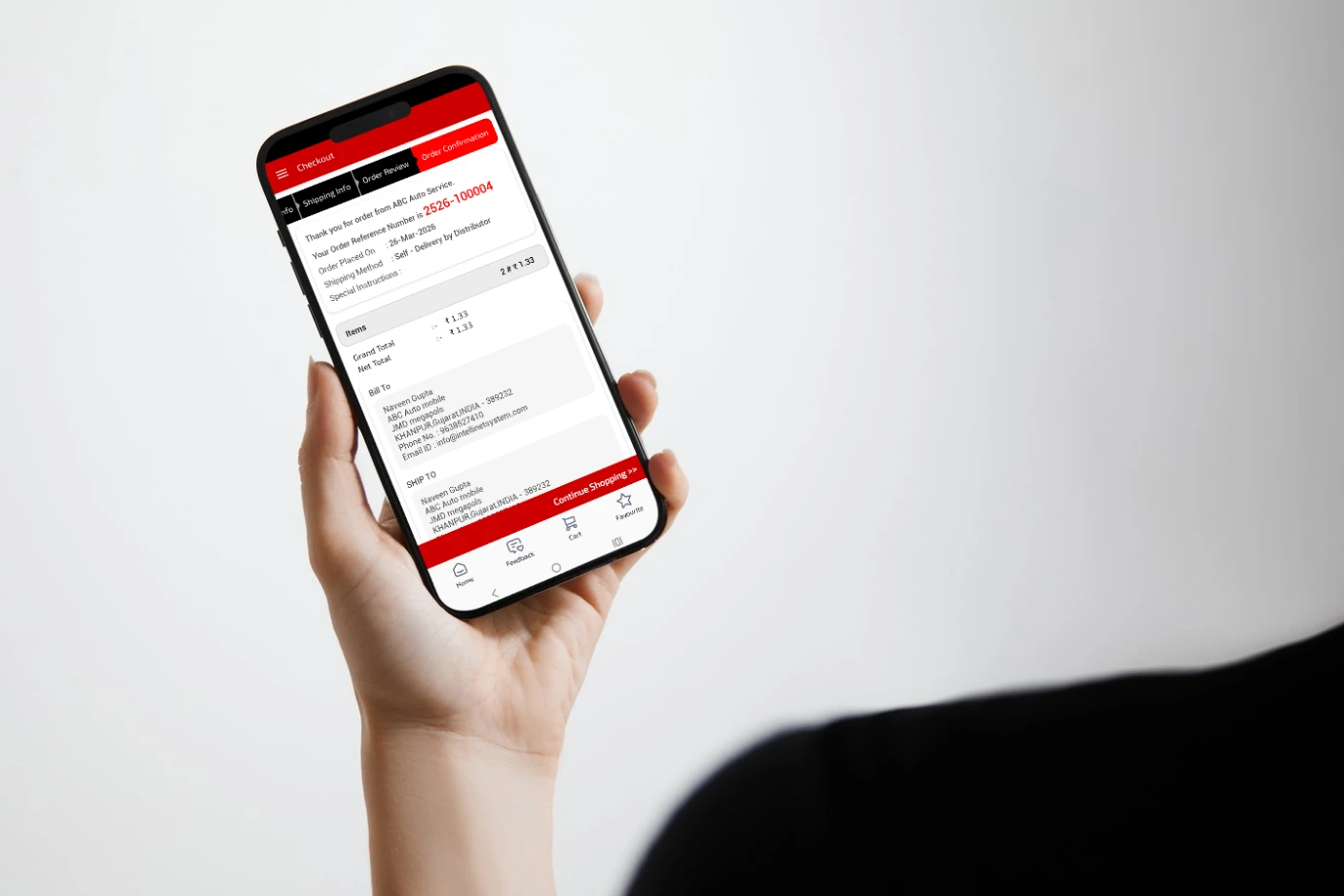
Retailers place orders from a mobile app on any smartphone, 24 hours a day, without requiring a sales representative to be present. Orders are submitted directly into the OEM's distribution workflow and created in the ERP system without manual re-entry. Order confirmation, dispatch updates, and backorder status are all visible in the same app, giving retailers a single source of truth for all their orders.
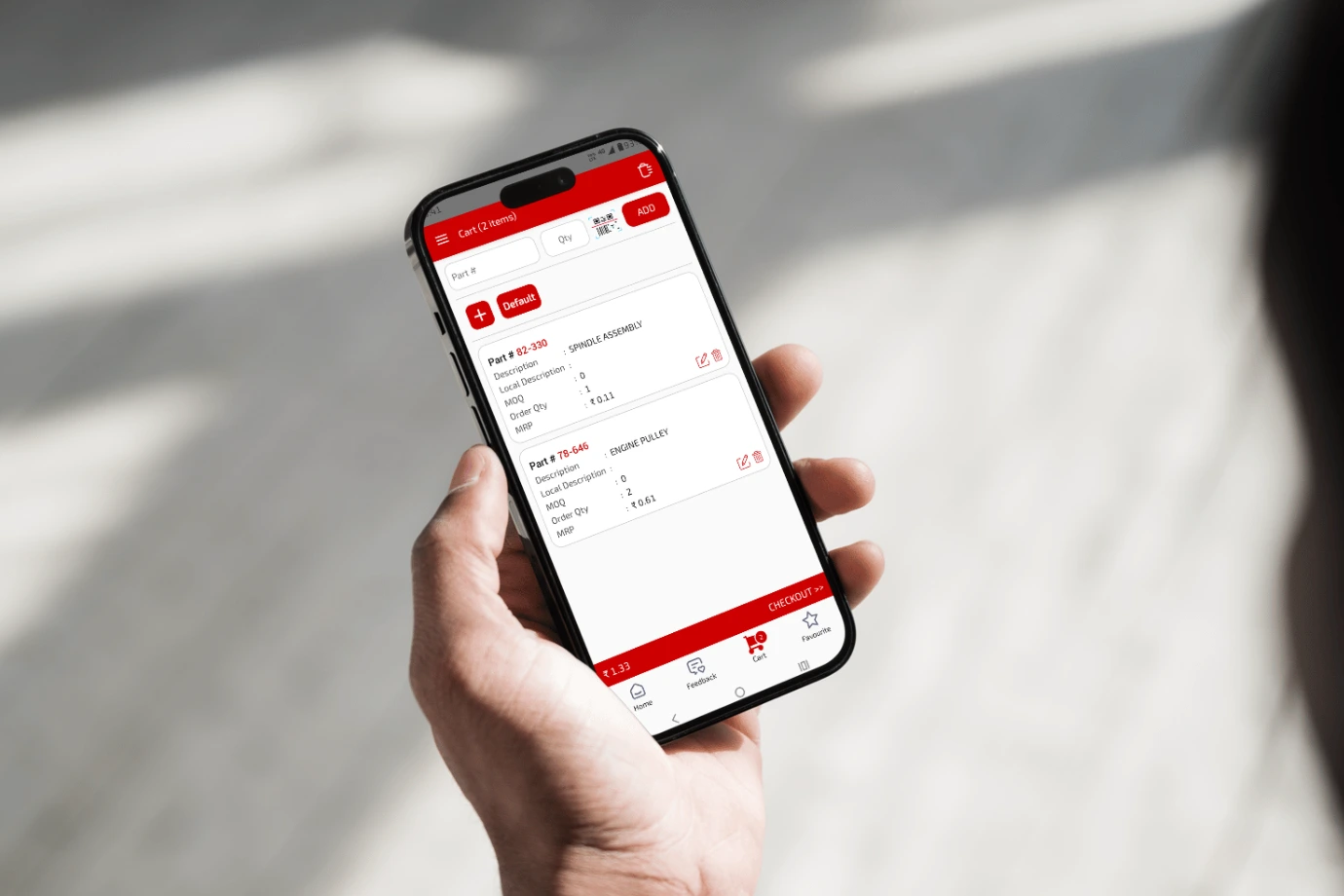
This removes the visit-dependency that constrains ordering frequency in most OEM secondary networks. A retailer at a farm equipment dealer during planting season, a parts counter at a construction machinery service center, or a workshop stocking automotive consumables can all place orders when stock runs low, not when a field representative visits them.
Multiple Parts Search Options
Retailers and field teams can search for parts by part number, part name, equipment model, figure/diagram, VIN, or QR/barcode scan in the Intelli Commerce app. This is critical for OEMs with large SKU catalogs with multiple equipment generations, common in automotive, industrial equipment, aerospace, and construction machinery.

Incorrect part identification is the primary reason for order errors and returns. Multi-mode search, including figure-based visual lookup from an integrated illustrated parts catalog, reduces that risk at the point of order. Customers (be it retailers, distributors, or field reps) can also reorder from purchase history or browse top-part recommendations, saving time on routine replenishment orders.
Real-Time Secondary Sales Visibility
With Intelli Commerce, every order placed through the retailer app is captured and visible to OEM headquarters in real time. Sales leaders see volume by region, by distributor, by product line, and by retailer, not in a monthly report from a distributor, but as a live transaction feed. OEMs can see demand signals building before stockouts occur and respond to slow-moving inventory before it becomes dead stock.
The platform also provides region-wise overlays of sales data and units in operation, enabling OEM aftermarket teams to identify geographic growth areas for retailer and distributor expansion.
Inbuilt Rules for Channel Control
Intelli Commerce lets OEMs define which retailers belong to which distributor, and which field sales executive covers which retailer. These rules are enforced at the platform level. Retailers can only order through their assigned distributor. Territory boundaries are maintained by the system, not through manual enforcement by field teams.
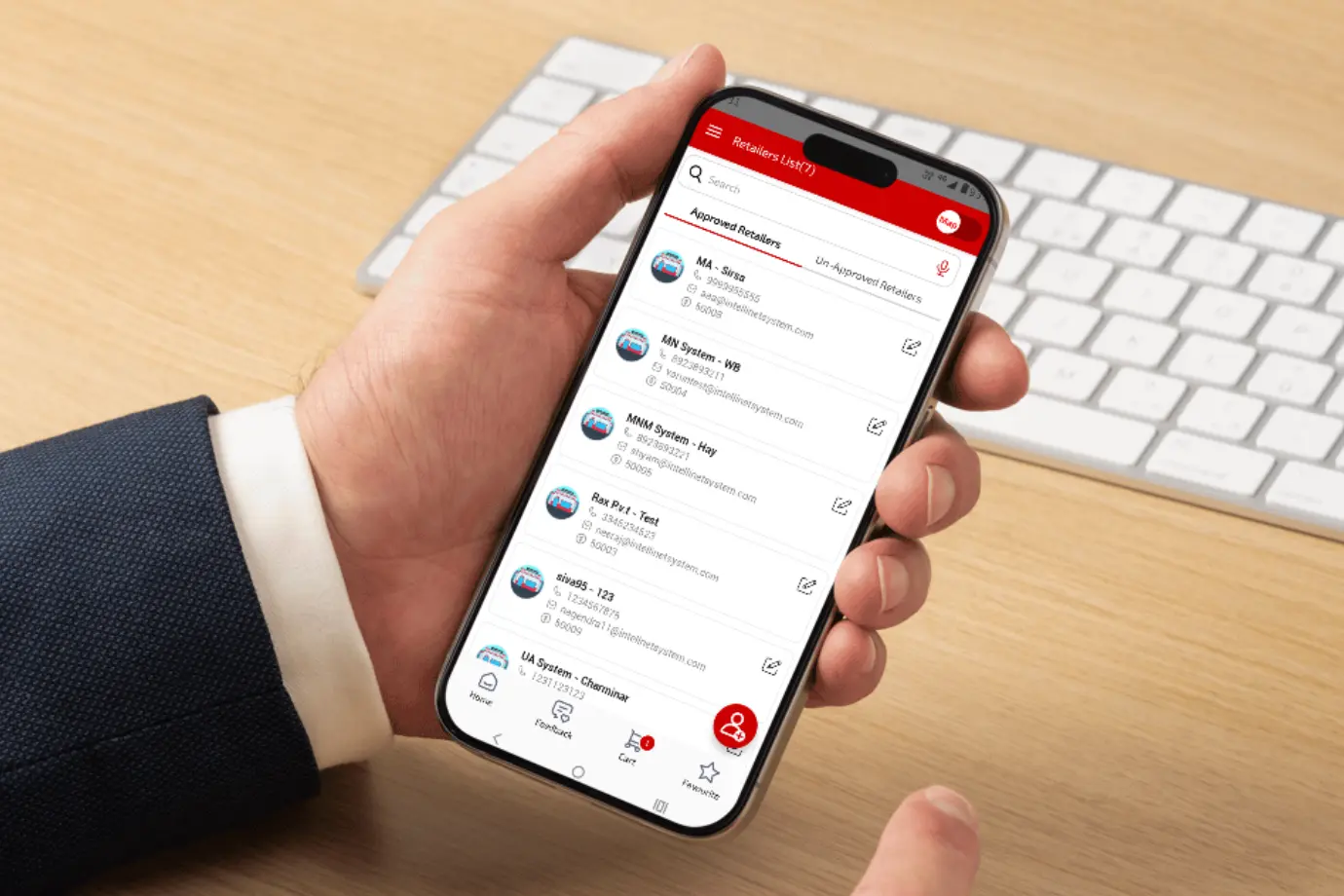
Distributors can add and manage new retailers directly within the app, enabling quick onboarding without requiring central IT configuration for every addition. When territories are reorganized, mappings are updated centrally and take effect immediately across the network.
Live Pricing and Promotions Management
OEMs configure pricing, tier discounts, and promotional schemes in one place. When a price changes, every retailer and distributor on the distributor management platform sees the updated price immediately, no email required, no price sheet to distribute, no version lag. Trade promotions and discounts are applied automatically at the point of order.
The Intelli Commerce platform also helps OEMs and distributors identify slow-moving inventory and run targeted promotions to reduce dead stock. Sales data and promotion performance are tracked in the same system, giving aftermarket leaders a factual basis for evaluating what is working.
AI-Powered Sales Productivity Tools
Intelli Commerce uses past order data, slow-moving inventory analysis, and active promotions to generate AI-driven talking points for field sales executives before retailer visits. Instead of visiting a retailer without preparation, the sales rep arrives with specific, data-backed topics: parts the retailer has not reordered recently, promotions relevant to that retailer's purchasing pattern, and inventory the distributor needs to move.
The distributor management platform also provides geolocation-based attendance tracking and smart route optimization for field teams. Sales executives mark attendance with geotagging, eliminating false visit claims. Route optimization considers real-time traffic and location data to sequence daily visits efficiently, reducing travel time and increasing productive call time per day.

Payment Collection and Financial Visibility
Field sales executives can record retailer payments, view ledger balances, and track collections directly in the app. This gives distributors and OEM finance teams visibility into outstanding balances across the retailer network without requiring a separate collections process or manual reconciliation.
ERP Integration
Orders placed through the mobile or web app are created directly in the OEM's ERP system. Dispatch details from the ERP flow back into Intelli Commerce, so retailers see accurate fulfillment status without contacting the distributor. Inventory records in the ERP reflect actual secondary sales activity, not just primary purchase volumes, giving procurement and planning teams more accurate data to work from. Moreover, Intelli Commerce can be integrated with the OEM's existing ERP systems.
Which OEM Segments Use Intelli Commerce
Intelli Commerce is currently being deployed across OEMs in six industry segments. The operational specifics differ by segment, but the underlying problem is the same: a multi-tier distribution network where order flow, pricing, and secondary sales data are not captured in a structured, real-time system.
- Automotive OEMs
Automotive spare parts distribution involves large SKU catalogs, model and year-specific fitment requirements, and a retailer base ranging from independent workshops to franchise service centers. Incorrect part identification and pricing inconsistencies across dealer tiers are the most frequent order-level problems. Real-time secondary sales visibility helps aftermarket teams detect when retailers shift to non-genuine parts before volume loss becomes significant.
- Agriculture and Farm Equipment OEMs
Farm equipment dealers operate across geographically dispersed regions with seasonal demand spikes. A parts stockout during planting or harvest season is not recoverable - the farmer does not wait. Distributors managing farm equipment parts need retailer-level demand data before seasonal peaks arrive, not after. Intelli Commerce's real-time order data and inventory analysis give both the distributor and the OEM the visibility to position stock in advance.
- Construction and Mining Equipment OEMs
Construction and mining equipment parts are high-value, and equipment downtime from a stockout is expensive for the end customer. Dealers on active project sites order based on immediate need, not scheduled rep visits. The 24/7 mobile ordering channel and real-time order status visibility are especially relevant here. ERP integration supports the part traceability requirements common in this segment.
- Aerospace OEMs
Aerospace aftermarket parts distribution requires precise part identification, full order traceability, and controlled access to pricing and availability. Intelli Commerce's inbuilt channel rules, distributor-retailer mapping, access control, and complete order audit trail - every order timestamped with user credentials and part details - address these compliance requirements directly.
- Industrial Equipment OEMs
Industrial equipment manufacturers covering food processing, packaging, textiles, and general manufacturing distribute parts through networks that often span multiple US regions and, in many cases, multiple countries. Pricing structures vary by geography. Distributor performance is hard to evaluate without secondary sales data. Intelli Commerce's regional pricing management and live distributor performance visibility are the most-used capabilities in this segment.
- Electric Vehicle OEMs
EV aftermarket parts and service distribution is being built now, from scratch. OEMs that establish digital-first distribution infrastructure from the start will not need to retrofit digital systems onto a manual network as their dealer and service networks scale. Intelli Commerce's mobile ordering, real-time data capture, and ERP integration provide the right foundation as EV service networks expand across the US.
Key Business Benefits of Intelli Commerce
Reduced Operational Cost
Running a large field sales team just to collect and enter orders manually is expensive. When retailers can place orders themselves through the app, OEMs require fewer people to do that task. On top of that, every time a price changes or a new catalog is released, manufacturers no longer need to print and ship updated materials to every distributor and retailer. Those costs go away.
OEMs Can See What Retailers Are Actually Buying
Right now, most OEMs wait for distributors to send sales reports, which may come weekly, monthly, or not at all. With Intelli Commerce, every order a retailer places shows up at OEM headquarters in real time. OEMs stop guessing what is moving in the market and start seeing it directly.
Fewer Wrong Orders and Invoice Disputes
A significant portion of order errors happens because someone searched for the wrong part number or ordered a part that does not fit the equipment. Intelli Commerce lets retailers search by model, figure, VIN, or barcode, so they find the right part before ordering, not after the wrong one arrives. And because pricing is set centrally and applied automatically, there are no more disputes over which price list was in effect when the order was placed.
More Parts Sold
When retailers can only order during a sales representative’s visit, the number of orders they place is limited by how often that representative shows up. Intelli Commerce removes that barrier; retailers order whenever they need something, day or night. Field executives also sell more per visit because the app shows them exactly which products to focus on for each retailer, based on that retailer's past orders and current promotions.
Less Dead Stock
Every distributor network has parts sitting in warehouses that are not moving. Intelli Commerce identifies those slow-moving items and lets OEMs and distributors run targeted promotions to clear them. This reduces the cost of holding inventory that is not selling and frees up space for parts that are in demand.
Better Business Decisions, Based on Real Data
Today, decisions about pricing, inventory levels, and where to add new distributors or retailers are often based on experience because the actual data is either unavailable or weeks old. Intelli Commerce gives aftermarket leaders a live picture of what is selling where, which distributors are performing, and which regions have unmet demand, so decisions are based on what is actually happening in the market, not on last month's report.
Is Your Network Ready for Intelli Commerce?
The following conditions indicate that an OEM's secondary sales network's current approach is producing measurable operational and revenue risk:
- Secondary sales data arrives monthly, quarterly, or inconsistently across distributors
- Retailers place routine orders by calling or messaging field representatives, which leads to a delay in the order
- Sales reps lack real-time order status info, leading to delays and miscommunication
- Frequent part updates and price changes cause disputes between distributors or retailers
- Part order errors and returns are a regular occurrence
- Distributor performance is evaluated on primary purchase volumes, with no view into secondary sales
- New retailer onboarding takes more than a week
- The field team visit activity cannot be verified without manual check-ins
- The OEM cannot identify in real time which parts are moving and which are stagnant across the retailer base
If three or more of these apply, the cost of running the OEM distributor network without a structured system is already escalating through excess inventory, lost sales, manual labor overhead, and pricing revenue leakage.
Conclusion
A distributor management system is the operational infrastructure that determines whether an OEM's secondary sales channel runs on real data or on estimates, delays, and manual workarounds. The difference is measurable in inventory costs, order fill rates, and parts sales volume.
Intelli Commerce gives OEMs across automotive, agriculture and farm equipment, construction and mining, aerospace, industrial equipment, and electric vehicles a single connected platform, replacing fragmented manual workflows with real-time order data, automated pricing, AI-assisted field productivity, and direct ERP integration.
Book a personalised demo to see how Intelli Commerce maps to your specific distributor network structure, ERP system, and secondary sales goals.


Explore More Insights


.webp)


About the Author


Chandra Shekhar
Chandra Shekhar is the Senior Manager, Strategy & Business Development at Intellinet Systems. With over a decade of experience in the automotive industry, Chandra Shekhar has led digital transformation and aftersales strategy initiatives for OEMs across multiple markets. His background combines deep industry knowledge with a practical understanding of how technology can solve real operational challenges. He focuses on making complex ideas clear and relevant for automotive and aftermarket professionals navigating ongoing change.


