

The global automotive aftermarket is projected to reach USD 624 billion in 2032. OEMs that operate dealer networks across 70 or more countries are not just competing on product quality. They are competing on how fast and accurately their dealers can identify, order, and receive the right spare parts.
A dealer in Germany, a technician in Brazil, and a service advisor in Japan all need the same parts data. The difference is the language they work in, the regulations they operate under, and the pricing structures that apply to their market. When your multilingual parts catalog fails to account for those differences, misorders happen, downtime increases, and dealer trust erodes.
This blog covers what catalog localization OEM teams need to get right, where most global catalogs fall short, and how the right software infrastructure closes those gaps.
Why Catalog Localization Is a Business-Critical OEM Requirement
Many OEMs still treat catalog translation as a document management task, but it’s not; it's a core function of your aftermarket operations. Here is why.
Your dealer network in Southeast Asia is not reading the same part descriptions as your network in France. If your parts catalog translation workflow is manual, inconsistent, or dependent on static PDFs, version mismatches are almost unavoidable. A dealer using a six-month-old translated catalog can order the wrong superseded part, causing a return, a service delay, and a frustrated customer.
The problem scales with the number of markets. Consider a mid-size OEM with a dealer network in 80 countries. That typically means managing catalogs in 30 to 50 languages, across varying regulatory environments, different currencies and pricing structures, and multiple right-to-left and special-character script requirements.
Without a centralized platform designed for multilingual catalog management, teams end up with fragmented translation workflows, no single source of truth, and no reliable method to push real-time updates across all languages.

What is the Real Cost of Poor Parts Catalog Translation
Translation errors in technical documentation carry direct operational costs. According to CSOFT International, inaccurate translations of service documentation can lead to product recalls. In the parts context, a single incorrect part description in a translated catalog can trigger a chain of wrong orders, increased returns, dealer downtime, and warranty claim disputes.
The localization challenges OEM aftermarket teams face most often include:
- Terminology inconsistency: The same part is described differently across language versions because translators worked without shared glossaries or technical term bases, which leads to part misidentification.
- Outdated translated versions: The master catalog gets updated, but the translated version lags by weeks or months. Dealers in non-English markets operate on stale data.
- Non-localized pricing and tax data: Catalog localization OEM teams often overlook currency, VAT rates, and import duty fields that must be market-specific.
- Script and formatting issues: Arabic, Japanese, and Chinese require character encoding and right-to-left or double-byte handling that generic translation tools mismanage, leading to broken catalog interfaces.
- No visual confirmation across languages: A technician who cannot confirm a translated part description with a visual diagram is more likely to misorder, regardless of how accurate the translation is.
The downstream costs add up. Wrong parts create logistics costs, delay repairs, and in heavy equipment or commercial vehicle segments, idle machinery directly translates into financial loss for the end customer and reputational damage for the OEM.
Discover how a multilingual electronic parts catalog helps OEMs manage parts data across 70+ countries to search and order parts accurately. Schedule a demo today.
What Effective Multilingual Parts Catalog Management Looks Like
A well-managed multilingual parts catalog is not a translated PDF. It is a live centralized data environment where every language version stays synchronized with the master catalog, and every dealer, regardless of region, works from current, accurate parts data.
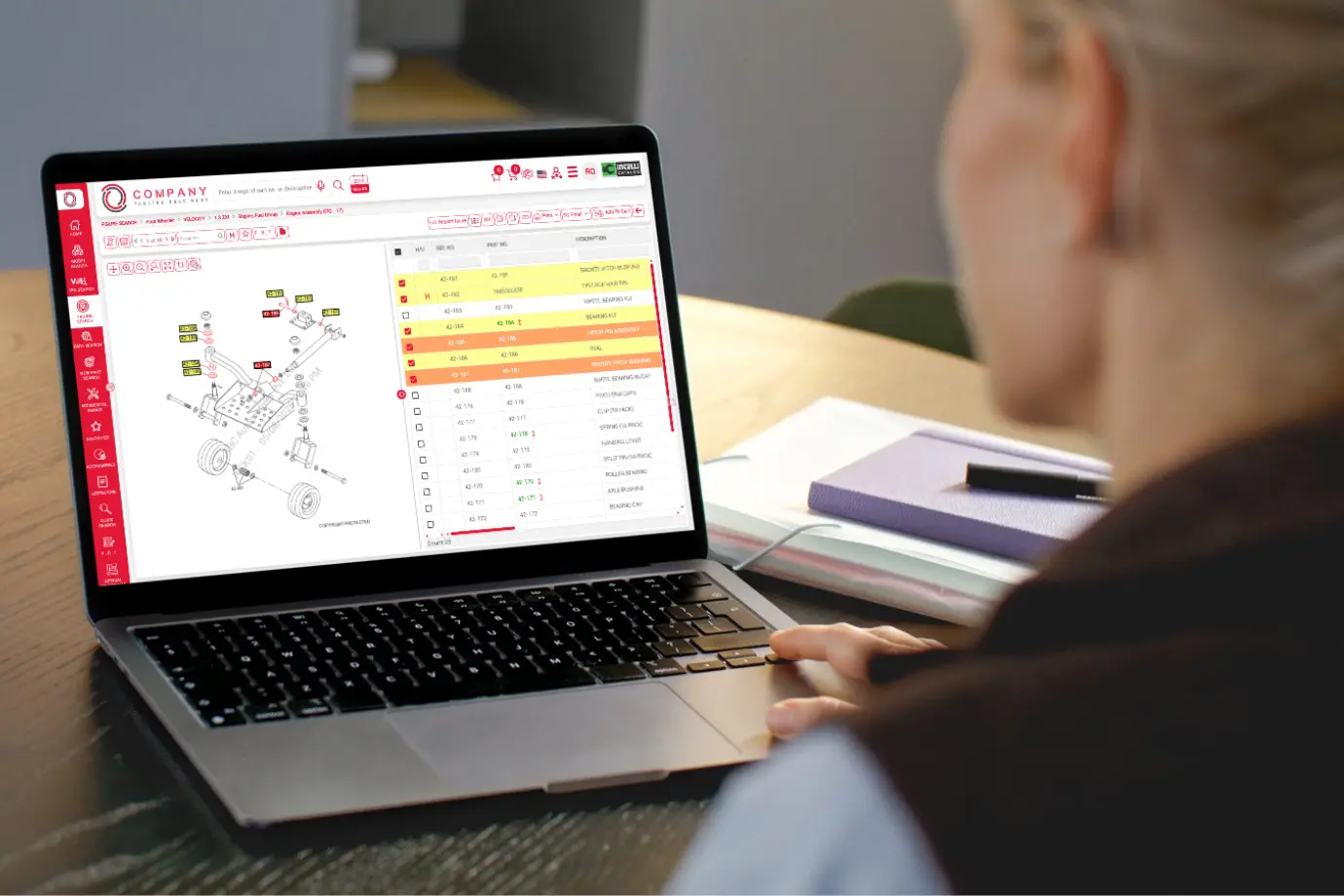
The key requirements for managing multilingual catalogs at scale include:
- Centralized catalog engine: All parts data, descriptions, and illustrations are managed from a single source, so language-specific versions stay consistent. Intelli Catalog operates on a centralized parts database, meaning any update to the master, whether a part supersession, description change, or price adjustment, propagates to all language versions simultaneously. There is no lag between what the OEM updates and what a dealer in any market sees.
- Real-time multilingual updates: When catalog content changes, translated versions must reflect those changes immediately. Intelli Catalog pushes updates to all market versions in real time, so distributors and dealers in every location always work from current data.
- Terminology governance: Approved translation glossaries must be enforced across all market versions to prevent the terminology drift that causes misidentification. Consistent part naming across languages is one of the primary controls against wrong orders.
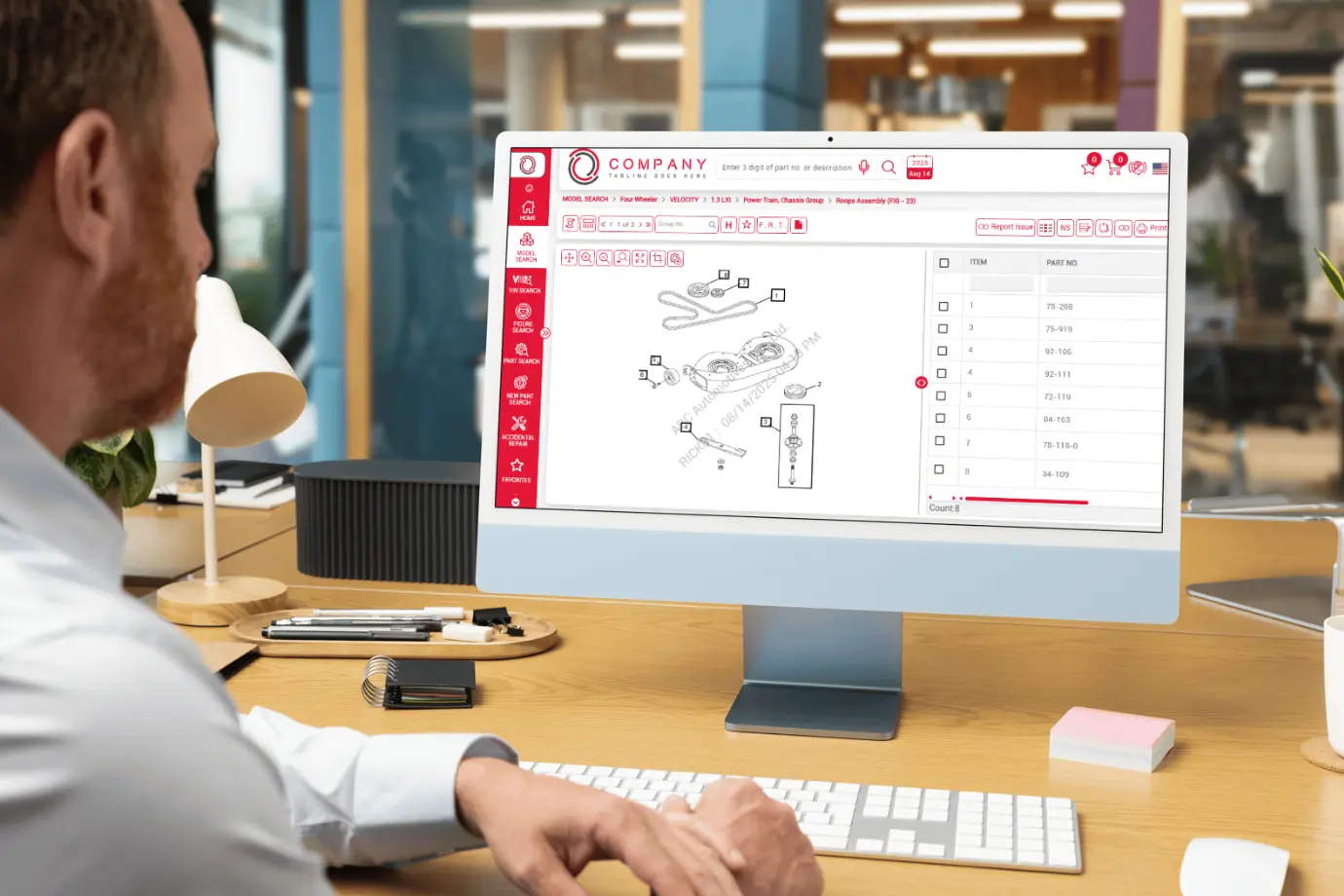
- Visual-first identification: Interactive 2D and 3D diagrams with hotspot functionality let technicians visually confirm parts regardless of language. Intelli Catalog’s visual-first design means a technician in Thailand and a dealer in Poland work from the same assembly diagrams, which removes ambiguity. The platform also supports AI-powered visual search, where a technician can point a camera at a device to find the matching replacement part.
- Multi-language search across local contexts: Search must work in the technician’s own language and terminology, not just in English. Intelli Catalog supports VIN and serial number, model, figure, and natural language AI search. A technician can describe a part requirement in their local language, and the system returns relevant results, which is especially valued in markets where catalog terminology varies from how local technicians describe parts.
- Country-specific pricing and compliance fields: Localized catalogs must reflect market-specific pricing, applicable taxes, and import regulations. Intelli Catalog supports multi-country pricing management with market-specific pricing structures and currency handling, so distributors and dealers in each market see pricing depending on their location.
- Multi-script support and ERP integration: Intelli Catalog integrates with ERP and DMS systems, connecting localized catalog updates directly to the ordering and inventory workflows dealers already use, eliminating manual re-entry across markets.
Read More: Spare Parts Management Software: Buyer’s Guide for US OEMs
Managing Catalog Localization Across 70+ Countries: A Practical Framework
OEMs that manage global catalogs at scale need a structured approach. Here is the framework that works:
- Establish a single master catalog as the source of truth
All parts data, descriptions, and illustrations should originate from one master. Translated versions should be outputs of this master, not independently maintained documents. This eliminates version drift.
- Build and enforce a multilingual parts terminology glossary.
Technical terms must be standardized across all markets. Consistent terminology is the foundation of an accurate parts catalog translation and the primary control against misidentification.
- Connect translation workflows directly to the catalog platform
Translation should be triggered automatically when the master catalog changes. Manual copy-paste translation workflows cannot scale across 70 markets and will always produce lag and inconsistency.
- Validate localized catalogs with in-market technicians.
Linguistic accuracy and technical accuracy are not the same thing. A grammatically correct translation may still use terminology that local technicians do not recognize. In-market validation catches these issues before they reach the dealer network.
- Use visual tools to reduce translation dependency.
Interactive diagrams reduce the weight placed on text descriptions. An OEM that has strong 2D and 3D hotspot-enabled illustrations in its catalog is less exposed to the risk of translation errors causing misorders.
- Monitor misorder rates by market.
If wrong parts orders are disproportionately high in specific markets, the root cause is often a localization failure. Track misorder rates by country and tie them back to catalog quality reviews.
Conclusion
Managing a multilingual parts catalog across 70 or more countries is an operational challenge that goes well beyond translation. It requires a centralized platform, real-time synchronization, visual identification tools, and market-specific pricing management working together.
OEMs that treat parts catalog translation as a standalone document task will continue to deal with version drift, misorders, and dealer dissatisfaction in their international markets. OEMs that build it into a connected, platform-driven workflow create a durable competitive advantage in the global aftermarket.
Intelli Catalog, electronic parts catalog solution by Intellinet Systems, is built for exactly this requirement and designed to help global OEMs manage complex multilingual catalog environments, keep dealer networks current across every market, and reduce the part identification error that erodes aftermarket profitability.
Explore how a multilingual electronic parts catalog supports accurate parts search and ordering across global dealer networks. Request a demo.
FAQ
Can pricing and taxes be localized in a parts catalog?
Yes, Intelli Catalog is a multilingual parts catalog that supports region-based pricing, currency conversion, taxes, and dealer-specific discounts.
Can pricing and taxes be localized in a parts catalog?
Yes, Intelli Catalog supports region-based pricing, currency conversion, taxes, and dealer-specific discounts.
Can Intelli Catalogs integrate with dealer systems?
Yes, Intelli Catalog integrates with dealers' ERP, DMS, and ordering systems to ensure smooth workflows.


Explore More Insights





.webp)


About the Author


Chandra Shekhar
Chandra Shekhar is the Senior Manager, Strategy & Business Development at Intellinet Systems. With over a decade of experience in the automotive industry, Chandra Shekhar has led digital transformation and aftersales strategy initiatives for OEMs across multiple markets. His background combines deep industry knowledge with a practical understanding of how technology can solve real operational challenges. He focuses on making complex ideas clear and relevant for automotive and aftermarket professionals navigating ongoing change.


