


Building a vehicle is hard. Getting it to market is harder. One challenge most US mobility startups fail to anticipate is what happens when the first warranty claim is submitted, and by the time it becomes visible, it is already too late to correct.
At that point, the product engineering team has already shifted focus, the operations team is stretched thin managing day-to-day issues, and the finance team is left trying to forecast warranty costs without any reliable historical data. The dealer is waiting for reimbursement. The supplier responsible for the faulty part remains unaware that they are liable.
What follows is not just operational friction; it is cost leakage, delayed payments, and strained startup-dealer relationships.
This is why warranty claims management for automotive startups, including mobility and EV startups, is not a back-office function; it is a foundational system that must be built before scale begins. This article explains why warranty claims management for automotive startups, including mobility and EV startups, is a foundational business capability that impacts dealer relationships, cost control, and product quality.
The Warranty Reality US Automotive, Mobility, and EV Startups Face

Every vehicle an automotive startup, including mobility and EV startups, sells comes with a warranty obligation. In the US, federal Magnuson-Moss Warranty Act requirements and state-level lemon laws create legal accountability from the moment of first delivery. Dealers who service those vehicles under warranty submit claims to the OEM for reimbursement. That process begins with the first vehicle delivered and continues uninterrupted thereafter.
According to a WarrCloud study published by F&I and Showroom, the cost of processing automotive warranty claims has increased by 28% of revenue since 2020, while the time required to process each claim has risen by 47% over the same period.
At the same time, claim volumes are also rising. Nearly 60% of US dealerships report an increase in warranty claims, up 17% compared to 2020. More than 75% of dealers attribute this growth to the increasing complexity of modern vehicle technology, which is driving higher claim frequency and processing demands.
For EV startups, the challenge is even more pronounced. In 2023, 48% of US dealers stated that electric vehicles are expected to generate higher warranty claim volumes than internal combustion vehicles, up from just 30% in 2020.
The challenge is structural. Legacy OEMs such as Ford and GM operate with decades of claims data, established dealer training programs, mature supplier contracts, and large warranty teams. Automotive startups, including mobility and EV startups, are building their warranty infrastructure while simultaneously developing vehicles, scaling dealer networks, and working toward profitability.
Real-World Impact on Automotive, Mobility, and EV Startups

The impact of these trends is already visible across automotive startups, particularly in EV-focused companies, where warranty costs are rising rapidly as vehicle volumes scale.
- Lucid: Reported a 24% warranty accrual rate, among the highest recorded for an EV startup.
- Rivian: Recorded $261 million in warranty accruals in 2024, reflecting a 12% year-over-year increase.
These figures reflect the reality of building warranty infrastructure while simultaneously scaling production, distribution, and dealer onboarding. For early-stage automotive startups, including mobility and EV startups, this sends a clear signal: the longer the warranty process maturity is deferred, the harder and more expensive it becomes to establish.
What Happens Without Warranty Claims Management for Automotive, Mobility, and EV Startups

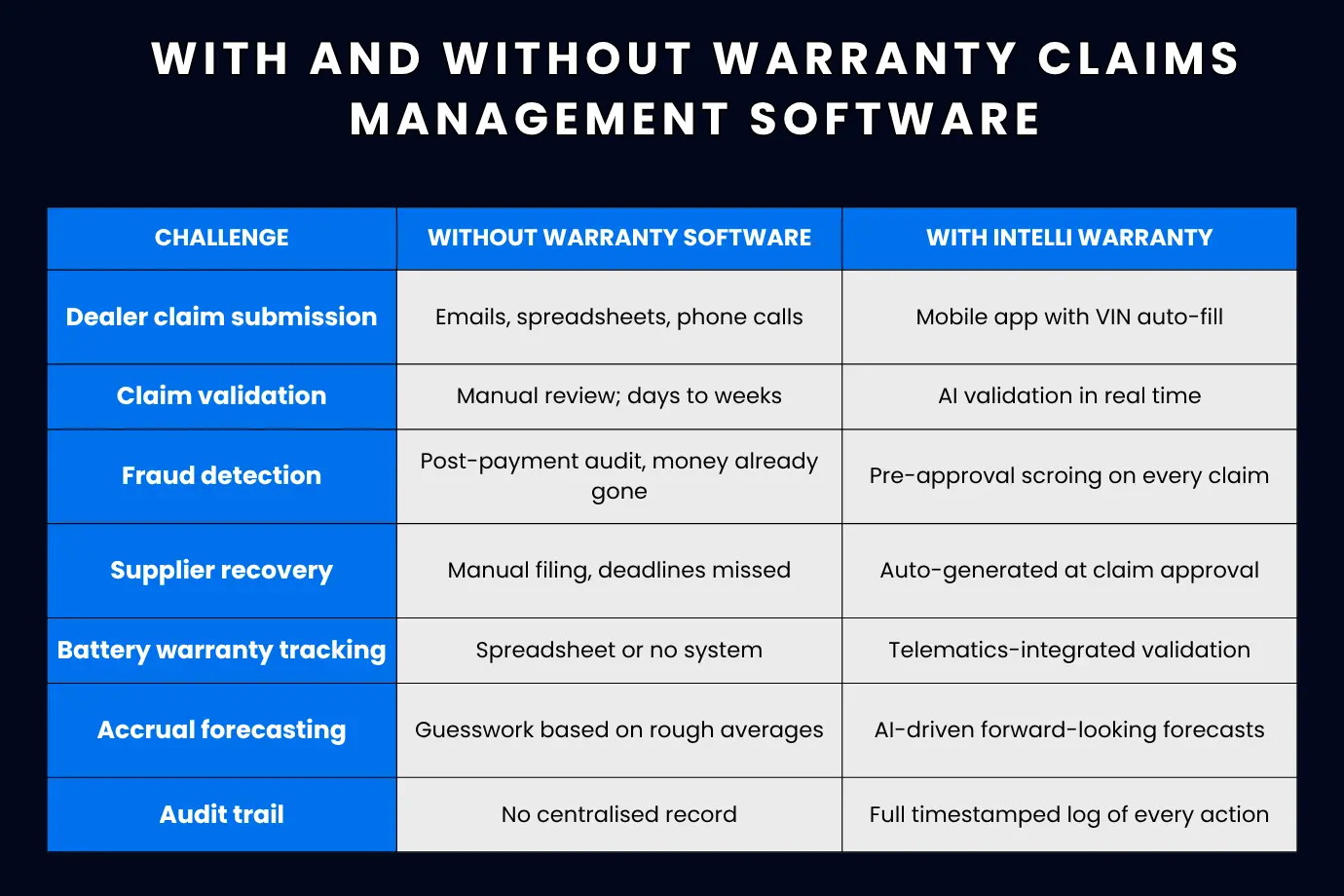
When a startup lacks a structured dealer warranty claims process, the gap is inevitably filled with improvisation. Dealers submit claims by email, spreadsheets, or phone calls. Finance teams track reimbursements manually, and customer service handles escalations as they arise. Each workaround increases processing time, introduces errors, and creates fragmented data that cannot be aggregated or analysed.
For automotive startups, including mobility and EV startups, the financial and operational consequences are direct and measurable across five areas:
1. Unstructured dealer claim submission
Without a standardised dealer warranty claims process, dealers continue to submit claims in different formats, often with incomplete documentation and inconsistent information. What begins as a manageable workaround quickly turns into a recurring operational issue as claim volumes grow. Warranty teams end up spending increasing amounts of time chasing missing details instead of efficiently validating claims. This leads to higher rejection rates, repeated submissions, and growing frustration across the dealer network.
2. Manual validation and processing delays
In the absence of automation, every claim must be reviewed manually. This may work at low volumes, but as vehicle numbers increase, processing becomes slower and more resource-intensive. Claims take days or weeks to resolve, teams expand to handle the workload, and errors increase due to reviewer fatigue. Delays in validation directly extend reimbursement timelines.
3. Fraud and claim leakage
Without structured validation controls and historical benchmarks, startups cannot easily identify abnormal claim patterns. Fraudulent and inflated claims can pass through undetected. According to Mordor Intelligence, automotive and industrial firms typically allocate 1.5% to 2.5% of annual revenue to warranty claims.
Without validation at the point of submission, a share of this cost is driven by errors and leakage that a structured system could have prevented.
4. Dealer reimbursement delays
Dealers who service vehicles under warranty expect prompt reimbursement. When a startup's process relies on manual review, email follow-up, and spreadsheet tracking, reimbursement timelines extend. Dealers absorb the carrying cost of that delay. Over time, slow reimbursement erodes dealer confidence in the brand and, in competitive markets, reduces their willingness to prioritize the startup’s vehicles in the service queue.
5. Loss of product quality intelligence
Every warranty claim is a structured data point about what failed, in which vehicle configuration, at which mileage, and under what conditions. Startups that manage claims informally lose that data. They cannot identify recurring failure patterns early enough to issue a technical service bulletin, adjust a component specification, or prevent a costly recall. For a startup with limited engineering resources, early failure pattern detection through warranty claims management is one of the most cost-effective quality improvement tools available.
Why Automotive, Mobility, and EV Startups Need Warranty Software Before Volume Demands It

The instinct to wait until claim volume justifies investment in warranty software for automotive startups, including mobility and EV startups, is understandable. However, this approach creates operational risk early and becomes significantly more expensive to correct later. The value of a structured warranty claims management system extends beyond efficiency at scale. It lies in establishing control, consistency, and visibility from the very first claim.
Early implementation of warranty software is driven by four key factors.
A. Dealer onboarding sets process expectations.
The first warranty claim submitted by a dealer sets the standard for all future interactions. A structured dealer warranty claims process with clear submission workflows and faster acknowledgment establishes operational discipline from the outset. In contrast, relying on email-based submissions and manual review creates inconsistency and signals a lack of process maturity. Once these expectations are set, changing them without disruption becomes difficult.
B. Historical data has compounding value.
Warranty data generated during the first 6 to 18 months in the field is critical for identifying early failure patterns. When captured in a structured format, it enables faster root-cause analysis and supports timely corrective action. If claims are managed informally during this period, the data remains fragmented and cannot be reconstructed later. This results in a permanent loss of actionable insight.
C. US regulatory and legal exposure increases with scale
Warranty reimbursement requirements in the US continue to evolve, with several states requiring alignment with third-party labour time guides. Without a system to manage state-level rules, track claim decisions, and maintain audit trails, startups face growing compliance risk. As dealer networks expand, the absence of structured processes increases financial exposure and creates audit challenges.
D. Investor and partner scrutiny requires operational visibility
Startups seeking funding, partnerships, or fleet contracts are expected to demonstrate control over warranty liabilities. A structured system provides measurable metrics such as claim rates, reimbursement timelines, and cost trends. These indicators reflect operational discipline and strengthen credibility with investors and partners. Manual tracking through spreadsheets and emails does not provide this level of visibility.
How Intelli Warranty Solves These Challenges for Automotive, Mobility, and EV Startups
.webp)
Intelli Warranty is an automotive warranty management software designed for startups, including mobility and EV startups, as well as established OEMs managing multi-tier dealer networks. It is designed to make the dealer warranty claims process structured, transparent, and data-rich from the first claim submitted.
Key capabilities relevant to US automotive, mobility, and EV startups include:
- Structured claim submission portal: Dealers submit claims through a guided digital workflow that enforces required fields, documentation uploads, and condition codes before submission. This lowers rejection rates and improves overall processing efficiency.
- Automated business rules engine: Warranty policy parameters, including coverage periods, eligible repair types, and reimbursement structures, are configured within the system and applied automatically during claim validation, eliminating the need for manual policy checks.
- Real-time claims dashboard: OEM warranty teams have real-time visibility into claim status, approval queues, pending documentation, and reimbursement liability across the entire dealer network, with no need for spreadsheet reconciliation.
- Supplier recovery management: When a warranty failure is linked to a third-party component, Intelli Warranty captures the failure data and automatically initiates the supplier recovery workflow. For startups with complex supply chains, this is a direct cash recovery mechanism.
- Failure pattern analytics: Claims data is aggregated and analysed across vehicle configurations, build dates, and mileage bands. Recurring failure patterns surface as alerts before they reach recall-level volume, giving engineering teams early warning to act.
- ERP integration: Intelli Warranty integrates with your existing financial and dealer management systems, ensuring that claim approvals and reimbursements flow directly into accounting without manual data entry.
The Bottom Line
For US automotive startups, including mobility and EV startups, the warranty claims management decision is not about whether you can afford to invest in the right system before your dealer network is live. It is about whether you can afford not to.
Lucid's 24% accrual rate and Rivian's $261 million warranty spend in a single year are not just the result of building new vehicles with new technology. They are also the result of building warranty operations reactively, after claims begin to arrive, rather than proactively from the outset. Startups that get this right from day one spend less per claim, recover more from suppliers, maintain stronger dealer relationships, and have the data infrastructure to improve their products faster.
Warranty claims management for automotive startups, including mobility and EV startups, is not a back-office function to be deferred. It is a core operational capability that determines whether a new OEM's dealer network trusts it, whether its costs are controlled, and whether it can build on its early vehicles to reach the scale it needs. The right time to build it is before the first claim arrives.
Book a free demo to see how Intelli Warranty gives automotive, mobility, and EV startups the warranty claims management infrastructure they need from day one.
Frequently Asked Questions
At what stage should a US automotive startups implement warranty claims management software?
Before the first vehicle is delivered to a dealer. The process expectations set in the first claim submission define the dealer relationship standard going forward. Implementing after volume arrives means retrofitting a process under operational pressure, which is more disruptive and more expensive than building it correctly from the start.
How does warranty claims management software reduce dealer reimbursement disputes?
By enforcing submission standards at the point of entry. When dealers submit claims through a structured portal that validates required fields, documentation, and labour operation codes before submission, the proportion of claims rejected or partially approved due to incomplete data drops significantly. Fewer rejections mean fewer disputes and faster reimbursement cycles.
Can warranty software for US automotive startups, including mobility and EV startups, integrate with existing ERP or accounting systems?
Yes. Intelli Warranty integrates with standard ERP platforms, including SAP and Oracle, as well as custom financial systems, so approved warranty reimbursements flow directly into accounting without manual data re-entry.
How does Intelli Warranty help US automotive startups, including mobility and EV startups, manage compliance across multiple states?
US state franchise laws governing warranty reimbursement rates vary by state and are actively evolving. Intelli Warranty allows OEMs to configure reimbursement rate structures by region, log all claim decisions with an auditable trail, and generate compliance reports. This gives legal and finance teams the documentation needed to demonstrate compliance in any state where dealer warranty law applies.
Does Intelli Warranty support supplier recovery for component failures?
Yes. When a warranty claim is traced to a component failure attributable to a specific supplier, Intelli Warranty captures the failure data, links it to the relevant purchase order, and automatically initiates the supplier recovery workflow. For startups with complex multi-supplier bill of materials, this is a direct mechanism for recovering warranty costs from the supply chain rather than absorbing them internally.


Explore More Insights








.webp)


About the Author


Chandra Shekhar
Chandra Shekhar is the Senior Manager, Strategy & Business Development at Intellinet Systems. With over a decade of experience in the automotive industry, Chandra Shekhar has led digital transformation and aftersales strategy initiatives for OEMs across multiple markets. His background combines deep industry knowledge with a practical understanding of how technology can solve real operational challenges. He focuses on making complex ideas clear and relevant for automotive and aftermarket professionals navigating ongoing change.


