

Overview: AI in the automotive aftermarket is fundamentally changing how OEMs generate revenue across the vehicle lifecycle. For years, automotive OEMs relied primarily on vehicle sales as their main source of revenue, while services and spare parts contributed only a modest share. Today, that model is evolving as connected vehicles, software subscriptions, predictive maintenance, and data-driven services create new revenue opportunities long after the initial sale. As a result, OEMs are increasingly investing in AI-powered technologies to improve operational efficiency, strengthen dealer networks, and enhance customer experiences.
According to McKinsey, AI adoption in the automotive sector is expected to grow by more than 25% annually, with applications ranging from product development to supply chain automation. OEMs who are using AI in the automotive aftermarket are already seeing measurable results in claims processing, inventory efficiency, and dealer support.
Read this blog to explore how and where AI is making a real operational difference and what automotive OEMs need to know to stay ahead of their peers.
Why Is Traditional Aftermarket No Longer Enough?
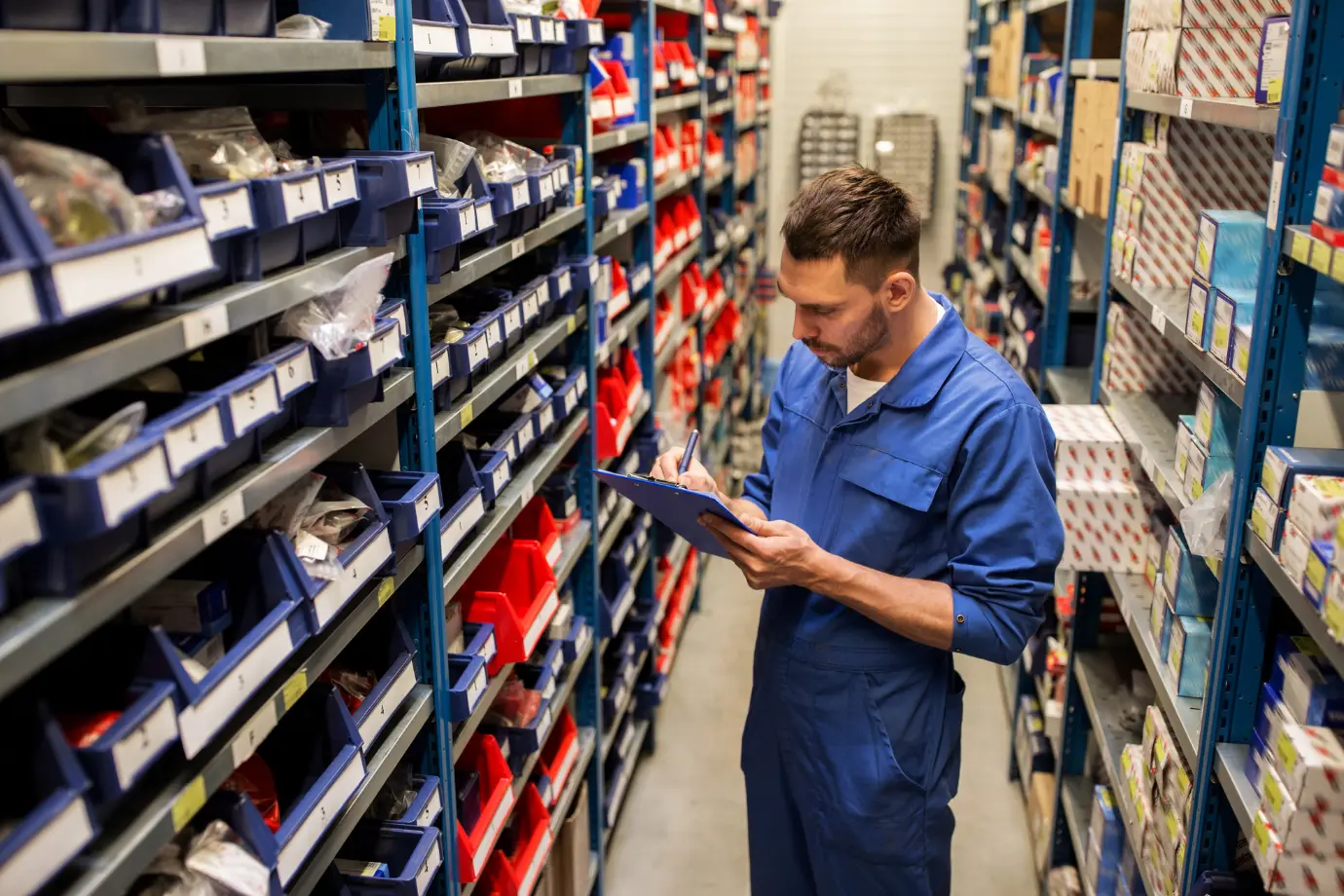
Traditional aftermarket operations are no longer enough because they cannot keep pace with growing data complexity, rising customer expectations, and increasing pressure on margins. Manual forecasting, disconnected systems, and reactive processes make it difficult for OEMs to optimize inventory, process claims efficiently, and deliver the fast service experiences customers now expect.
The automotive aftermarket is one of the highest-margin and most difficult to manage. Parts demand is unpredictable, a high volume of warranty claims arrives with unstructured data, or dealer networks operate on different systems. Moreover, end customers expect faster turnaround times than most OEM service operations are built to deliver.
According to a McKinsey aftermarket executive survey, 65 percent of executives see a growing risk of margin compression, up 22 percentage points from the prior year.
Traditional pricing tools, manual forecasting, and siloed claim workflows are not equipped to handle this pressure. AI addresses the gap created by traditional pricing tools, manual forecasting, and siloed claim workflows by processing more data much faster, which provides actionable insights that operational teams can act on immediately.
For a complete overview of how AI is reshaping the industry, see our pillar guide: AI-Powered Transformation in the Aftermarket Industry.
How Does AI Improve Spare Parts Forecasting and Inventory Management?
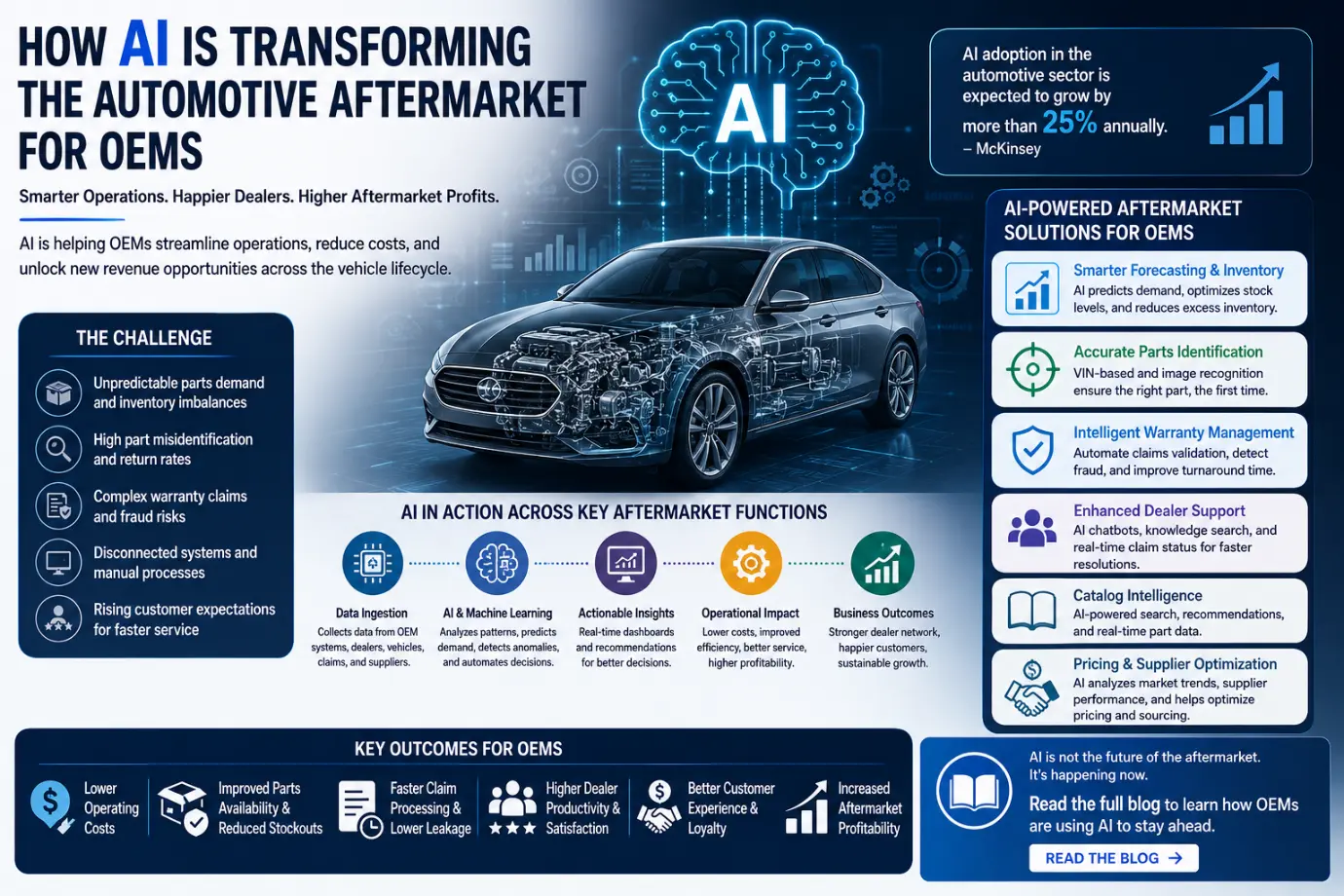
AI spare parts forecasting and inventory management improve inventory accuracy by predicting future demand using historical service data, vehicle usage patterns, dealer orders, and real-time operational signals. This enables OEMs to reduce stockouts, lower excess inventory, automate replenishment, and maintain optimal parts availability across the aftermarket network.
Spare parts forecasting is difficult because demand is driven by vehicle age, usage patterns, unexpected component failures, and regional conditions. AIAG’s MMOG/LE framework highlights that forecast inaccuracies contribute to excess inventory, higher costs, and reduced supply chain efficiency, and encourages structured planning processes to minimize these inefficiencies.
AI spare part management changes this by using machine learning models trained on VIN records, historical service data, regional failure error rates, and dealer order patterns to identify demand signals, and they update continuously as new data flows in.
What does this look like in practice for an automotive OEM?
Here's how this works in practice: a US commercial vehicle OEM managing parts availability across 450+ dealer locations. Without AI, each location orders based on local intuition and periodic stock reviews. With an AI-driven system, the commercial vehicle OEM can:
- Predict which parts will be needed at each location based on fleet age, mileage bands, and seasonal vehicle maintenance patterns
- Automatically trigger replenishment orders before parts stockouts occur.
- Move slow-moving inventory from overstocked locations to those with higher demands
- Flag obsolete parts early, which reduces write-off costs at year's end
The operational output is fewer emergency orders, better parts availability, and lower carrying costs at the dealer level.
Can AI Actually Identify the Right Part the First Time?
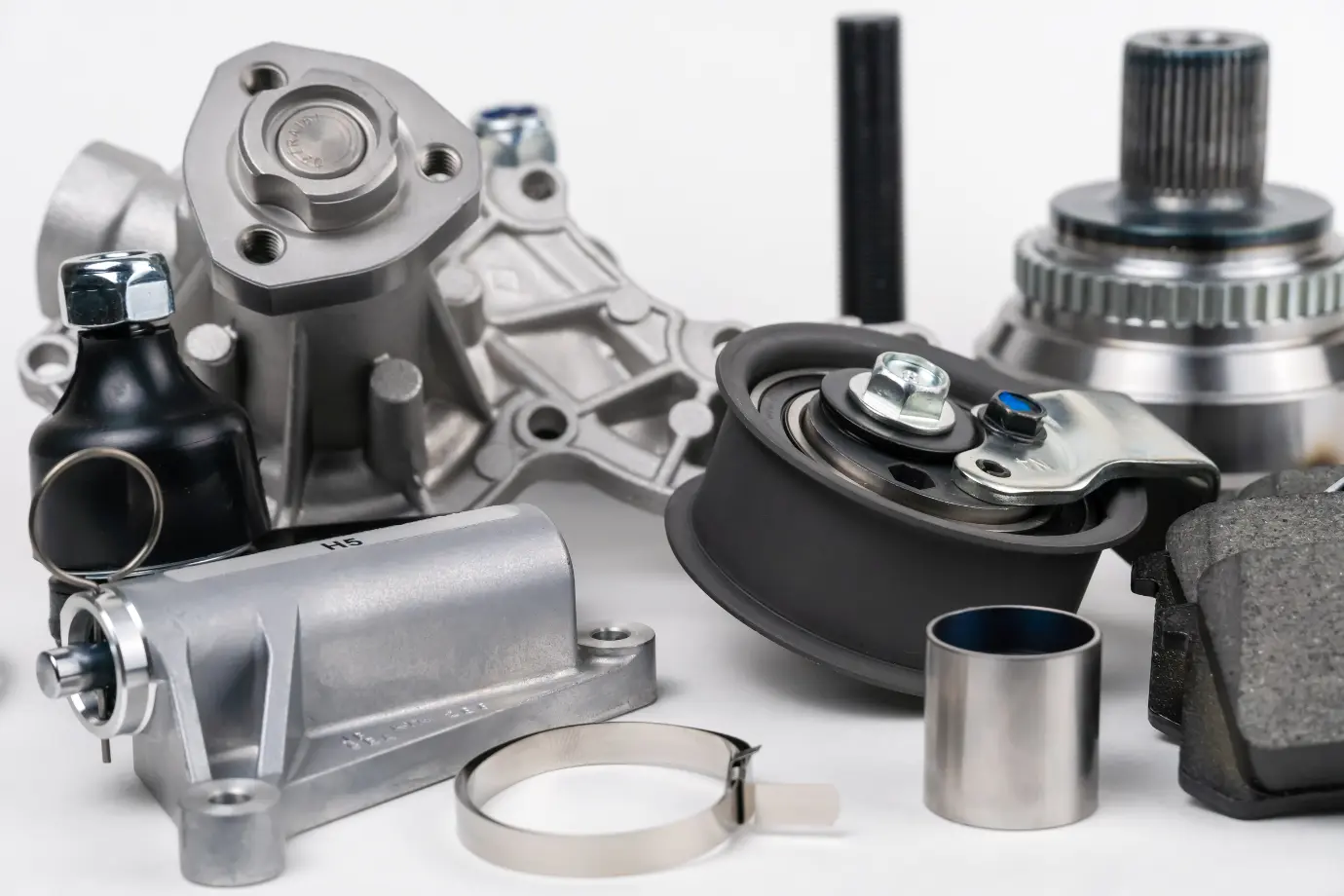
Yes. AI-powered parts identification helps OEMs and dealers identify the correct replacement part on the first attempt by using VIN data, vehicle build information, catalog intelligence, and image recognition technology. This reduces part misidentification, lowers return rates, improves first-time fix rates, and shortens vehicle downtime.
Part misidentification remains one of the most costly challenges in aftermarket operations. When a dealer selects the wrong part, the return process begins, a replacement order must be placed, and the customer's vehicle remains out of service for longer than necessary. These errors increase labor costs, consume service bay capacity, generate additional shipping expenses, and negatively affect customer satisfaction.
AI parts identification addresses these challenges through VIN-based lookup and visual recognition technologies.
How does VIN-based parts identification work?
VIN-based parts identification works by matching a vehicle's unique Vehicle Identification Number (VIN) to its exact build configuration, allowing dealers and technicians to access only the parts that apply to that specific vehicle. This reduces lookup errors and improves parts selection accuracy.
A VIN contains 17 characters that encode the vehicle's manufacturer, plant, model year, engine type, and build sequence. An AI-powered parts catalog connected to this data can pull up the exact BOM for that specific vehicle build, including production changes, regional variants, and superseded part numbers. Dealers or technicians no longer need to navigate generic paper-based catalogs or rely on memory.
AI parts identification feature typically works as follows:
- A dealer or technician enters or scans the VIN.
- The system retrieves the vehicle's build information.
- AI matches the vehicle configuration to the appropriate parts catalog.
- Only applicable parts are displayed for selection.
This eventually drops the lookup times, meaning misidentification rates fall, leading to improvement in first-time fix rates. For OEMs, this means fewer invalid warranty claims tied to incorrect part fitment.
How does visual or image-based parts identification work?
Visual or image-based parts identification uses AI-powered image recognition to analyze photographs of vehicle components and recommend matching part numbers based on shape, geometry, and catalog imagery. This helps technicians identify parts when traditional text-based searches are insufficient.
This capability is particularly valuable when:
- Part numbers are damaged, missing, or unreadable
- Components are difficult to access during repairs
- Technicians cannot confidently identify the correct part through catalog searches
- Part numbers have changed multiple times throughout a vehicle's lifecycle
By comparing uploaded images against catalog and product databases, AI can quickly suggest likely matches, helping technicians identify the correct part faster and with greater confidence.
How Is AI Changing Warranty Intelligence for OEMs?

AI changes warranty intelligence by turning warranty claims data into actionable insights. By identifying failure trends, detecting anomalies, and automating analysis, it helps OEMs accelerate claims processing, reduce fraud, and improve product quality decisions.
Warranty management is more than just fixing a damaged vehicle; for OEMs, it's about building trust and loyalty with their end customer. Claims arrive as a mix of structured fields and unstructured text, where each claim requires validation against repair codes, labor times, and policy rules. When these claims have a huge volume, manual warranty processing is slow, error-prone, and expensive for OEMs.
AI in automotive warranty operations attacks this problem in the following way:
- Large language models can parse unstructured claim text, identify recurring part failure patterns across a vehicle population, and flag anomalies that suggest fraudulent or inflated claims.
- This enables the warranty analysis data to be used in real-time for intelligence capabilities, like predicting which parts are breaking the most and which parts have the highest warranty cost.
What can OEMs do with warranty data once AI has processed it?
Once AI has processed warranty data, OEMs can use it to identify emerging quality issues, accelerate root-cause analysis, improve supplier recovery efforts, support compliance reporting, and make faster engineering and product improvement decisions.
- Processed warranty data becomes a product quality feedback loop.
- If AI detects a spike in claims for a specific vehicle part in a specific model year, that signal reaches engineering teams weeks or months earlier than a traditional warranty audit would surface it.
- Field campaigns can be triggered proactively.
- Supplier recovery processes can be initiated faster.
- And design changes can be incorporated into the next production cycle with less delay.
- Intelli Warranty’s AI-accelerated warranty intelligence also supports compliance, meaning documented claim patterns, validated against repair data, provide an audit trail that manual processes struggle to maintain at scale.
How Does AI Improve Dealer Support and Service Operations?

AI improves dealer support and service operations by automating routine tasks, accelerating access to technical information, and providing data-driven insights. This helps dealers process claims faster, improve service efficiency, reduce operational errors, and deliver a better customer experience while lowering support costs for OEMs.
OEM dealer networks are the frontline of aftermarket revenue. When dealers operate inefficiently, either due to poor parts availability, slow claim processing, or a lack of technical guidance, it will all cost the OEM. This can be through lost service revenue, increased warranty disputes, and lower customer retention.
AI supports dealer operations through three specific ways:
- Automated claim pre-screening: AI in Intelli Warranty software validates claims before they reach the OEM review team, flagging missing documentation, incorrect labor times, or mismatched repair codes. Dealers get faster approvals; OEMs reduce processing backlogs.
- AI-assisted digital manual: Natural language processing in Intelli Manual allows dealers or technicians to query repair procedures, technical service bulletins, and parts substitutions in plain language rather than navigating static PDF libraries.
- Dealer performance analytics: AI models identify dealers with higher warranty rejection rates or parts return rates, allowing OEM field teams to target training and support where it will have the greatest impact.
Can AI Help OEMs Get More Value from Their Parts Catalog?
Yes. AI helps OEMs get more value from their parts catalogs by improving catalog accuracy, automating data maintenance, enhancing search functionality, and reducing parts identification errors. This enables dealers to find the correct parts faster while helping OEMs reduce returns, warranty disputes, and catalog management effort.
An OEM parts catalog covers hundreds of thousands of SKUs across multiple vehicle model years, regional variants, superseded part numbers, and cross-references. Keeping it accurate and searchable is a significant ongoing effort because errors in the catalog create downstream problems: wrong parts ordered, fitment failures, and dealer frustration, which all affect OEMs’ revenue.
AI in OEM aftermarket electronic parts catalog management automates several labor-intensive tasks:
- Identifying duplicate or conflicting part records and flagging them for consolidation
- Automatically mapping superseded part numbers to current equivalents across model year changes
- Enriching part records with additional attributes, such as fitment compatibility, installation notes, and technical service bulletin links, using structured and unstructured data sources
- Improving search relevance so that the dealer search results show the right part, even with incomplete or inconsistent inputs
This makes electronic parts catalogs easier to maintain, more accurate, and more useful for dealer networks by improving data consistency, automating part mapping, and enhancing search relevance. As a result, OEMs can reduce parts identification errors, which leads to fewer incorrect orders, lower return rates, reduced warranty disputes, and shorter customer vehicle downtime.
Where Does AI Fit in Supplier Coordination and Parts Pricing?
AI supports supplier coordination and parts pricing by improving demand forecasting, optimizing inventory planning, and enabling data-driven pricing decisions, helping OEMs strengthen supplier relationships, negotiate more effectively, reduce supply chain uncertainty, and maximize profitability across large and complex parts portfolios.
Supplier coordination is another area where AI adds significant operational value, as automotive OEMs manage hundreds of suppliers across the network that need accurate demand parts signals to negotiate supply agreements, plan inventory and its pricing, and manage lead times. AI-generated demand forecasts, like in Intelli Catalog, give procurement teams a quantified view of parts requirements weeks or months ahead, enabling more stable supplier relationships and better pricing leverage.
According to McKinsey, AI-driven pricing strategies can improve profit margins by 2–4%. In another case study, McKinsey highlighted how an automated AI pricing tool managed real-time pricing for more than 140 million parts, contributing to margin gains of 11–15%.
For OEMs with long-tail SKU portfolios, this level of pricing granularity is simply not achievable with manual processes. AI enables dynamic, SKU-level pricing that accounts for demand velocity, competitive positioning, regional variations, and inventory status simultaneously.
The AI revolution in the automotive aftermarket industry has arrived. Are you ready? If not, then book a demo with us to see how Intellinet System can help transform your automotive aftermarket services.
FAQ
How does AI improve spare parts forecasting accuracy?
AI improves spare parts forecasting accuracy by analyzing historical service records, VIN data, dealer ordering patterns, vehicle usage trends, and regional demand signals. This helps OEMs predict future demand more accurately, reduce stockouts, lower excess inventory, and optimize replenishment planning.
What is VIN-based parts identification?
VIN-based parts identification uses a vehicle's unique Vehicle Identification Number (VIN) to match the exact build configuration and display only the applicable replacement parts. This reduces parts identification errors, improves first-time fix rates, and helps dealers find the correct part faster.
How does AI reduce warranty fraud?
AI reduces warranty fraud by analyzing warranty claims for unusual patterns, inconsistencies, duplicate submissions, and policy violations. It can automatically flag suspicious claims for review while accelerating approval for legitimate claims, helping OEMs reduce unnecessary warranty costs.
How does AI improve OEM parts catalog management?
AI improves parts catalog management by identifying duplicate records, mapping superseded part numbers, enriching product data, and improving search relevance. This helps dealers locate the correct parts more quickly while reducing catalog maintenance effort and parts ordering errors.
How does AI support dealer service operations?
AI supports dealer service operations through automated claim validation, AI-assisted access to repair information, and dealer performance analytics. These capabilities help dealers resolve issues faster, improve service efficiency, and deliver better customer experiences.
Where can automotive OEMs use AI in the aftermarket?
Automotive OEMs can use AI across spare parts forecasting, inventory management, parts identification, warranty processing, dealer support, electronic parts catalogs, supplier coordination, and dynamic parts pricing. These applications help improve operational efficiency, reduce costs, and increase aftermarket profitability.


Explore More Insights






.webp)


About the Author


Chandra Shekhar
Chandra Shekhar is the Senior Manager, Strategy & Business Development at Intellinet Systems. With over a decade of experience in the automotive industry, Chandra Shekhar has led digital transformation and aftersales strategy initiatives for OEMs across multiple markets. His background combines deep industry knowledge with a practical understanding of how technology can solve real operational challenges. He focuses on making complex ideas clear and relevant for automotive and aftermarket professionals navigating ongoing change.


