

Overview: Technician errors in OEM aftersales operations fall into predictable categories: missed torque specifications, skipped inspection steps, misread wiring diagrams, and procedures applied from outdated documentation. This article examines why these errors persist, how interactive digital service manuals address the root causes, and what OEM aftersales teams should evaluate when replacing static documentation. It also covers the operational and financial case for making this shift, with examples drawn from automotive and commercial vehicle OEM contexts. The Intelli Manual platform is referenced in the latter sections as one solution approach.
Key Takeaways
- Technicians' errors in OEM aftersales are primarily documentation design failures, not training failures. The root cause is a mismatch between how paper-based procedures are structured and how repair work actually unfolds.
- Interactive digital service manuals reduce errors by enforcing step sequencing, displaying specifications contextually, and eliminating version drift through live OEM updates.
- The three error categories most directly addressed are step omission, specification misapplication, and outdated-procedure errors. These account for the majority of documented service quality failures in OEM audits.
- Senior technicians often benefit more from guided digital procedures than junior technicians, because the platform interrupts confident substitution errors based on procedural memory.
- OEM teams' evaluation platforms should prioritize content governance control, step-level audit logging, offline capability, and DMS integration over interface aesthetics.
- Effective implementation requires restructuring procedures at the step level before deployment. Digitizing a paper manual without restructuring replicates the same documentation design failures in a new format.
Why Do Technicians' Errors Persist Despite Existing Training Programs?
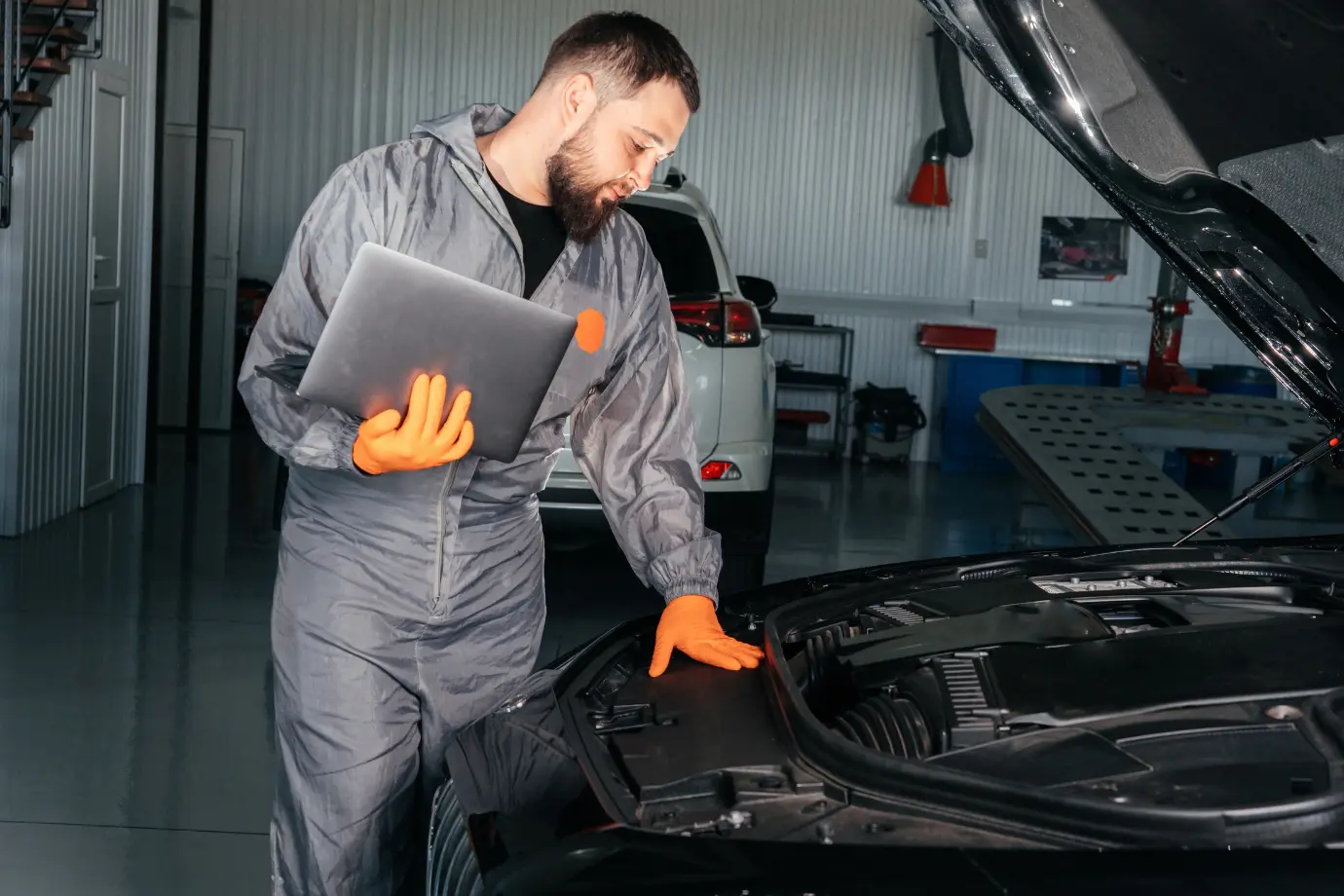
Technician errors persist primarily because even well-trained technicians work from documentation that is difficult to navigate under workshop conditions. Training provides foundational knowledge, but errors happen at the point of execution, when a technician is under time pressure, working on an unfamiliar variant, or relying on a manual that no longer reflects the current model specification.
The problem is structural, not behavioral. Paper-based service manuals and static PDFs share a fundamental limitation: they present information in a linear, document-centric format that does not match the way hands-on diagnostic and repair work actually unfolds. A technician completing a brake system overhaul does not read a chapter first, and they work. They move between the vehicle, the documentation, and their tools repeatedly, often across 15 to 30 discrete steps.
Each transition introduces a failure point. The technician may lose their place, misread a value, or assume a step is complete when it is partially done. These are not training failures but documentation design failures.
What Makes Paper-Based Service Manuals a Source of Operational Risk?
Paper-based manuals create operational risk through version fragmentation, information density, and the absence of any enforcement mechanism. When an OEM releases a technical service bulletin or a specification update, there is no reliable way to ensure that the updated information reaches every technician in every dealer location before the next relevant repair is attempted.
Three structural risk factors are present in almost every paper-based documentation environment:
- Version drift: Dealers operate with different printed editions. A technician in one regional market may work from a manual that reflects specifications superseded six months ago.
- Specification burial: Critical values such as torque figures, fluid volumes, and clearance tolerances appear embedded in dense procedural text. Under workshop conditions, a technician reading quickly is more likely to miss a value than to catch an error.
- No competition verification: There is no record of which steps were completed, in what order, or by whom. Errors are only visible after the fact, typically at a quality inspection or, in the worst case, at a warranty claim.
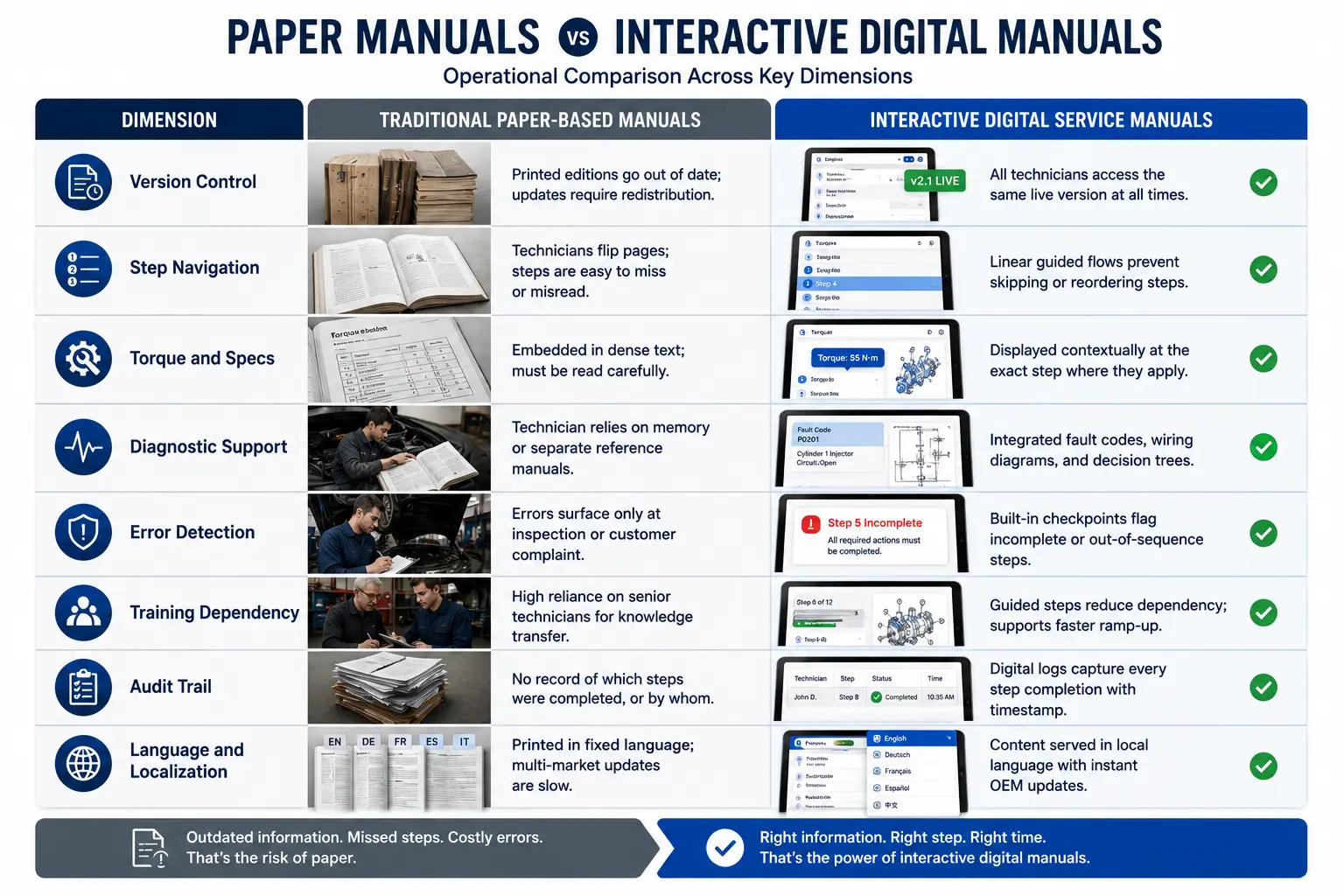
The table below contrasts these conditions with what interactive digital manuals provide at the operational level:
Replace static PDFs and paper manuals with guided, interactive digital service documentation. Book a Demo of Intelli Manual Today
What is the Most Overlooked Risk in Manual-Based Service Operations?
The most overlooked risk is not the error itself but the absence of an audit trail. When a warranty claim is filed, and the root cause is traced to a service procedure, OEM technical teams often cannot determine whether the error was a documentation issue, a training issue, or a technician's deviation. Without step-level completion logs, every investigation starts from zero.
This has a direct cost implication. According to Warranty Week's Worldwide Auto Warranty Expenses report, global automotive OEMs paid an estimated USD 43.1 billion in warranty claims in 2022, highlighting the substantial financial impact of quality issues, recalls, and repair-related failures across the industry. The inability to distinguish documentation-related errors from technician errors makes it very difficult to close the loop on repeat failures.
How Do Interactive Digital Service Manuals Structurally Reduce Errors?
Interactive digital service manuals reduce technician errors by redesigning the relationship between the procedure and the technician. Instead of presenting a complete document for the technician to navigate independently, they deliver procedure steps in a controlled sequence, with contextual information appearing at the moment it is needed.
The core error-reduction mechanisms include:
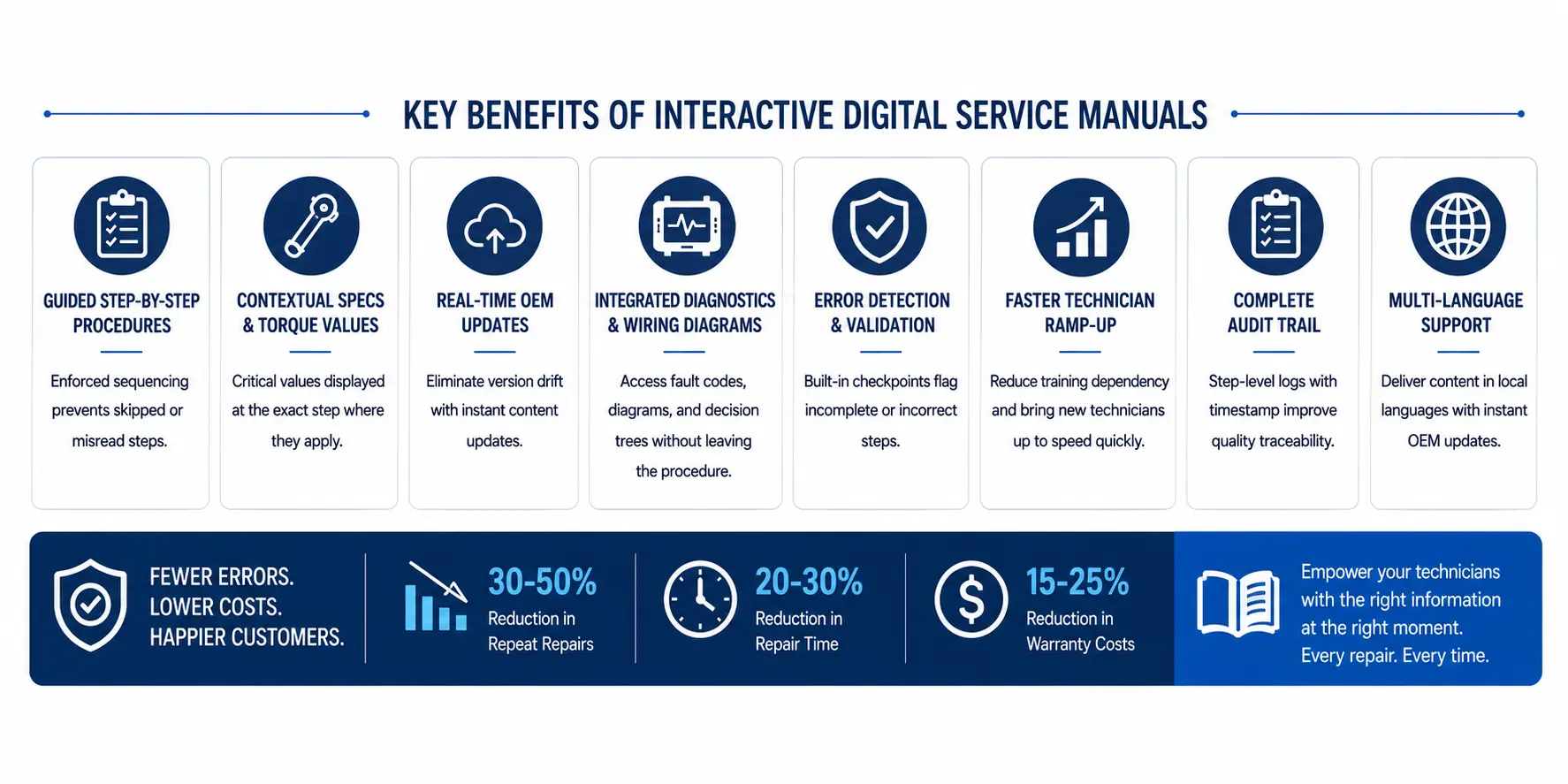
- Enforced step sequencing: Technicians cannot advance to the next step until the current step is confirmed. This eliminates step-skipping, which McKinsey’s 2021 automotive service operations benchmark identified as the most common cause of repeat repair visits.
- Contextual specification display: Torque values, gap tolerances, and fluid specifications appear as overlays or callouts at the specification step where they apply, not in a separate reference section that requires the technician to cross-reference.
- Embedded visual guidance: Exploded diagrams, 2D and 3D component views, and annotated photographs appear inline with the procedural step rather than on a separate plate at the back of a chapter.
- Integrated fault code lookup: When a procedure involves diagnostic checks, fault code definitions and decision trees are accessible without leaving the procedural context.
- Real-time OEM updates: When a technical service bulletin changes a specification, the update appears in the relevant step for every user, without requiring a new print run or redistribution.
What is a Common Implementation Mistake When Deploying Digital Manuals?
A common implementation mistake is treating the digital manual as a digitized version of the paper manual rather than as a redesigned workflow tool. OEMs that simply convert their existing PDF documentation into a digital viewer without restructuring the content at the step level do not achieve meaningful error reduction. They produce a searchable PDF, which is a modest improvement but not a structural one.
Effective implementation requires a content restructuring exercise before deployment. Procedures need to be broken into discrete, verifiable steps. Specifications need to be mapped to the specific steps where they apply. This restructuring is the time-consuming part, but skipping it produces a digital tool that replicates the same documentation design failures as the original paper manual.
Which Technician Error Categories Do Digital Manuals Address Most Effectively?

Interactive digital service manuals address three categories of technician errors more effectively than any other intervention: step-omission errors, specification-misapplication errors, and outdated-procedure errors. These three categories account for the majority of documented service quality failures in OEM aftersales audits.
- Step omission errors occur when a technician completes a procedure but skips one or more steps, either because the steps are non-obvious in a paper format or because the technician is following a memorized sequence from a similar but different procedure. Enforced sequencing eliminates this category.
- Specification misapplication errors occur when a technician applies a value from memory or from an older procedure rather than from the current documentation. Contextual specification display eliminates the need for the technician to recall or cross-reference values.
- Outdated-procedure errors occur when the technician’s physical documentation does not reflect the current model specification. Live OEM updates eliminate version drift at the point of use.
A fourth category, diagnostic interpretation errors, is partially addressed by integrating fault codes libraries and wiring diagrams into the procedural flow, but this requires a higher level of content integration and is not universally implemented across all digital manual platforms.
What is the Counterintuitive Finding About Senior Technician Error Rates?
The counterintuitive finding is that senior technicians often benefit more from interactive digital manuals than junior technicians do, but for a different reason than training advocates typically expect. Senior technicians are less likely to skip steps from lack of knowledge. They are more likely to make confident substitution errors, applying remembered specifications from procedures they have completed hundreds of times.
When a platform enforces step-level engagement and displays current contextual specifications, it interrupts the senior technician’s reliance on procedural memory at the exact moment it is most likely to cause an error. Several European automotive OEMs have reported in internal quality audits that error rates among technicians with more than 10 years of experience dropped more sharply after the deployment of digital manuals than among technicians with fewer than 3 years of experience.
How Does Intelli Manual Address These Operational Requirements?
Intelli Manual is an interactive electronic technical manual platform designed specifically for OEM aftersales and dealer network environments. It addresses the structural causes of technician error by replacing static documentation with guided, step-controlled procedures that deliver specifications, visuals, and diagnostic reference in context.
The platform’s approach maps directly to the error categories and operational requirements described in the preceding sections.
For step omissions control, Intelli Manual delivers procedures as enforced sequential flows. Technicians confirm each step before advancing. The platform records completions with the technician's identity and timestamp, creating the audit trail that paper-based operations cannot provide.
For specification accuracy, specifications and torque values appear as contextual overlays at the step level. When an OEM issues a technical service bulletin, the update is applied directly in the relevant step and becomes visible to all dealers immediately.
For diagnostic integration, fault codes, wiring diagrams, and component references are embedded within the procedural flow rather than held in separate reference documents. This reduces the time a technician spends context-switching between sources during diagnostic procedures.
The platform’s content authoring environment enables OEM technical publications teams to control procedure structure, update specifications, and manage multi-language versions without requiring vendor involvement for routine updates.
Intelli Manual supports offline operation for dealer environments with unreliable connectivity, with synchronization occurring when connectivity is restored. This removes a practical adoption barrier that causes technicians to abandon digital tools in favor of paper fallbacks. The platform is also designed to support the smart repair process by providing guided access to the correct procedure based on job card data from the dealer’s workflow system.
How Does Intelli Manual Support Service Heads Transitioning from Paper?
Service heads transitioning from paper-based operations to digital documentation face a change management challenge as much as a technology challenge. Technicians with established working patterns may initially resist guided digital procedures, particularly senior technicians who perceive the step enforcement as a constraint on their expertise.
Intelli Manual’s approach to this transition focuses on reducing friction rather than imposing control. The platform presents procedures in a format that experienced technicians find familiar while adding the verification and contextual support that paper manuals cannot provide. Adoption data from OEM dealer networks that have deployed the platform indicates that resistance decreases significantly after technicians complete their first complex procedure using the guided format, particularly for procedures involving recently updated specifications.
Conclusion
Technician errors in OEM aftersales operations are not primarily a training problem. They are a documentation design problem. Paper-based and static digital manuals present information in formats that were designed for reading, not guiding hands-on repair work under workshop conditions.
Interactive digital service manuals address the structural causes of error by enforcing step sequencing, supplying specifications at the moment of use, and eliminating the version fragmentation that occurs when printed materials are distributed across large dealer networks.
The business case for OEM aftersales teams is grounded in warranty cost reduction, first-time-fix improvement, and the creation of audit trails that support both quality investigation and warranty liability management. The technology is mature, the operational case is well-established, and the implementation path is known.
The question for OEM aftersales directors is not whether to move in this direction. It is how to structure the content transformation and platform selection process to avoid the implementation mistakes that limit results.
Book a free demo of Intelli Manual today and see how interactive digital service manuals can reduce technician errors, improve service quality, and create a complete audit trail across your dealer network.
Frequently Asked Questions
How do interactive digital service manuals reduce technician errors compared to PDF manuals?
PDF manuals improve search and portability but do not change the underlying documentation design. Technicians still navigate non-linear content, locate specifications by scanning text, and confirm their own step completion. Interactive digital service manuals enforce sequential step completion, display specifications in context, and record each step with a timestamp. The error reduction comes from workflow control, not document format.
Can digital service manuals work in dealer workshops without reliable internet access?
Platforms designed for workshop use typically support offline operation, with procedure content cached locally on the technician's device. Updates synchronize when connectivity is restored. Platforms that require continuous internet access are a poor fit for workshop environments and tend to be abandoned in favor of paper fallbacks when connectivity is unreliable.
How long does it take an OEM to deploy interactive digital service manuals across a dealer network?
Deployment timelines vary significantly based on the scale of the procedure library and the degree of content restructuring required. OEMs that approach deployment as a content transformation project rather than a software rollout report more successful outcomes. A phased approach, starting with the highest-volume repair categories, allows the OEM to demonstrate value quickly while managing the restructuring workload.
How do interactive digital manuals support warranty claims reduction?
By creating a step-level audit trail, digital manuals allow OEM warranty teams to determine whether a warranty-relevant failure occurred because a procedure was not followed correctly. This allows OEMs to distinguish documentation-related failures from technician deviations, close the loop on repeat failure patterns, and provide evidence in disputes about warranty liability with dealers.
What is the difference between an interactive electronic technical manual and a standard service manual in PDF?
A PDF service manual is a digital version of a printed document. It is searchable and portable but delivers information in the same linear, document-centric format. An interactive electronic technical manual delivers procedure steps in controlled sequence, with contextual specifications, embedded visuals, and step confirmation. The format is designed around the workflow of a technician completing a repair, not around the structure of a printed publication.


Explore More Insights





.webp)


About the Author


Chandra Shekhar
Chandra Shekhar is the Senior Manager, Strategy & Business Development at Intellinet Systems. With over a decade of experience in the automotive industry, Chandra Shekhar has led digital transformation and aftersales strategy initiatives for OEMs across multiple markets. His background combines deep industry knowledge with a practical understanding of how technology can solve real operational challenges. He focuses on making complex ideas clear and relevant for automotive and aftermarket professionals navigating ongoing change.


