

Overview: OEMs are losing significant aftermarket revenue not because their parts are inferior, but because buying genuine parts is harder than buying third-party alternatives. This “cost of aftermarket alternatives” shows up in lost orders, dealer substitution, and declining customer loyalty. As aftermarket suppliers offer faster, simpler digital purchasing experiences, OEMs risk long-term erosion of both revenue and control over their service ecosystem.
In automotive, EV, construction, or heavy equipment dealer networks, loyalty to the OEM and preference for the OEM are not the same thing, and the gap between them is widening. The cost of aftermarket alternatives is not just a pricing difference; it is showing up as lost revenue, reduced control, and weakening dealer loyalty over time.
The dealer still sells your equipment, attends training events, and flexes your brand signage in their showroom. On paper, everything is the same.
But the parts orders have been declining, and OEMs capture only a fraction of potential aftermarket revenue.
The reason for this is not product quality. It is simply that OEMs' genuine parts have become harder to buy, while non-genuine parts have become easier to find.
The genuine OEM part is available somewhere in the authorized dealer network, but finding it requires navigating the OEM’s website to locate an authorized dealer, making phone calls, and waiting for quotes. By the time the dealer responds, the aftermarket part is already in transit.
This is the reality many OEMs face today. The cost of aftermarket alternatives is not just a number on a pricing sheet; it will show up in lost orders and weakened dealer loyalty over time. And all this happens without any alarm bells.
This blog breaks down where OEMs can actually lose ground to aftermarket parts, why it keeps happening, and what you can do to close the gap.
Why Is OEM Aftermarket Revenue Under Attack?

OEM aftermarket revenue is under attack because buyers are increasingly shifting to faster, easier-to-access third-party parts channels. While OEM parts often deliver higher long-term value, friction in discovery, pricing, and purchasing pushes customers toward convenient aftermarket alternatives.
Spare parts and service are not a secondary revenue line. According to McKinsey, aftermarket parts can deliver margins up to four times higher than new equipment sales. OEMs that follow a value-based pricing model often price equipment competitively at the front end and rely on aftermarket parts and services to drive long-term profitability.
That model works as long as end buyers keep coming back for genuine parts; however, when they start buying third-party alternatives, the OEM's entire revenue structure takes a hit.
The shift from genuine parts to non-genuine parts happens just because the experience of buying genuine parts is more difficult than it should be.
Where OEMs Actually Lose Revenue to Third-Party Parts

OEMs lose revenue across the entire parts buying journey, not in a single moment. Each friction point, from search to checkout, pushes buyers toward faster, more accessible third-party alternatives, compounding revenue leakage at every step.
The third-party parts' impact on OEM revenue is not confined to one channel; it plays out across the entire buying journey, and it compounds at every step.
- Dealers Cannot Find the Right Genuine Parts Quickly
OEMs lose revenue when technicians cannot quickly identify or locate genuine parts due to complex catalogs, poor search systems, or missing fitment clarity. Slow discovery pushes buyers toward aftermarket suppliers that offer faster, more intuitive search and instant availability.
When a dealer technician needs a replacement part, the first step is usually a search. If the OEM website requires users to know exact part numbers, go through complex PDFs or menus, or call a dealer to confirm the fitment, most technicians will not wait. Non-genuine parts suppliers offer clean catalog data, real-time inventory, and one-click checkout.
For OEMs with large, complex product lines, poor catalog usability directly leads to lost orders because technicians choose the fastest, most reliable option, usually aftermarket suppliers with simpler search, clearer fitment, and instant purchasing.
- Dealers Substitute Genuine Parts Without the OEM Knowing
OEMs also lose revenue when dealers substitute genuine parts with third-party alternatives due to stock gaps or urgency, often without informing the OEM. This hides true demand patterns and leads to both direct revenue loss and lost visibility into parts consumption.
Here is a scenario that plays out constantly across dealer networks: a technician contacts a dealer for a genuine part, but the dealer is out of stock; rather than losing the customer, the dealer recommends an available third-party substitute, thereby closing the sale without the OEM’s knowledge.
Dealers are not trying to undermine the OEM, but their motto is to keep customers happy with what they have available. But from the OEM’s perspective, this is a double loss: the revenue from that transaction and the data on what buyers need.
Without visibility into dealer-level substitution patterns, OEMs cannot fix stocking problems, cannot identify demand signals, and cannot protect their most profitable revenue stream.
- The Genuine vs Aftermarket Parts Gap Widens on Price Strategy
OEMs lose revenue when price becomes the only visible decision factor, with aftermarket parts winning on upfront cost while OEMs fail to communicate lifecycle value, durability, and lower failure rates.
When buyers compare genuine vs aftermarket parts, the immediate price difference is hard to ignore. According to Roland Berger Aftermarket Pulse 2025, U.S. consumer preference for independent aftermarket parts over OEM-authorized parts has continued to rise, with 57% of consumers now favoring independent aftermarket brands, an increase of 14 percentage points from 2024. The report also notes that U.S. consumers continue to shift toward independent repair shops, driven primarily by lower prices and shorter wait times.
OEM parts are priced 30-50% above independent alternatives on average, a premium that was historically justified by quality assurance and brand trust and is now being systematically questioned by both customers and workshops.
What gets missed in that comparison is the total cost. The upfront saving often turns into a higher total cost of ownership, but that story is rarely told clearly at the point of purchase. Aftermarket parts carry a secondary repair rate of 22 percent, compared to just 8 percent for genuine OEM parts.
OEMs that do not communicate the long-term value of genuine parts effectively are letting third-party suppliers win on price without defending on value.
- Friction in the Transaction Process Pushes Buyers to the Easiest Option
74% of B2B buyers say they would switch suppliers if a competitor offered a better digital buying experience. For OEMs relying on slow quote-based workflows, this is a direct revenue risk, as buyers increasingly prioritize speed, transparency, and ease of purchase over brand loyalty.
Even when a technician wants genuine parts, OEM buying journeys often introduce unnecessary friction. Common issues include being redirected to dealer locators, waiting for quote responses via email or phone, and dealing with inconsistent pricing across dealer networks. When non-genuine suppliers offer instant checkout and real-time availability, they consistently win on convenience.
B2B buyers today expect consumer-like digital experiences. According to a Sana Commerce study, 74% of buyers will switch suppliers for better digital buying experiences. This makes transaction friction one of the most critical drivers of OEM revenue loss.
- Loyalty Erodes Quietly Over Time
OEM revenue loss compounds over time as repeated friction and substitution gradually shift buyer behavior from OEM channels to aftermarket ecosystems, reducing both repeat purchases and long-term brand dependence.
Every frustrating parts ordering experience plants a seed of doubt in technicians' or dealers' minds. Over time, buyers who start with one or two aftermarket parts begin to rely on third-party suppliers. By the time OEMs see the revenue decline, the buying behavior has already shifted.
The damage extends beyond the parts transaction. Customers who lose confidence in an OEM's after-sales support are also more likely to consider third-party suppliers for parts or service requirements.
Why OEM Revenue Loss Keeps Happening Despite Good Products

OEM revenue loss continues because product superiority cannot compensate for structural and digital friction in the buying journey. Buyers shift to aftermarket suppliers when OEM systems are slower, harder to navigate, or less transparent.
Most OEMs produce higher-quality parts with tighter engineering standards, exact fitment, and verified compatibility. However, the purchasing experience is still built around legacy dealer workflows that require calls, quotes, and delays. In contrast, aftermarket suppliers offer fast, searchable catalogs and instant purchasing.
The core issue is not product quality but process design. When buyers cannot quickly find, confirm availability, or complete a purchase, they default to the easiest available alternative.
What OEMs Can Do to Protect Aftermarket Revenue and Control
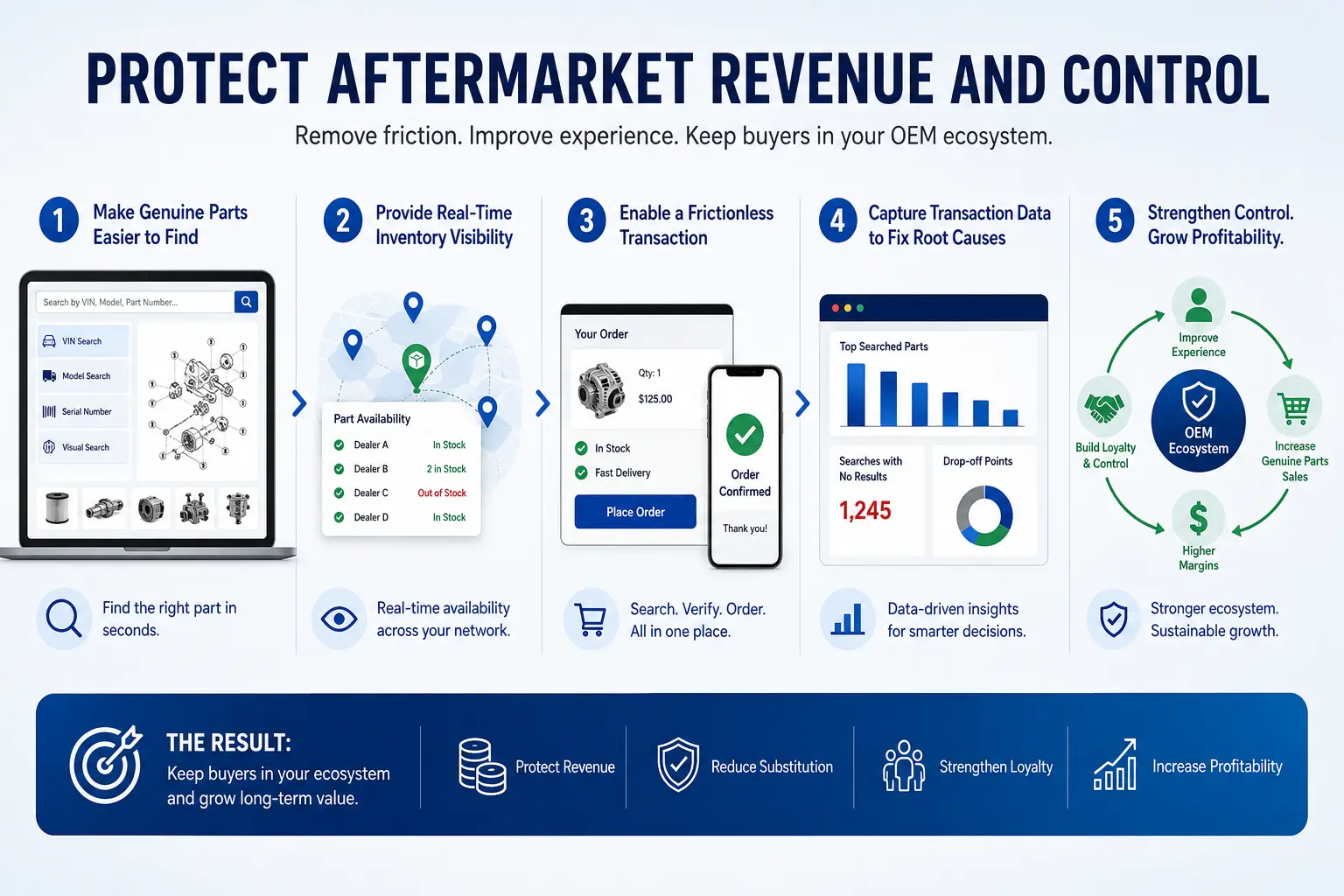
OEMs can protect aftermarket revenue by removing friction across parts discovery, availability, and purchasing. When genuine parts are easy to find, verify, and order, buyers are far less likely to switch to aftermarket alternatives and remain within the OEM ecosystem.
- Make genuine parts easier to find than alternatives. Invest in an electronic parts catalog like Intelli Catalog that supports multiple search methods, including VIN, serial number, model, and visual or AI-based search. When buyers can identify the right part in seconds without needing to contact a dealer, they have no reason to go elsewhere.
- Provide dealers and buyers with real-time inventory visibility. Aggregate inventory across the dealer network and make it visible in real-time to buyers, thereby eliminating contact for availability friction. By displaying product availability and delivery cost on their parts catalog, OEMs offer real-time visibility to dealers to win the sale.
- Enable a frictionless transaction from start to finish. Reduce the number of steps between product discovery and order confirmation. Buyers should not need to leave the OEM digital environment to complete a purchase. For this, OEMs can integrate an electronic parts catalog such as Intelli Catalog with a distributor management platform like Intelli Commerce, enabling users to identify the correct part, check availability, and place orders from a unified digital experience.
- Capture transaction data to fix the root causes. Without data on what parts buyers are searching for, what they cannot find, and where they drop off, OEMs cannot make informed decisions about inventory, pricing, or catalog coverage.
How Intelli Catalog Helps OEMs Close the Gap
Intelli Catalog reduces aftermarket leakage by replacing fragmented catalog and ordering systems with a unified digital experience. It improves speed, accuracy, and dealer efficiency across the parts lifecycle.
Intelli Catalog, an AI-powered electronic parts catalog software, supports multiple identification methods, including VIN lookup, model browsing, figure search, natural language queries, and visual search. This results in faster identification and fewer ordering errors.
For OEMs, the platform also centralizes catalog management, dealer tracking, and order flow visibility through a unified dashboard, reducing dependency on disconnected dealer systems.
The Longer You Wait, the Harder It Gets to Recover
OEM revenue loss compounds over time because buyer behavior becomes habitual. Once customers shift to aftermarket suppliers, it becomes difficult to bring them back due to both inertia and convenience advantages.
The real cost of aftermarket alternatives is not just lost transactions but the long-term shift in buying behavior. Every friction-filled experience increases the likelihood of switching to third-party suppliers.
OEMs that act early win by making genuine parts easier to find, confirm, and order than any alternative available in the market.
If your aftermarket revenue is not growing alongside your installed base, the gap likely has less to do with your parts and more to do with the process of buying them. Book a demo to know how Intelli Catalog can help you close that gap.
FAQ
Why do dealers substitute genuine parts with aftermarket alternatives?
Dealers often substitute genuine parts with aftermarket alternatives when OEM parts are not immediately available or when the quoting and ordering process takes too long. Their priority is to keep the customer’s equipment running with minimal downtime, even if that means choosing a non-genuine option. In many cases, these substitutions happen without formal reporting back to the OEM, making them invisible in demand data. This leads to both lost revenue and reduced control over parts strategy.
What is the true cost of aftermarket parts compared to OEM parts?
The true cost of aftermarket parts goes beyond the initial purchase price difference. While aftermarket parts are often cheaper upfront, they can result in higher long-term costs due to higher failure rates, repeat repairs, and reduced equipment uptime. Studies show that repair rates for aftermarket components can be significantly higher than OEM parts, increasing lifecycle maintenance costs. When these downstream costs are factored in, the total cost of ownership often favors OEM parts.
How can OEMs prevent revenue loss to third-party parts suppliers?
OEMs can reduce revenue loss by eliminating friction across the parts discovery and purchasing journey. This includes improving catalog searchability, enabling real-time inventory visibility, and reducing dependency on manual quote-based systems. When buyers can quickly identify, verify, and purchase genuine parts, the incentive to switch to aftermarket suppliers decreases significantly. Strengthening digital infrastructure is often more effective than competing on price alone.


Explore More Insights





.webp)


About the Author


Chandra Shekhar
Chandra Shekhar is the Senior Manager, Strategy & Business Development at Intellinet Systems. With over a decade of experience in the automotive industry, Chandra Shekhar has led digital transformation and aftersales strategy initiatives for OEMs across multiple markets. His background combines deep industry knowledge with a practical understanding of how technology can solve real operational challenges. He focuses on making complex ideas clear and relevant for automotive and aftermarket professionals navigating ongoing change.


