

Overview: Warehouse inventory optimization for OEM parts operations means matching what is stocked, where it is stocked, and how it gets replenished to actual dealer and service demand, instead of carrying broad safety stock across every SKU. The core issue for OEMs is scale: a full-line parts catalog can run into the hundreds of thousands of active part numbers, demand is heavily concentrated in a small share of those numbers, and a stockout on the wrong part still sends a vehicle back to the service bay unrepaired or pushes a dealer toward an aftermarket supplier for a one-time sale.

Getting inventory right depends on segmenting SKUs by demand velocity, keeping part number and fitment data clean enough that the ordered part matches the vehicle the first time, positioning stock closer to regional demand, and tracking fill rate and backorder performance by distribution center rather than only at the network level. The practical result of doing this well is fewer emergency shipments, fewer wrong-part returns, and a dealer network that keeps ordering through the OEM supply chain instead of routing more business to aftermarket channels.
Key Takeaways:
- Warehouse inventory optimization means aligning stock levels and location with real demand patterns, not simply increasing stock across the board.
- OEM parts operations differ from independent aftermarket distribution because dealer network structure, warranty obligations, and brand control change how and where inventory sits.
- Long-tail service parts (low turn, high SKU count) need a different stocking approach than high-turn maintenance items.
- Catalog and fitment data accuracy has a direct effect on inventory accuracy, since misidentified parts create false demand signals and avoidable returns.
- Fill rate, backorder rate, and dead stock percentage are the metrics that show whether optimization efforts are actually working.
What Does Warehouse Inventory Optimization Mean for OEM Parts Operations?
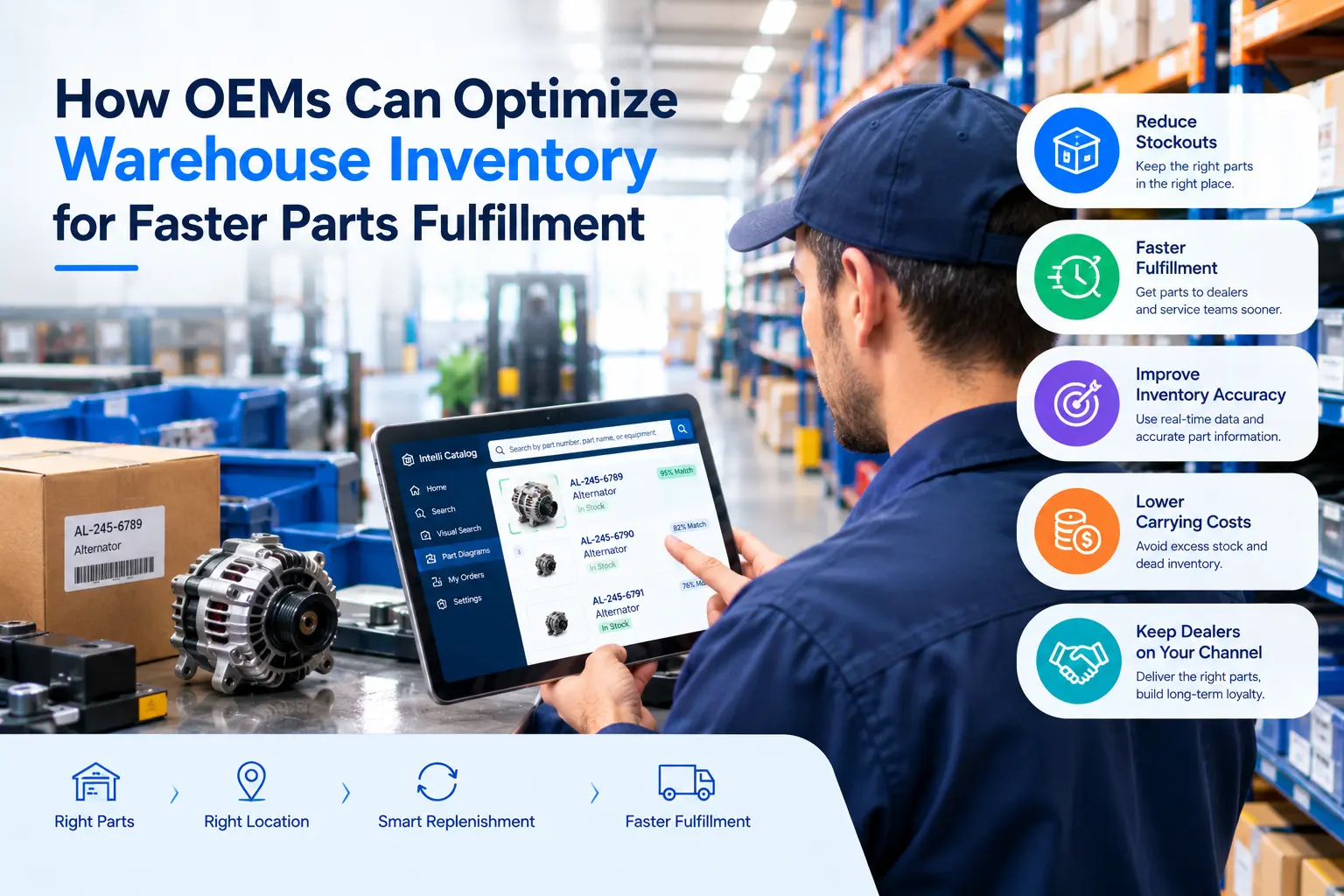
Inventory Management System covers the day-to-day decisions around stock levels, storage locations, and replenishment rules, while warehouse inventory optimization focuses on improving those decisions so parts availability matches real demand at each distribution point. For OEMs, that means balancing dealer service needs, warranty parts obligations, and long-tail SKU coverage against warehouse space and carrying cost.
This is not a one-time project. Demand shifts every model year as new parts enter the catalog and older ones move toward the end of production. A part that sold steadily for three years can drop off overnight once a redesign hits the assembly line, and a part that barely moved can spike when a recall or a service bulletin comes out. Optimization means the stocking rules keep adjusting to that, not that a warehouse gets re-slotted once and left alone.
For an OEM, this plays out across at least two layers: the central or regional distribution center that supplies, and the dealer parts department itself. Both layers need their own view of demand, because a part that is fast-moving at the network level might still be slow at any individual dealer.
What Does ‘Long-Tail’ Mean in Spare Parts?
Long-tail parts are spare parts that:
- Have many different part numbers (SKUs)
- Sell very rarely
- May be needed only once every few months or even years at any particular location
For example, a dealer may regularly sell brake pads and oil filters, but a specific engine bracket might be needed only once a year. That engine bracket is a long-tail part.
Why Do OEM Parts Warehouses Struggle With Fulfillment Speed?
Fulfillment speed can suffer when SKU counts are high, demand is spread thinly across the catalog, and superseded part numbers are not reflected promptly in warehouse systems and physical bin locations. Add inconsistent dealer ordering habits and a warehouse layout built around history rather than current pick frequency, and even well-stocked facilities ship slower than they should.
A few patterns show up again and again in OEM and dealer operations:
- Model year proliferation: Each new model year adds part numbers without necessarily retiring old ones immediately, since vehicles already on the road still need service.
- Supersessions: When a part number is replaced, accurate cross-reference data must be synchronized across every system, including the parts catalog, warehouse management system, and dealer counter screen. A gap in any of those causes a picker to pull the wrong bin or a counter person to order a part that is no longer active.
- Warranty parts obligations: OEMs must continue supporting vehicles under warranty even as demand for certain parts declines, leaving some low-velocity SKUs in inventory for years.
- Slotting that does not match current velocity: Warehouses built around yesterday’s top movers keep fast-moving parts in slow-to-reach locations, adding pick time on every order regardless of how much stock is on hand.
- Dealer ordering behavior: Dealers batch orders based on cash flow, order minimums, and confidence in a given distribution center’s (DC’s) fill rate, which can make underlying demand appear more volatile than it is.
What Are the Core Levers for Automotive Parts Warehouse Management?
The levers that actually move fulfillment speed are demand segmentation, velocity-based safety stock, slotting by pick frequency, disciplined supersession management, and a cycle counting program that catches errors before they become stockouts. None of these require exotic technology; they require consistent execution.
How Do OEM, Dealer, and Distributor Roles Differ in Parts Inventory?
An OEM central warehouse, a franchised dealer parts department, and an independent aftermarket distributor are not running the same playbook, even when they stock overlapping parts. Ownership of the catalog, replenishment source, warranty obligations, and brand control all differ, and treating them as interchangeable leads to stocking decisions that do not fit any of the three.
Independent aftermarket businesses are not bound by OEM warranty obligations or brand-specific fitment data the way a franchised dealer or OEM DC is, which is why their inventory mix skews toward high-turn categories like brakes, filters, and belts rather than full parts coverage.
How Should OEMs Manage Long-Tail Parts?
Spare parts warehouse management requires a different approach for long-tail parts than for high-turn maintenance items. Keeping these parts at every dealer or warehouse is expensive because they may sit unused for years, but keeping too little inventory can delay repairs when a rare part is needed.
A better approach is to use different stocking levels at different locations:
- Dealers: Keep common, fast-moving parts such as filters, brake parts, and belts.
- Regional distribution centers (DCs): Keep a wider range of parts that dealers need less frequently.
- National warehouses: Keep very slow-moving parts that might be needed only occasionally across the entire country.
For the slowest-moving parts, OEMs can also use direct shipping, sending the part from the distribution center directly to the dealer or customer. This can reduce inventory costs, as long as the delivery time is realistic and the service advisor knows when the part is expected to arrive.
How Does Catalog and Fitment Data Quality Affect Warehouse Inventory Accuracy?

Warehouse inventory accuracy depends on more than counting bins correctly. When a counterperson or online buyer orders the wrong part because of a fitment error or unclear supersession, the mistake can later appear as a return, a warehouse mis-pick, or a false demand spike that distorts the next forecast cycle.
This is where catalog quality and warehouse performance intersect, even though different teams manage them. A fitment error at the point of order does not stay contained to that one transaction. It generates a return that has to be processed, restocked, or scrapped. It can also inflate apparent demand for the wrong part number while understating demand for the correct one, causing forecasts to be built on inaccurate data.
Electronic parts catalog software, such as Intelli Catalog, helps solve the identification side of this problem by ensuring that the part shown to a counterperson, technician, or online customer fits the vehicle and reflects the latest supersession before the order is placed. That does not replace a warehouse management system or a demand planning tool, and it will not fix a warehouse that is poorly slotted or under-staffed. What it can do is reduce one of the upstream causes of inventory noise, so the numbers a warehouse team is optimizing against are closer to real demand in the first place.
Conclusion
Warehouse inventory optimization for OEM parts operations is not about carrying more stock; it is about carrying the right stock in the right place, backed by clean catalog and fitment data so demand signals reflect what customers actually need. OEMs, dealers, and distributors operate under different constraints, and a stocking strategy that ignores those differences will underperform no matter how much technology sits on top of it. The operations that get this right combine demand segmentation, disciplined supersession management, and metrics tracked by SKU class, not network averages, and they treat catalog accuracy as part of the inventory problem rather than a separate concern.
Book a Demo
Wrong-part orders and unclear supersessions are two of the quieter causes of inventory noise in an OEM parts operation. Book a demo to see how Intelli Catalog helps dealers and service teams identify the correct part the first time, and how it fits alongside your existing warehouse and dealer ordering workflows.
FAQ
What is warehouse inventory optimization in automotive parts operations?
It is the practice of setting stock levels, storage locations, and replenishment timing to match actual demand at each warehouse or dealer, instead of applying the same safety stock rule to every part. The goal is fewer stockouts on fast-moving parts and less capital tied up in slow-moving ones.
How is OEM parts warehouse management different from aftermarket distributor inventory?
OEM warehouses carry warranty and long-tail obligations tied to every vehicle still in service, while independent aftermarket distributors stock mainly high-turn, cross-brand wear items with no obligation to cover low-volume or discontinued parts. The inventory mix and replenishment source differ accordingly.
What causes backorders in OEM parts warehouses?
Common causes include poor demand segmentation, safety stock rules that do not reflect actual part velocity, supersession data that lags between the catalog and the warehouse system, and warehouse slotting built around outdated pick patterns rather than current demand.
How does catalog data quality affect warehouse inventory accuracy?
Fitment or part identification errors at the time of order can lead to returns and mis-picks that are recorded as warehouse problems. They can also distort demand signals for both the incorrect and correct part numbers, which can throw off forecasting and replenishment.
What metrics show if automotive parts warehouse inventory is optimized?
Line fill rate, backorder rate by SKU velocity class, inventory turns by class, and dead stock percentage together show whether stock is positioned correctly. Total inventory value can look healthy even when some parts are overstocked, and others are understocked.


Explore More Insights







.webp)


About the Author


Chandra Shekhar
Chandra Shekhar is the Senior Manager, Strategy & Business Development at Intellinet Systems. With over a decade of experience in the automotive industry, Chandra Shekhar has led digital transformation and aftersales strategy initiatives for OEMs across multiple markets. His background combines deep industry knowledge with a practical understanding of how technology can solve real operational challenges. He focuses on making complex ideas clear and relevant for automotive and aftermarket professionals navigating ongoing change.


