

Overview: A warranty claims process is the set of steps an OEM follows to receive, validate, approve, and reimburse a warranty claim from a dealer or supplier. A seamless warranty claims process removes manual bottlenecks among dealers, OEMs, and suppliers by automating validation, routing, and payment. This guide covers the five steps OEMs need to build a warranty claims process that runs faster and with fewer errors, plus common questions about switching to a warranty claim processing system.

Key Takeaways:
- A warranty claims process covers submission, validation, approval, and reimbursement of a claim.
- Manual, spreadsheet-based systems slow this down and increase the risk of errors and fraud.
- Five steps make the process seamless: centralized data, automated validation and routing, defined roles, real-time visibility, and closed-loop supplier recovery.
- A dedicated warranty claims processing system connects dealers, OEMs, and suppliers on one platform instead of scattered spreadsheets and emails.
- Faster, more accurate claims processing lowers cost per claim and improves dealer and customer satisfaction.
Ready to Streamline Your Warranty Claims Process? Schedule a personalized demo today.
What Is a Warranty Claims Process?
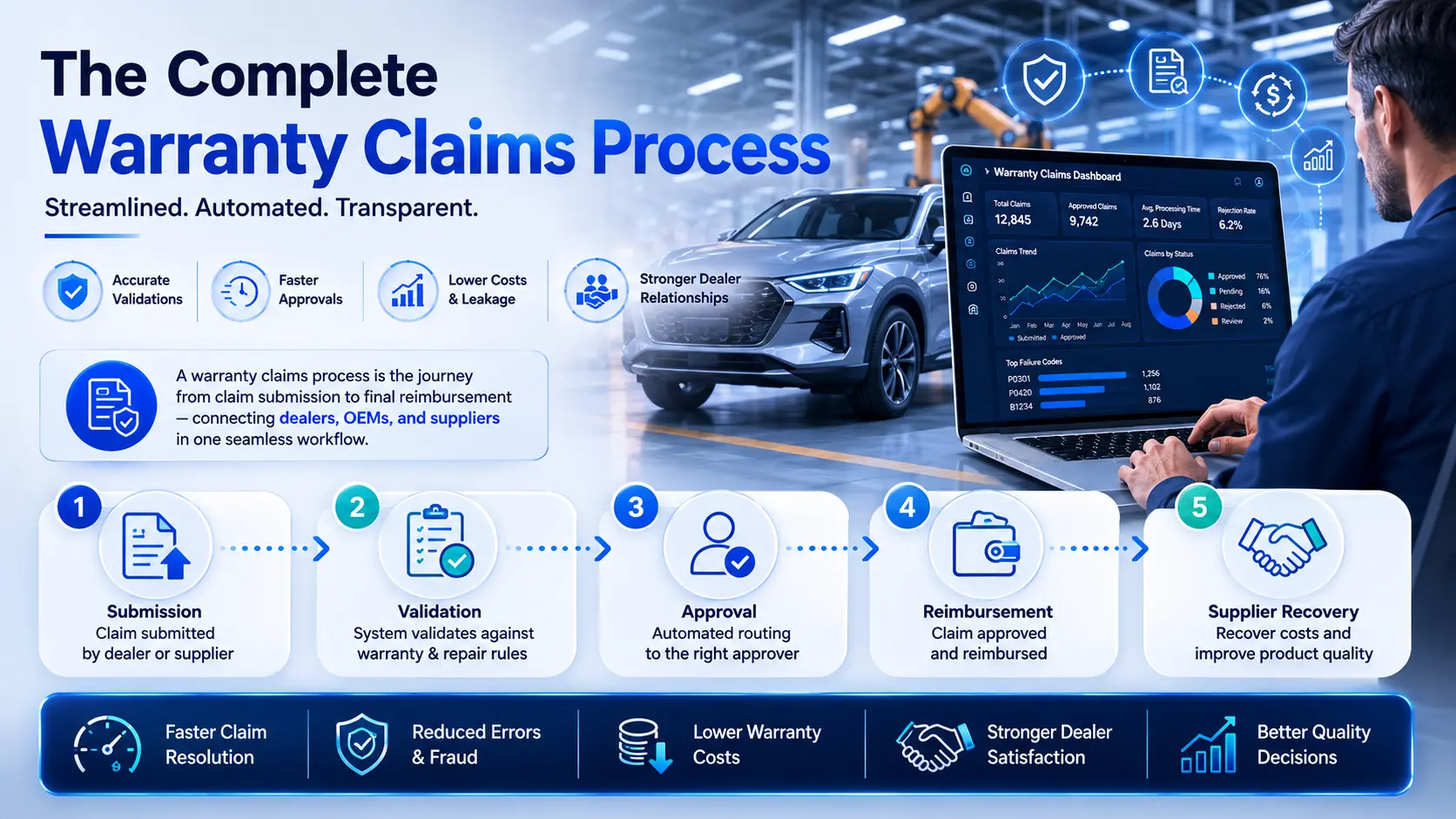
A warranty claims process is the sequence of steps an OEM uses to receive, verify, approve, and pay a warranty claim filed by a dealer, distributor, or supplier. It covers claim submission, data validation, approval routing, reimbursement, and supplier recovery, from the first filing to final payout.
For most OEMs, this process touches several teams at once: dealer service departments, OEM warranty administrators, and part suppliers. When it works well, a claim moves through validation and approval in a matter of days. When it depends on spreadsheets, email threads, and manual checks, that same claim can sit unresolved for weeks, tying up cash and creating friction with the dealer network.
Why Does a Seamless Warranty Claims Process Matter for OEMs?
A seamless warranty claims process matters because delays and errors directly increase cost, hurt dealer relationships, and open the door to fraud. Every extra day a claim sits unresolved adds administrative cost and slows reimbursement, which affects both OEM cash flow and dealer trust.
A study by WarrCloud found that processing a single warranty claim now takes 47% longer than it did five years ago, as manual review processes struggle to keep pace with growing claim volumes.
That extra time compounds across thousands of claims a year. Manufacturer warranty claims average five to eight days from submission to resolution industry-wide, while top performers using dedicated platforms complete the same claims in two to three days, according to industry benchmarking data. The gap between the average and the top performer is where most OEMs lose money without noticing.
5 Steps to Build a Seamless Warranty Claims Process
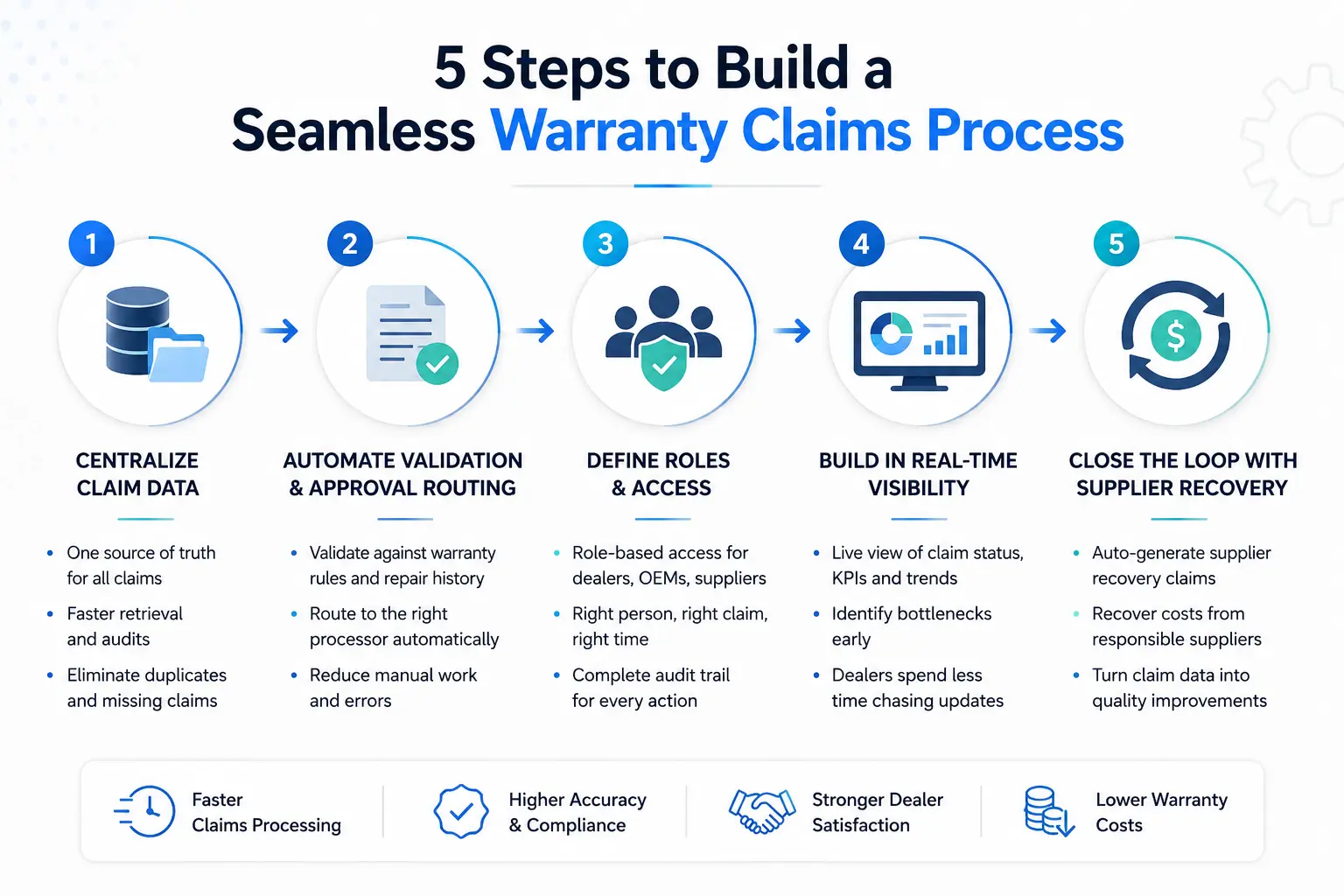
OEMs can build a seamless warranty claims process by centralizing claim data, automating validation and routing, defining clear roles, adding real-time visibility, and closing the loop with supplier recovery and feedback. Each step removes a specific point of delay in the current process.
1. Centralize Claim Data
Centralizing claims data means every claim, part number, repair record, and dealer submission lives in one system instead of scattered spreadsheets or emails.
- One record per claim, accessible to dealers, OEM staff, and suppliers
- Faster retrieval during audits or disputes
- Fewer duplicate or lost claims
2. Automate Validation and Approval Routing
Automating validation checks a claim against repair history, part usage, and warranty terms before it reaches a human reviewer. A programmable work queue then evaluates claim attributes and automatically routes the claim to the appropriate processor or review queue based on predefined rules.
- Claims are flagged for errors or fraud risk before approval
- Claims are routed to the right processor based on factors such as claim type, region, dealer, or designation
- Manual reassignment and data entry are reduced, helping shorten processing time
3. Define Roles and Access Clearly
Role-based access means each person, whether at the dealer, OEM, or supplier, sees and acts only on the claims relevant to their job, based on rules tied to region, dealer, part, or claim type.
- Reduces unauthorized access to sensitive claims data
- Speeds up approval because the right person sees the claim immediately
- Creates a clear audit trail for every action taken
4. Build In Real-Time Visibility
Real-time claim visibility gives OEMs, dealers, and suppliers a live view of where each claim stands, from submission to payment, instead of waiting on status update emails or phone calls.
- Dashboard shows pending claims rejection rates and average cycle time
- Bottlenecks get caught early instead of after month-end reporting
- Dealers spend less time chasing claim status
5. Close the Loop With Supplier Recovery and Feedback
Closing the loop means every approved claim tied to a supplier defect automatically triggers a supplier recovery claim, and claims data feeds back into product quality and dealer performance reviews.
- Recovers cost from suppliers instead of absorbing it internally
- Surfaces recurring part failures early
- Turns claims data into a feedback loop for product and dealer teams
What Does a Warranty Claims Processing Solution Actually Automate?
A warranty claims processing solution like Intelli Warranty automates claims intake, validation against warranty and repair rules, approval routing, supplier recovery, and reporting. It replaces manual handoffs between dealers, OEM staff, and suppliers with a single connected workflow, allowing claims to move through the entire process without repeated data entry or status-check calls.
Intelli Warranty supports six claim types:
Dealer PDI: Warranty claims related to dealer pre-delivery inspection
OEM PDI: Warranty claims related to OEM pre-delivery inspection
Post-Sale: Claims arising after the vehicle has been sold
Campaign: Claims associated with OEM campaigns or specific corrective actions
Spare Part: Claims related to defective or warrantable spare parts
Goodwill: Claims approved as a customer goodwill measure outside standard warranty coverage
It integrates with ERP and SAP systems to cross-check part orders during claims generation, and automatically generates a supplier claim once a dealer claim is approved.
Within Intelli Warranty, claims are routed based on OEM-defined rules such as region, designation, or dealer. Interactive dashboards give OEMs a real-time view of pending claims, rejection rates, and part return requests, helping them identify bottlenecks before they become month-end surprises.
What Should OEMs Look for in a Warranty Claim Processing System?
OEMs should look for a warranty claim processing system that integrates with existing ERP or DMS software, automates claim validation and routing, supports role-based access, and provides real-time reporting. Without these four, most of the manual bottlenecks in the current process remain.
Conclusion
A seamless warranty claims process comes down to five things: centralized data, automated validation and routing, clear roles, real-time visibility, and a closed loop with supplier recovery. OEMs that implement these capabilities within a dedicated warranty claims processing system spend less time tracking claim status and less on delays and errors, while giving dealers a faster and more predictable claims experience. The larger the dealer network, the more that speed and accuracy matter to the bottom line.
Book a free demo to see how Intelli Warranty, a purpose-built warranty claim processing system, handles claim intake, validation, and supplier recovery for OEMs at scale.
FAQ
What is the first step in building a warranty claims process?
Centralizing claim data is usually the first step. Before automation or routing rules can work, OEMs need one system where claim details, repair history, and part records live together. Without a centralized data source, automation just moves the same disorganized information faster instead of fixing the underlying problem.
What is warranty fraud, and how does a claims processing system prevent it?
Warranty fraud happens when claims are filed for repairs that were not performed, parts that were not used, or issues not covered under warranty terms. A claims processing system helps prevent this by automatically validating claims against repair history and part usage, while flagging anomalies such as repeat claims from a specific dealer.
Can a warranty claims processing system integrate with our existing ERP?
Most modern warranty claims processing systems are built to integrate with ERP, SAP, and DMS platforms already in use. This lets the system cross-check part orders, purchase history, and repair records automatically during claim validation, instead of requiring OEM staff to look up that information manually in a separate system.
Does automating the warranty claims process reduce cost per claim?
Yes. Automating validation, routing, and supplier recovery reduces the manual labor tied to each claim and cuts the time claims sit unresolved. Since both labor hours and claim aging contribute to cost per claim, removing manual steps lowers processing cost, even before accounting for reduced fraud and error rates.


Explore More Insights







.webp)


About the Author


Nishant Sharma
Nishant Sharma is the Marketing & Sales Lead at Intellinet Systems, specializing in B2B sales, digital marketing, and automotive aftermarket solutions. With extensive experience in driving business growth, lead generation, and go-to-market strategies, he is passionate about helping businesses adopt innovative technologies that enhance operational efficiency and customer experience. Through his articles, Nishant shares practical insights on industry trends, emerging technologies, and best practices shaping the future of the automotive aftermarket.


