

Overview: Pre-delivery inspections help ensure vehicles are ready for delivery, but delayed inspection data often limits an OEM's ability to act on issues in time. As dealer networks grow, real-time access to PDI data is becoming essential for improving visibility, supporting operational decisions, and maintaining consistent quality standards across locations.
For OEM operations teams, the value of real-time PDI data goes beyond simply digitizing an inspection checklist. The real advantage is having current vehicle-level information available while there is still time to act on an inspection result, resolve a defect, and make an informed delivery decision.
What Is Real-Time PDI Data and Why Does It Matter to OEM Operations?
Real-time PDI is inspection information captured digitally at the point of vehicle check and transmitted immediately to OEM systems, without manual upload steps, batch processing, or dealer-side delays. It gives operations teams a live view of which vehicles have passed, which are pending, and which have open defects, before dispatch decisions are made.
Traditional PDI processes rely on paper checklists or locally stored digital forms that get uploaded at the end of a shift or week. By the time the OEM sees the data, the vehicle may already be in transit or delivered to a customer. The inspection record exists, but the operational window to act on it has closed.
Consider a national distributor managing 40 dealer outlets across three regions. Under a batch-upload PDI model, the central operations team typically reviews inspection data 25 to 72 hours after the inspection occurs. For vehicles dispatched same-day, that means defects identified in the morning are invisible to operations until the following day at best. Real-time PDI data eliminates that window.
The business impact is direct: OEM teams can intervene before a defective vehicle moves, redirect inventory based on live readiness status, and hold dealers accountable to inspection completion standards without waiting for period-end reports.
In practice, this means PDI data becomes an operational input rather than a record that is reviewed after the vehicle has already moved through the delivery process.
What Are the Operational Pain Points That Make PDI Visibility a Priority Right Now?

The five pain points that consistently surface in OEM aftersales operations are delayed data visibility, inconsistent inspection quality across dealer networks, inability to link defects to pre-delivery versus post-delivery causes, reactive rather than proactive escalation handling, and the absence of inspection audit trails for warranty dispute resolution.
- Delayed Data Visibility
When inspection data arrives in batch form, operations teams make dispatch and delivery decisions on incomplete information. A regional OEM with 25 active dealer locations and a daily dispatch volume of 300 to 400 vehicles can experience a meaningful number of vehicles moving through the chain with unresolved PDI flags simply because no one could see them in time.
- Inconsistent Inspection Quality Across Dealer Networks
Without live monitoring, there is no reliable mechanism for the OEM to know whether an inspection was completed thoroughly or rushed. Dealers operating under delivery pressure will sometimes mark inspections complete without performing every check. This only becomes visible when a warranty claim arrives weeks later.
- Inability to Distinguish Pre-Delivery from Post-Delivery Defects
Without a timestamped, geo-tagged inspection record at the PDI stage, OEMs cannot reliably determine whether a defect reported by a customer existed before delivery. This creates warranty claim disputes that are expensive to resolve and damage dealer relationships. The absence of a clean inspection baseline is the root cause.
- Reactive Escalation Handling
When inspection issues are identified only through period-end reports or customer complaints, the response is always reactive. By contrast, OEM teams with live PDI data can identify patterns, such as a specific model variant consistently failing a particular check at one dealer outlet, and intervene before volume escalates.
- No Audit Trail for Warranty Disputes
When a customer raises a claim on a defect that should have been caught at PDI, the OEM’s ability to evaluate the dealer’s liability depends entirely on the quality of the inspection record. Paper records and manual uploads rarely provide the stamped, photo-evidence trail that makes these assessments defensible.
These challenges are closely connected. When inspection data is delayed or incomplete, the OEM loses both visibility into current delivery readiness and the historical evidence needed to understand what happened later.
How Does Real-Time Inspection Visibility Compare to Traditional PDI Approaches?
The table below contrasts the traditional, manual PDI model with a real-time digital approach across the dimensions that most affect OEM operations performance.
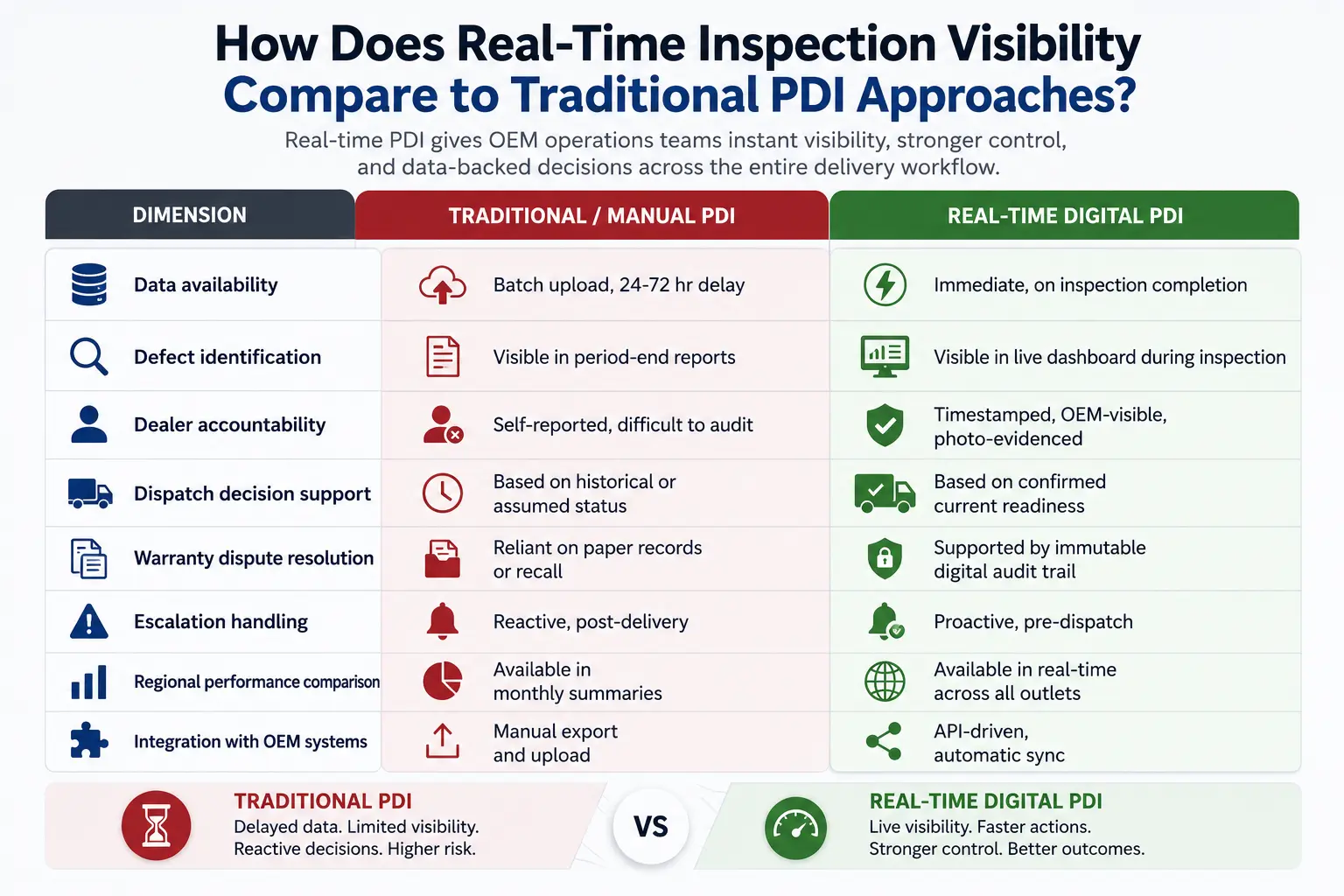
Real-time visibility into the pre-delivery inspection process allows OEM operations teams to monitor inspection progress, identify unresolved defects, and verify vehicle readiness before dispatch. Instead of relying on delayed reports, teams can access current inspection status across dealer locations and take corrective action while vehicles are still within the delivery workflow.
How Does Real-Time Visibility Into the Pre-Delivery Inspection Process Improve Delivery Readiness?
Live delivery readiness means the OEM operations team can, at any point in the working day, see the inspection status of every vehicle in scope: completed and cleared, completed with open defects, in progress, or not yet started. This is not a dashboard of yesterday’s data. It reflects the current state of the fleet as inspections are being conducted.
For a regional OEM manager overseeing 15 dealer locations with a combined active inventory of 1,200 vehicles, a live readiness view typically surfaces three categories of actionable information:
- Vehicles cleared for dispatch, with full inspection documentation attached
- Vehicles with open defect flags requiring resolution before release
- Vehicles where inspections are overdue or incomplete against the agreed inspection schedule
The operational value lies not just in seeing the data, but in being able to act on it without making phone calls or waiting for a report. If a dealer has 20 vehicles scheduled for delivery today and 6 of them have incomplete inspections, the OEM operations lead can see that at 8 AM and initiate a correction before the first truck leaves the yard.
This visibility also creates a clearer operational handoff between dealers and OEM teams because both sides can work from the same inspection status rather than separate reports or manually shared updates.
The Biggest PDI Bottleneck Isn't the Inspection -It's the Data Delay
Most OEM operations teams focus on speeding up the inspection itself when trying to improve PDI throughput. The actual bottleneck is usually the time between inspection completion and the OEM's receipt of the result. Compressing the inspection process by 20 minutes is far less valuable than eliminating the 36-hour data lag that follows it.
When inspection data is delayed, OEM teams cannot act on defects, adjust dispatch schedules, or prevent delivery issues in real time. By contrast, real-time PDI visibility enables immediate intervention while the vehicle is still in the delivery workflow.
For many OEMs, improving data flow delivers greater operational value than marginal improvements in inspection speed. Fixing the visibility gap often produces a larger impact on quality control, delivery readiness, and warranty risk than optimizing the inspection procedure itself.
How Does Real-Time PDI Data Reduce Warranty and Quality Risk for OEMs?
Real-time PDI data reduces warranty and quality risk by creating a verifiable pre-delivery baseline for every vehicle. When a warranty claim arrives, the OEM can immediately determine whether the reported defect was present, flagged, or absent at the time of inspection. This changes the economics of claim adjudication and the allocation of dealer liability.
The connection between PDI quality and warranty cost is not theoretical. Warranty costs remain a significant concern for automotive OEMs. In its Worldwide Auto Warranty Report (October 2025), Warranty Week reported that global automotive warranty claims increased by 18% between 2023 and 2024, highlighting the financial impact of quality issues that reach customers after delivery. While specific cost per claim varies by model and market, the pattern of PDI-related warranty exposure is well documented across the industry.
As an illustrative example, an OEM processing 80,000 vehicle deliveries annually across a 500-dealer network, where 3% of vehicles generate a PDI-related warranty claim in the first six months, is managing roughly 2,400 claims per year that could potentially be traced back to pre-delivery condition. If real-time PDI documentation allows the OEM to resolve 40% of those claims through evidence-based adjudication rather than full warranty payout, the financial impact is material.
Beyond claim costs, real-time PDI data supports proactive quality interventions. If a specific vehicle variant begins generating recurring defect flags at PDI across multiple dealer locations, the OEM quality team can identify the pattern within days rather than waiting for warranty data to surface the issue months later. That early signal is the difference between a contained quality response and a recall-scale event.
How Does Intelli PDI Address the Real-Time Visibility Gap in OEM PDI Operations?
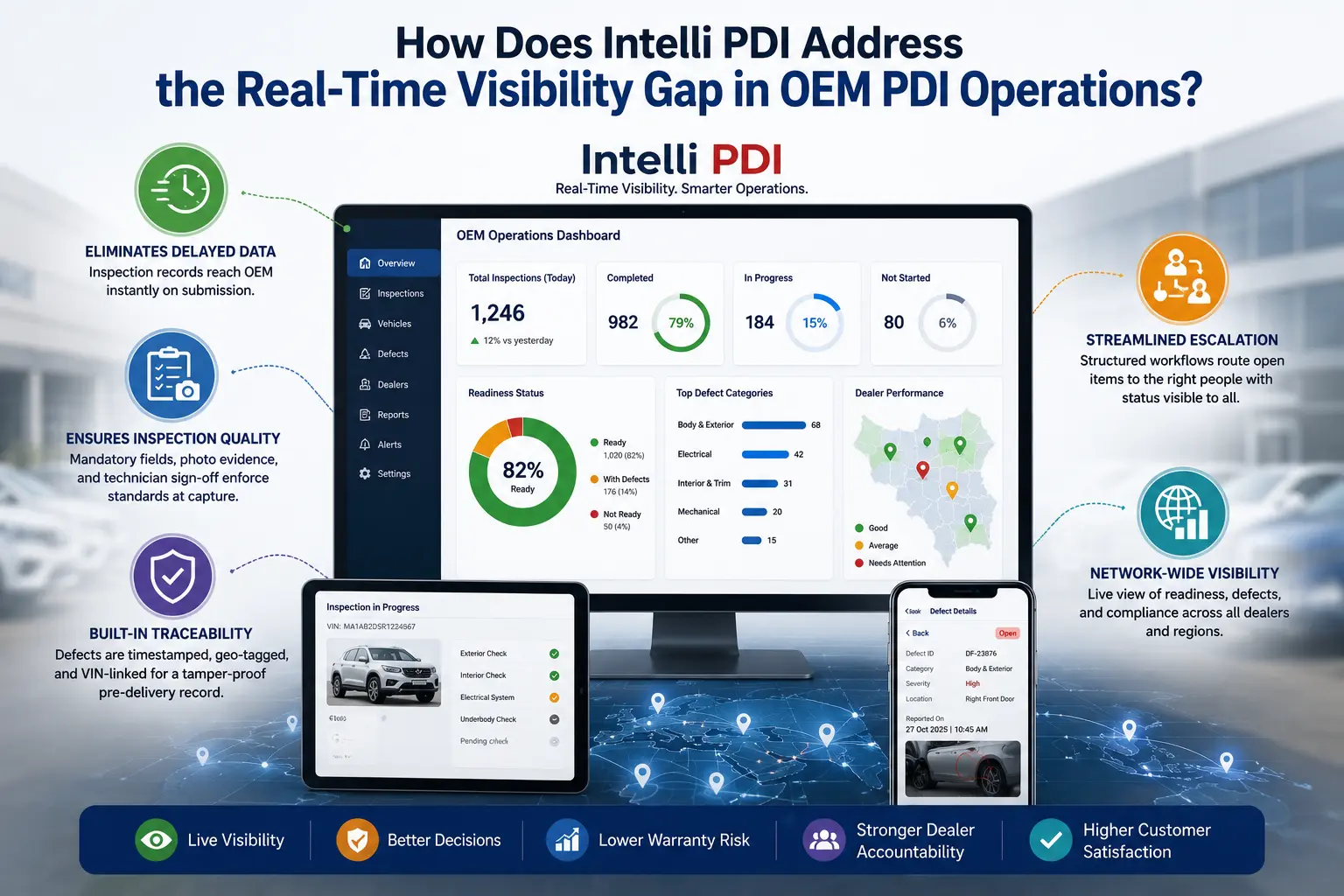
For OEMs evaluating what real-time PDI visibility looks like as a deployed platform, Intelli PDI illustrates how these capabilities work in practice across dealer networks.
Intelli PDI is a pre-delivery inspection platform designed for OEM and dealer network operations. It addresses the real-time visibility gap by capturing inspection data digitally at the point of check and making that data immediately available to OEM operations teams through a centralized dashboard, without requiring batch upload or dealer-side manual reporting steps.
The platform maps to the operational pain points described earlier in this article in the following ways:
- Delayed data: Intelli PDI transmits inspection records to the OEM view on submission, eliminating the 24 to 72-hour lag common in batch-based systems.
- Inconsistent inspection quality: The platform supports configurable mandatory fields, photographic evidence requirements, and technician sign-off steps that enforce inspection standards at the point of capture.
- Defect traceability: Each defect flag is timestamped, geo-tagged, and linked to the specific vehicle VIN, creating an immutable pre-delivery record that supports warranty dispute resolution.
- Escalation handling: The system includes structured defect escalation workflows that route open items to the appropriate resolution party, with status tracking visible to both dealer and OEM.
- Network-wide visibility: OEM operations leads can view readiness status, defect trends, and inspection completion rates across all dealer locations in a single view, filterable by region, model, or time period. Adoption quality determines data quality.
The platform is designed to integrate with existing OEM dealer management systems, parts ordering workflows, and warranty platforms, so that inspection data flows into the systems where operations teams already work.
Key Takeaways
- Real-time PDI data eliminates the 24 to 72-hour inspection data lag that causes OEM operations teams to make dispatch decisions without current readiness information.
- The five operational pain points most directly addressed by living inspection visibility are delayed data, inconsistent inspection quality, defect cause ambiguity, reactive escalation handling, and weak warranty audit trails.
- A live delivery readiness view does not replace the inspection process; it makes the results of that process immediately actionable for OEM teams before the vehicle moves.
- Evaluating a PDI platform on feature lists rather than data architecture and integration capability is the most common vendor selection mistake made by OEM operations teams.
- Dealers' change management is as critical to a successful rollout as the technical implementation. Adoption quality determines data quality.
- The financial case for real-time PDI visibility is grounded in warranty cost reduction, defect pattern detection speed, and the operational cost of reactive versus proactive escalation handling.
Conclusion
Real-time PDI data closes the inspection data gap that has long existed between when a vehicle is checked and when OEM operations teams can act on the result. For OEM managers, aftersales directors, and service operations leads, the operational case is straightforward: decisions made without current inspection data carry unnecessary risk, whether that risk materialises as a defective vehicle reaching a customer, a warranty claim that cannot be adjudicated cleanly, or a quality pattern that takes months to surface.
The transition from batch-upload PDI to live inspection visibility is not a technology replacement exercise. It is a workflow redesign that requires the OEM to define what data it needs, how that data must flow, and what it will do with a live readiness view. Platforms designed for this purpose, including Intelli PDI, provide the data architecture and dealer network integration that makes live visibility operationally sustainable.
For OEM teams making this transition, the primary value is not in the dashboard itself, but in the operational behavior it enables: earlier intervention, cleaner warranty records, and a network-wide inspection standard enforced at the point of capture rather than audited after the fact.
The inspection data gap is a solvable problem. Real-time PDI visibility is what closing it looks like in practice.
Eliminate inspection data delays and gain network-wide visibility with Intelli PDI. Request a Free Demo Today to see how real-time PDI can strengthen your OEM operations.
FAQ
What are the most common implementation mistakes when rolling out real-time PDI across a dealer network?
The three most common mistakes are:
- Deploying a digital inspection form that mirrors the paper process without enforcing mandatory fields or photo evidence requirements.
- Attempting a full-network rollout without a structured pilot phase.
- Prioritising technical deployment speed over dealer change management.
Can real-time PDI data be integrated with existing OEM dealer management systems?
Yes, provided the PDI platform is designed with an API-based integration architecture. The key evaluation criterion is whether the platform pushes data to OEM systems automatically on inspection completion, or whether it requires manual export and upload steps.
How does real-time inspection visibility reduce warranty claim costs for OEMs?
Live inspection visibility reduces warranty costs through two mechanisms. First, it allows the OEM to intervene before a vehicle with an open defect flag is dispatched to a customer, preventing the defect from becoming a warranty event. Second, when warranty claims do arise, a timestamped and photo-evidenced pre-delivery inspection record allows the OEM to adjudicate the claim against verifiable baseline data, reducing the proportion of claims that require full payout without supporting evidence.
What is real-time PDI data and how is it different from standard digital inspection records?
Real-time PDI data is inspection information transmitted to OEM systems immediately on completion of the check, without any manual upload, batch processing, or dealer-initiated reporting step. Standard digital inspection records are often stored locally or in dealer-side systems and shared with the OEM through scheduled uploads. The distinction matters because only real-time data gives OEM operations teams the ability to act on inspection findings before dispatch decisions are made.


Explore More Insights





.webp)


About the Author


Chandra Shekhar
Chandra Shekhar is the Senior Manager, Strategy & Business Development at Intellinet Systems. With over a decade of experience in the automotive industry, Chandra Shekhar has led digital transformation and aftersales strategy initiatives for OEMs across multiple markets. His background combines deep industry knowledge with a practical understanding of how technology can solve real operational challenges. He focuses on making complex ideas clear and relevant for automotive and aftermarket professionals navigating ongoing change.


